Get Full Government Meeting Transcripts, Videos, & Alerts Forever!
Get email alerts on the Landowner Preference Program topic
No spam. Unsubscribe anytime.
Oregon agency seeks to make Landowner Preference program permanent to support working lands and damage management
Summary
The Oregon Department of Fish and Wildlife asked the Senate Committee on Natural Resources and Wildfire to remove the sunset on the Landowner Preference program and make it permanent to support private-land stewardship and damage management.
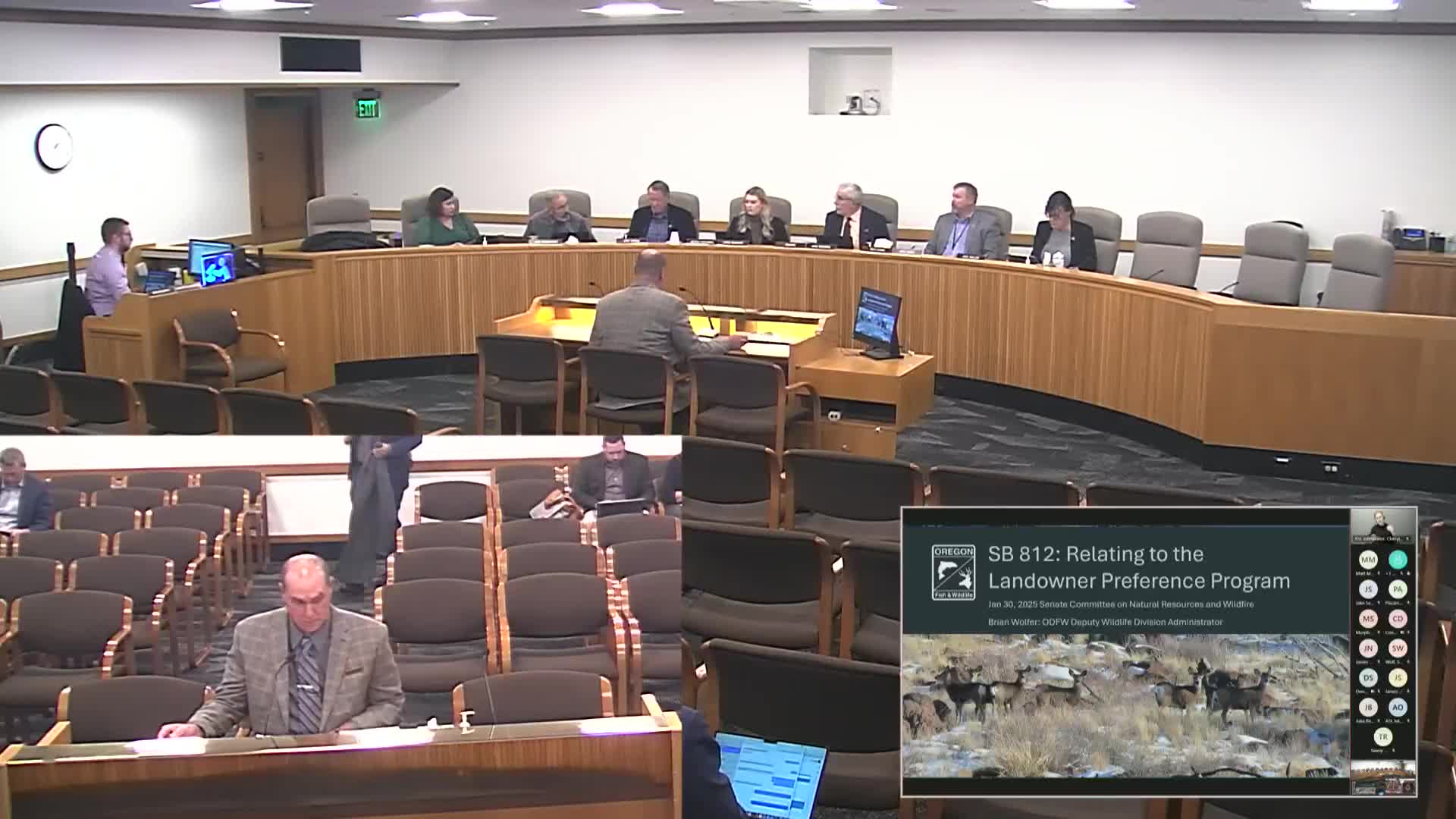
The Oregon Department of Fish and Wildlife urged the Senate Committee on Natural Resources and Wildfire on Jan. 30 to make the Landowner Preference (LOP) program permanent by removing its statutory sunset.
ODFW Deputy Administrator Brian Wolfer said private lands provide critical wildlife habitat and that the LOP program, first adopted in 1981 and modified several times since, balances landowner and public hunting interests while providing an incentive for landowners to steward habitat. "Private lands play a critical role in the conservation and management of wildlife in Oregon," Wolfer said, and the department recommended removing the program’s sunset so the statutory tool remains available. (Brian Wolfer, Deputy Administrator, Wildlife Division, Oregon Department of Fish and Wildlife.)
Key elements Wolfer described: tag allotments are tied to contiguous acreage thresholds (for example, 40 contiguous acres qualifies a landowner for two antlerless deer tags in certain Western Oregon hunts; 160 acres is a threshold for antlered tags in other units), the program includes limits on transfers of antler tags to non-family members (maximums apply) and the LOP can be used to address damage when authorized by the department.
Several agricultural, hunting and landowner organizations supported making the program permanent. Testimony included: landowners hosting disabled veterans and youth hunts, landowner representatives noting elk damage to crops and fences, and forest-industry and farm-bureau witnesses who said the current program structure has worked and that removing the sunset avoids recurring legislative renewals. "This program provides an important incentive to landowners to continue investing in habitat," said Seth Barnes of the Oregon Forest Industries Council. (Seth Barnes, Director of Forest Policy, Oregon Forest Industries Council.)
Committee members asked for data on tag transfers to non-family members and whether any monetary transactions are occurring when tags are transferred. ODFW said it can provide counts of transfers but does not track compensation or monetary arrangements associated with transfers.
Looking ahead: ODFW said the Fish and Wildlife Commission can still change program rules through public rulemaking within statutory constraints, and future legislatures could alter statute, but the department recommended making the LOP permanent to preserve a longstanding landowner-hunting management tool.
Sources: Public hearing, Senate Committee on Natural Resources and Wildfire, Jan. 30, 2025; testimony of Brian Wolfer (ODFW) and multiple supporting landowners and organizations.