Get Full Government Meeting Transcripts, Videos, & Alerts Forever!
Get email alerts on the Avian Influenza topic
No spam. Unsubscribe anytime.
Oregon health, agriculture officials brief lawmakers on avian influenza risks after animal spillovers
Summary
State veterinarian and state epidemiologist told a House committee that H5N1 remains principally an animal disease in Oregon but has produced rare human infections, occasional spillovers to pets and livestock, and ongoing surveillance is expanding across animals, wastewater and people.
Chair Tran opened an informational briefing of the House Committee on Emergency Management, General Government, and Veterans on Jan. 30, 2025, with Ryan Scholz, state veterinarian at the Oregon Department of Agriculture, and Dean Sadlinger, health officer and state epidemiologist at the Oregon Health Authority, presenting the state response to H5N1 avian influenza.
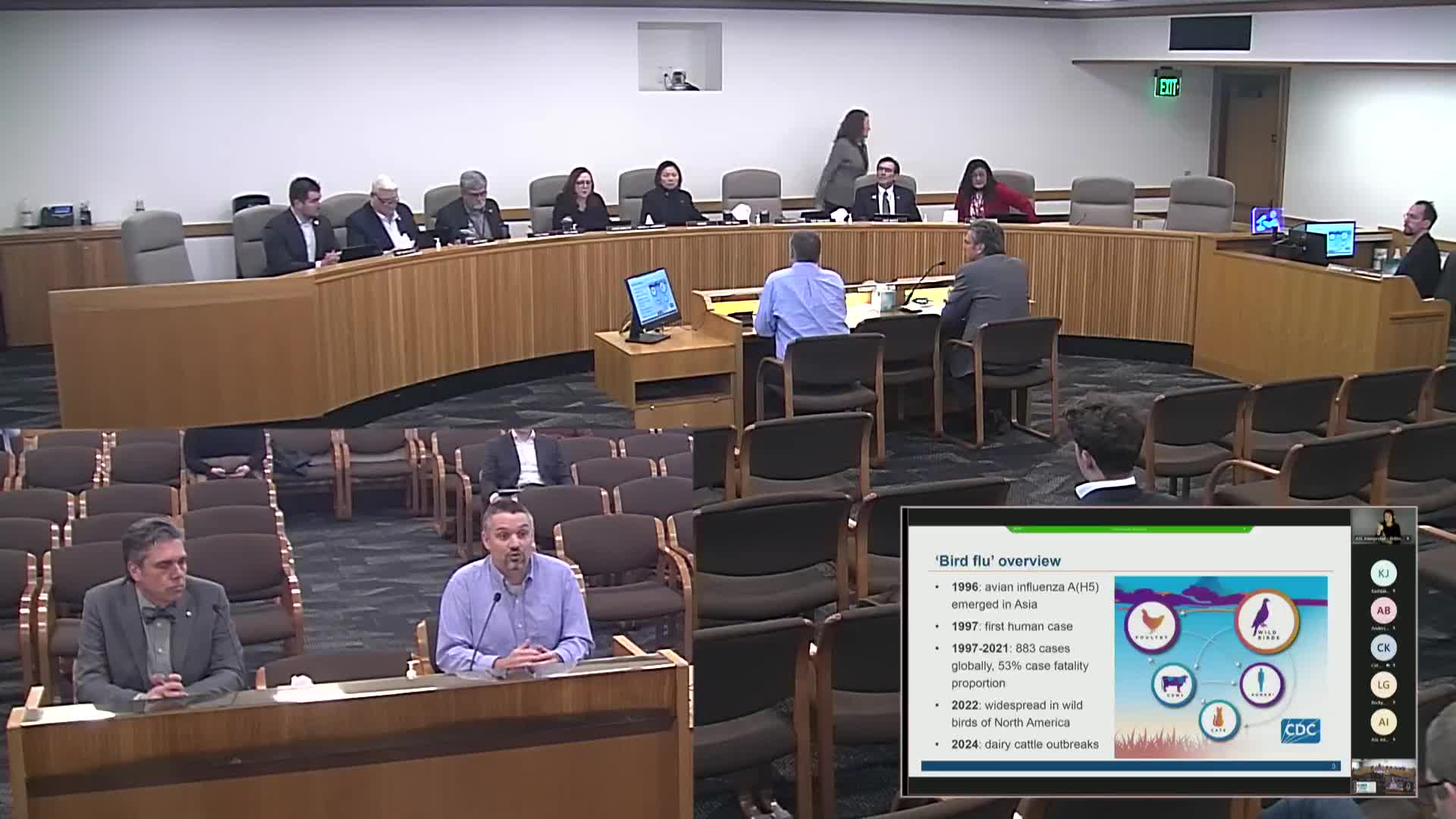
Scholz said the virus has primarily affected animals in Oregon and nationally, and that Oregon’s response pairs veterinary and public-health efforts. He told the committee that, since 2022, the virus became established in waterfowl and has in recent years produced spillovers to other species; Oregon has recorded 48 total poultry outbreaks in the past 2½ years — three commercial operations and 45 backyard flocks — and has not confirmed any dairy cattle outbreaks in the state. Scholz said dairy farms in Oregon have largely participated in voluntary weekly surveillance.
Sadlinger described human risk as low for the general public but said the state has monitored people with possible animal exposure. He said one Oregon resident who worked in a commercial poultry operation tested positive late last year; nationally there have been a small number of human infections associated with animal outbreaks. Sadlinger said about 219 people in Oregon have been monitored after animal exposures and that testing and antiviral treatment (oseltamivir) have been offered to symptomatic or high‑risk contacts.
Both officials described additional spillovers elsewhere and in Oregon: three infected cats (including one linked to contaminated raw pet food), one infected pig in Oregon, and isolated detections in wastewater. Scholz said whole‑genome sequencing played a central role in linking a cat to a contaminated raw pet‑food batch; Sadlinger described wastewater surveillance and said the state lab has sequenced more than 30,000 influenza specimens since 2022. Neither official reported sustained person‑to‑person transmission of H5N1.
Committee members asked about testing, costs, vaccine supplies and surveillance. Scholz described animal testing as swab-based, provided at no charge to owners; ODA or USDA covers testing and ODA supplies PPE kits. Sadlinger said human specimens are tested by the Oregon State Public Health Laboratory and testing is offered at no charge to those identified for monitoring; the state has access to oseltamivir from the strategic national stockpile and to existing vaccine stockpiles for H5 strains that federal partners hold but would need deployment decisions if human cases rose.
Both presenters emphasized interagency coordination. Scholz said ODA and OHA have worked “hand in hand” on animal cases and on owner and worker follow‑up. Sadlinger described layered surveillance — clinical testing, wastewater monitoring, and genomic sequencing — and said the CDC in January issued guidance urging additional sequencing of unusual flu specimens.
The committee closed the informational hearing after questions about veterinary vaccines, food safety and the state’s monitoring plans.