Get Full Government Meeting Transcripts, Videos, & Alerts Forever!
Get email alerts on the Comprehensive Plan topic
No spam. Unsubscribe anytime.
Shawnee council reviews proposed updates to Achieve Shawnee comprehensive plan
Summary
Doug Allman, community development director, briefed the Shawnee City Council committee on proposed updates to the Achieve Shawnee comprehensive plan and asked the council for feedback before the item returns for adoption.
Doug Allman, community development director, briefed the Shawnee City Council committee on proposed updates to the Achieve Shawnee comprehensive plan and asked the council for feedback before the item returns for adoption. "Our comprehensive plan is probably one of the most important documents that we have for the city," Allman said, describing the revisions as largely cleanup, clarifications and a few targeted land-use changes.
The presentation summarized three planning commission workshops, a public hearing held on the 16th and a resolution forwarding the recommended revisions to the council. The plan updates include a new typology-style framework for each future-land-use category (to show building height, massing, transition expectations and transportation context), a clarified definition of "mixed residential," transportation-map alignments tied to the Hickok Zara area plan, and a proposal to formally include the Hickok Zara TIF area plan in the comp plan.
Why it matters: the future-land-use framework guides where and how the city expects different types of development over a 10–15 year horizon and is used by staff, the planning commission, developers and residents as a consistency guide during rezoning or site-review applications. Allman said the proposed typologies are intended to make expectations clearer to developers and neighbors and to reduce redundancy between categories such as "attached residential" and "mixed residential." "A plan unit development is more defined than just a traditional district," Allman explained, adding that encouraging PUD zoning for mixed developments ties the approved site plan to the zoning and gives the city more control over design, amenities and transitions.
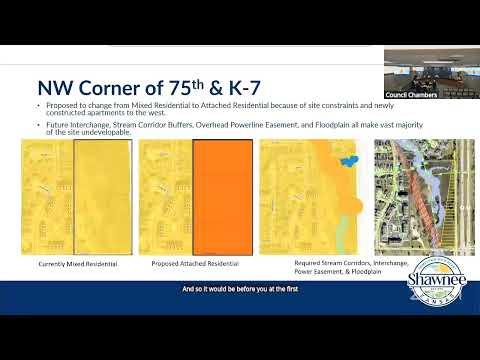
Staff highlighted several specific map amendments discussed by the planning commission: the 22400 block of West 40 Third Street was recommended to change from a mixed-use concept to light/flex industrial to match nearby Westlink development; the parcel south of the new fire station was suggested to be adjusted to neighborhood commercial/community facilities at the corner and mixed or attached residential to the south to reflect existing storage and WaterOne-owned property (Allman noted WaterOne owns about 20 acres west and may use some for underground water storage); a Midland parcel in the Zara TIF area (currently zoned commercial highway with no direct access to Shawnee Mission Parkway) was proposed to move toward attached residential with buffering because highway-fronting single-family would be poor planning; and a constrained vacant parcel affected by overhead power lines, floodplain and right-of-way for a potential future interchange at 70th and K‑7 was discussed for possible attached residential designation but several council members urged keeping it as mixed residential given access and topographic constraints.
Council members raised questions and made several points: Tony Gillette (Ward 1) praised the clearer mixed-residential language as helpful to both developers and residents. Laurel Burchfield (Ward 4) and others emphasized that the mixed-residential category is intended as a transition or "alternative" type that can include townhomes, rowhomes and some apartments but should not make apartments the dominant landform where the map does not place the designation on a major corridor. Doug Allman and councilors reminded the body that the comp plan is guidance—not zoning—and any rezoning or specific project would still require a separate public hearing and council decision. Paul Kramer, city manager, and Allman said staff intends to bring the item back for a formal adoption vote at the first regular council meeting in February unless further committee review is requested.
No formal adoption, rezoning or binding action on the comp plan occurred during the work session. The only formal motion recorded in the transcript was a procedural motion to adjourn, which was seconded and passed. Staff outlined the council's procedural options for the eventual vote: accepting the planning commission recommendation, reverting a single parcel back to its prior designation (which Allman said would require six votes because it would be a rejection of the planning commission recommendation), or remanding specific parcels back to the planning commission for further review (which would require five votes).
Council discussion also covered transportation updates that align the comp plan with approved street projects (for example, Midland was changed from a "green street" to a regular street on the map after council-approved project alignments). The parks section's alternative-bike/ shared-use-path framework was duplicated into the transportation framework to keep active-transportation elements visible in both land-use and mobility contexts. The plan includes a "Valley of Champions" concept for long-term recreational and mixed-use potential on the landfill site and language to make clearer how the city will judge TIF-consistency for projects within the Hickok Zara area plan.
The work session closed with council members generally expressing support for the revisions and a staff commitment to return the draft for formal consideration. Paul Kramer indicated the item would likely be placed on the first regular council meeting in February; no adoption vote was taken tonight.