Get Full Government Meeting Transcripts, Videos, & Alerts Forever!
Get email alerts on the Police Academy Forecast topic
No spam. Unsubscribe anytime.
DPSST says academy backlog cleared, forecasts steady hiring but flags retention and lateral volatility
Summary
The Department of Public Safety Standards and Training told the Public Safety Subcommittee it eliminated a multi-month academy backlog by piloting 60-person classes, cut average enrollment wait times to 30-60 days, and identified retention and lateral-hire trends that complicate training forecasts.
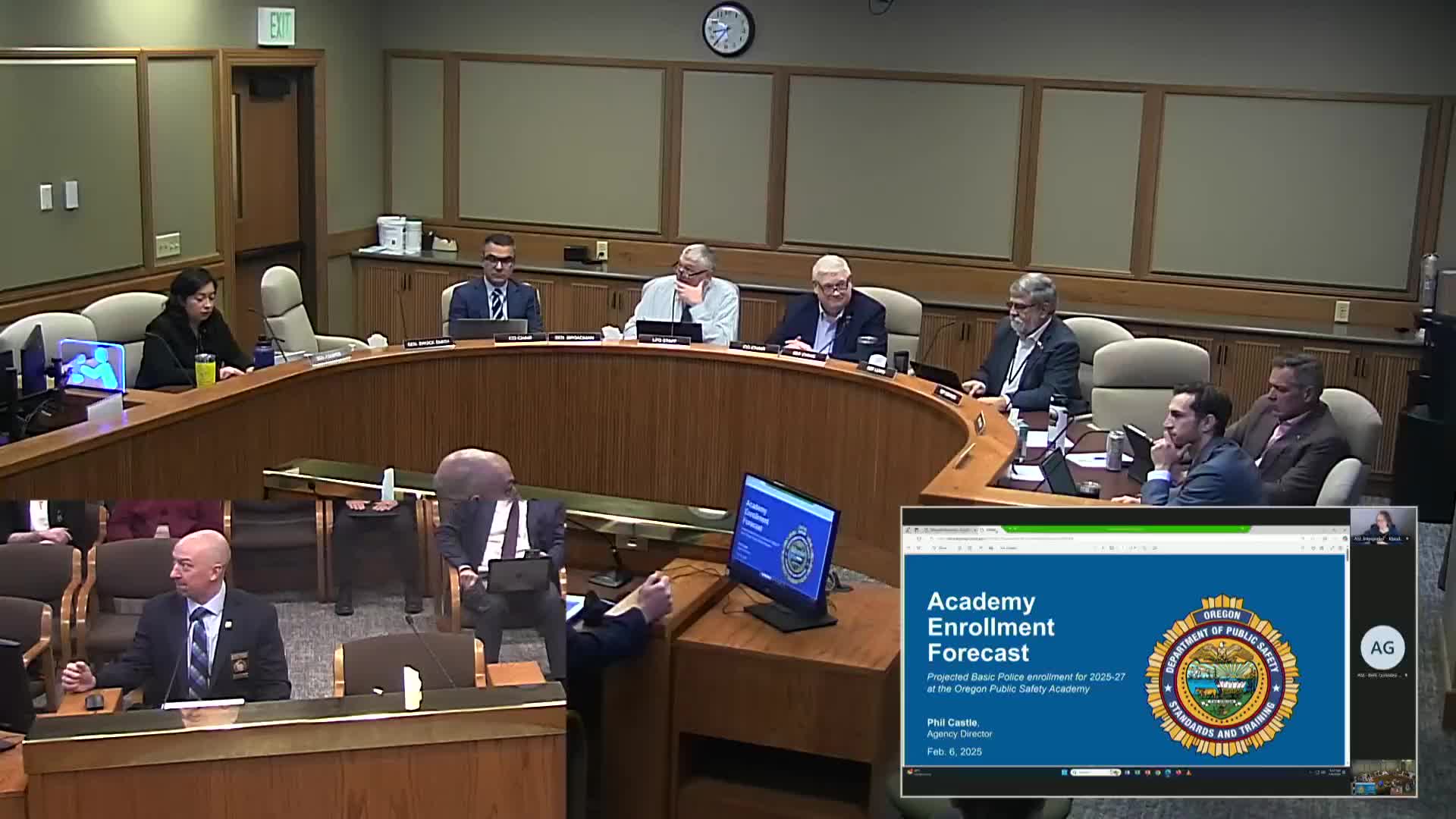
Phil Castle, director of the Department of Public Safety Standards and Training (DPSST), briefed the Public Safety Subcommittee on Feb. 6 on forecasting for police academies and workforce trends.
Castle said DPSST used a pilot program, enabled by legislative action, to run larger classes and partner with Oregon State Police to clear a backlog of recruits. "We were able to eliminate the backlog completely and get within our statutory requirement of 90 days of enrollment by the spring of 2024," Castle said. The pilot ran three 60-person courses and an OSP partnership included separate 40-person classes; Castle said the agency learned to adapt its training template to accommodate a 60-student cohort safely and maintain training quality.
Historically, DPSST's basic police classes have been 40 students; the academy design and venues are optimized for that size and for classroom groups of about 20. Castle said a 60-student class is manageable if it is limited to one such class at a time; running multiple concurrent 60-student classes strained venue capacity and safety planning. The agency said it requires roughly 90 days' lead time to expand a planned class to 60 students.
Castle reported current average academy enrollment wait time at about 30 to 60 days, down from a peak of about seven months in 2022. DPSST conducts an annual survey of roughly 180 law-enforcement agencies; the most recent survey yielded responses from 128 agencies representing about 94% of sworn officers in the state, which DPSST described as high coverage for forecasting.
Key workforce metrics discussed:
- Average tenure for officers in Oregon has fallen to about five years (from 10'15 years in the early 2000s), according to the agency. - Laterals accounted for about 38% of all hires in recent reporting; in 2024 roughly 12% of laterals came from out of state. - Nearly half of agencies have experienced failed recruitments; 30% of agencies reported hires who did not show up for their first day.
Castle said the agency is forecasting to meet its biennial training target (the CSL) of roughly 980 basic recruits over the biennium and will keep a flexible template to scale classes to 60 if needed. DPSST also conducted a "choosing to serve" survey of agency leaders and officers to identify retention drivers and expected to share aggregated results in late spring.
Committee members asked about veterans, lateral movement and geographic challenges for rural and eastern Oregon agencies; Castle said veteran representation is "pretty stable" and that eastern Oregon makes up about 10% of students. He also said DPSST is open to distributed training options where appropriate but noted challenges in building local cohorts large enough to run a class outside Salem.
Castle closed the report saying DPSST will continue monitoring hiring volatility and partner with law-enforcement organizations to maintain training throughput and safety.