Get Full Government Meeting Transcripts, Videos, & Alerts Forever!
Get email alerts on the Construction Contractors Board Budget topic
No spam. Unsubscribe anytime.
Subcommittee holds public hearing on Construction Contractors Board budget; agency seeks fee ratification and $1.5 million for licensing-system replacement
Summary
The General Government Subcommittee heard testimony on Senate Bill 5,509, the Construction Contractors Board(CCB) appropriation. Agency leaders described a newly adopted fee increase, a proposed $1.5 million IT modernization, and ongoing enforcement and outreach work funded primarily by license fees.
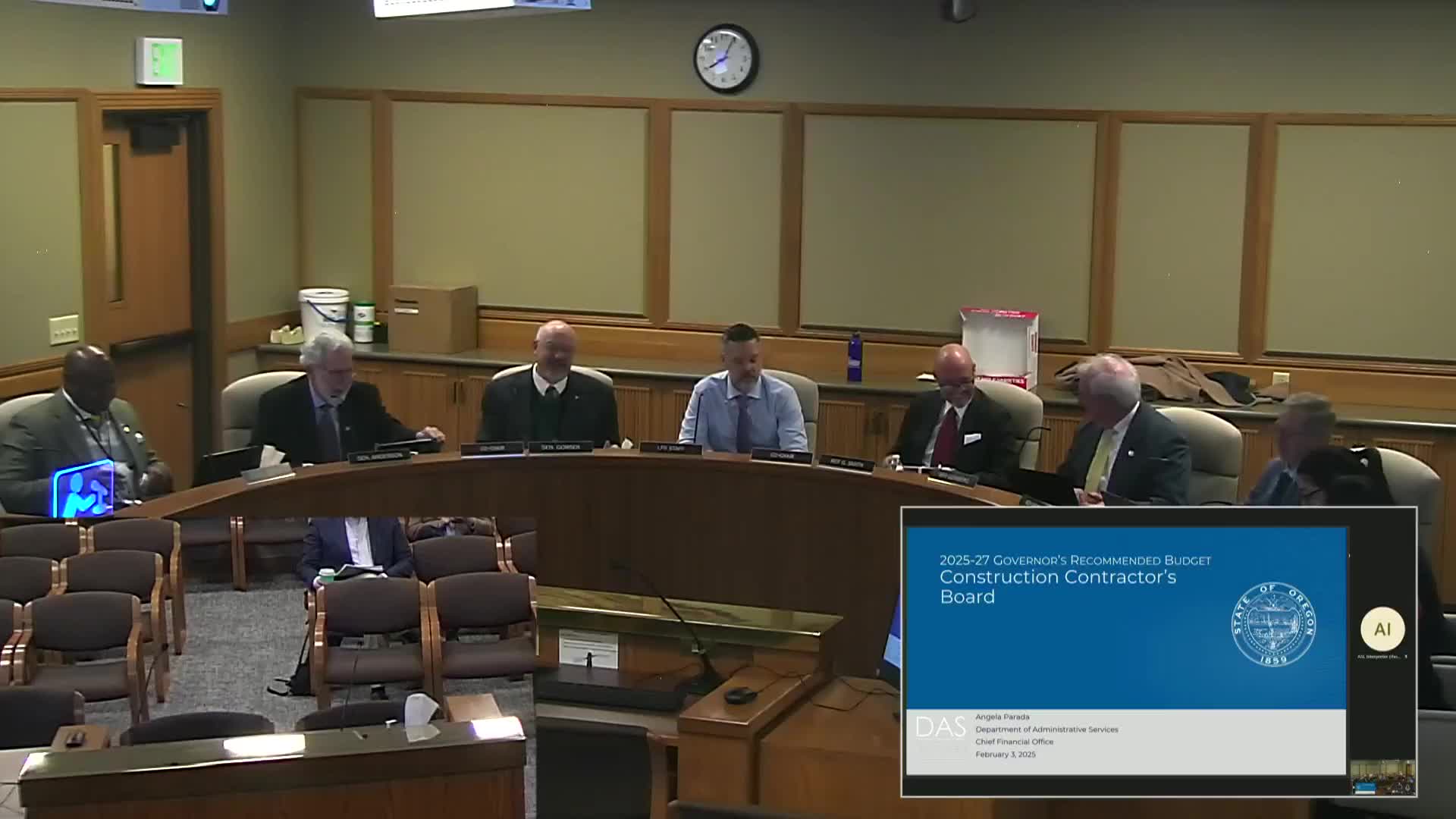
The General Government Subcommittee of the Ways and Means Committee opened a public hearing Thursday on Senate Bill 5,509, the appropriation bill for the Construction Contractors Board, with agency leaders outlining a budget built largely on contractor licensing fees and seeking approval to replace an aging licensing system.
The hearing matters because the CCB is almost entirely funded by fees paid by contractors, and the agency said it needs both the fee changes already adopted by its board and a one-time IT investment to sustain service levels including licensing, enforcement and dispute resolution.
Angela Perrotta, a budget and policy analyst with the Department of Administrative Services Chief Financial Office, told the subcommittee the governor's recommended budget for the CCB is about $23.3 million for the 2025-27 biennium and reflects an 8.7% increase driven largely by a one-time licensing-system investment and limited-duration staffing. Perrotta said the board is an "other funds" agency primarily funded by contractor licensing fees and that the agency also receives a portion of its revenue from complaint-processing and administrative fees.
Chris Huntington, administrator of the Oregon Construction Contractors Board, described the agency's operations and the rationale for the fee changes and technology investment. Huntington said the CCB currently supports roughly 50,000 licensees with 59 permanent staff and a proposed 0.5 full-time-equivalent limited-duration project manager to support the licensing-system replacement. He said the agency visits roughly 8,000 job sites a year and that more than 90% of its revenue comes from license fees.
Huntington explained the board adopted an increase in the two-year license fee from $325 to $400. The board staged the increase so renewals implemented the change in July 2024 while new applicants were scheduled to see the higher fee beginning July 2025. The administrator said the increase was prompted by rising costs: "Our costs had gone up 55% over the period since the fee was last adjusted," and the board decided a revenue increase was necessary to avoid cuts to service.
On the IT project, Huntington said the agency has built approximately $1.5 million in reserves for a license-system replacement, and that roughly $1.3 million of that estimate is for implementation costs provided by prospective vendors. He said the agency recently received a stage-gate endorsement from DAS enabling an RFP and that the new system will be a cloud-based commercial solution. Hosting and maintenance for a new system were estimated in committee documents at roughly $90,000 to $250,000 annually, and Huntington said the move of network hosting into the state data center would add an assessment of about $17,000 per year (approximately $34,000 to the biennial budget).
Members of the committee pressed agency staff on operational details. Huntington emphasized the CCB's daily monitoring of cash flow and renewals, noting, "every single day is renewal day at the CCB," because licenses renew on each licensee's birthday and renewal activity is fairly steady year-round. He said the agency watches month-to-month and year-over-year renewal trends and that a sustained drop of 2'3% in renewals over a few months would change agency decisions.
Committee members also asked about enforcement and consumer protections. Huntington described proactive field enforcement, dispute-resolution mediation that resolves roughly 70% of mediated complaints, criminal-history and cross-state screening of applicants, and cooperation with other agencies including the Oregon Building Codes Division, OSHA and the Department of Justice for referrals. He said the agency keeps 20% of civil penalties to cover collection costs while 80% goes to the general fund; he noted an industry bill (referred to in testimony as Senate Bill 87) proposing the agency retain a larger share for enforcement.
Industry testimony supported the agency request. Brian Krieg, representing the Sheet Metal and Air Conditioning Contractors Association and the Plumbing and Mechanical Contractors Association, said trade groups filed a joint letter and that the industry supported the fee increase and the IT modernization, calling the current system "fragile" and overdue for replacement.
Huntington and Perrotta provided additional budget detail: personnel services represent about 74% of the agency's expenditures; the agency projects roughly 4.6 months of ending balance at the close of the 2025-27 biennium after the planned IT investment; and as of the December close the agency reported roughly eight months of ending balance. The agency said other funds revenue is approximately 91% license fees and about 7% civil penalties (the percentage the agency retains), with remaining minor sources listed as miscellaneous charges.
No formal committee action or vote occurred at the hearing; the session served as a public hearing and question-and-answer period on the governor's recommended budget and on Senate Bill 5,509. The subcommittee calendar noted it will next convene on Feb. 10 for a public hearing on Senate Bill 55-22 (Government Ethics Commission budget).