Get Full Government Meeting Transcripts, Videos, & Alerts Forever!
Get email alerts on the Education School Choice topic
No spam. Unsubscribe anytime.
Senators press for expanded school choice, charter support and career-technical education amid low state scores
Summary
During a Senate floor session, multiple Republican senators urged policy changes including universal scholarships, expanded open enrollment, greater funding parity for charter schools, and support for homeschooling and career-technical education, citing low statewide student assessment results and graduation gaps tied to CTE participation.
Oregon senators used floor remarks to press for expanded school choice policies and structural changes in K–12 education, citing low student assessment results, graduation gaps tied to career-technical education (CTE) participation and perceived funding inequities for charter schools.
Senators across the Republican caucus argued the state's public education system needs greater parental choice and competition, and some urged specific legislation to relax oversight of homeschoolers and expand scholarship and open-enrollment options.
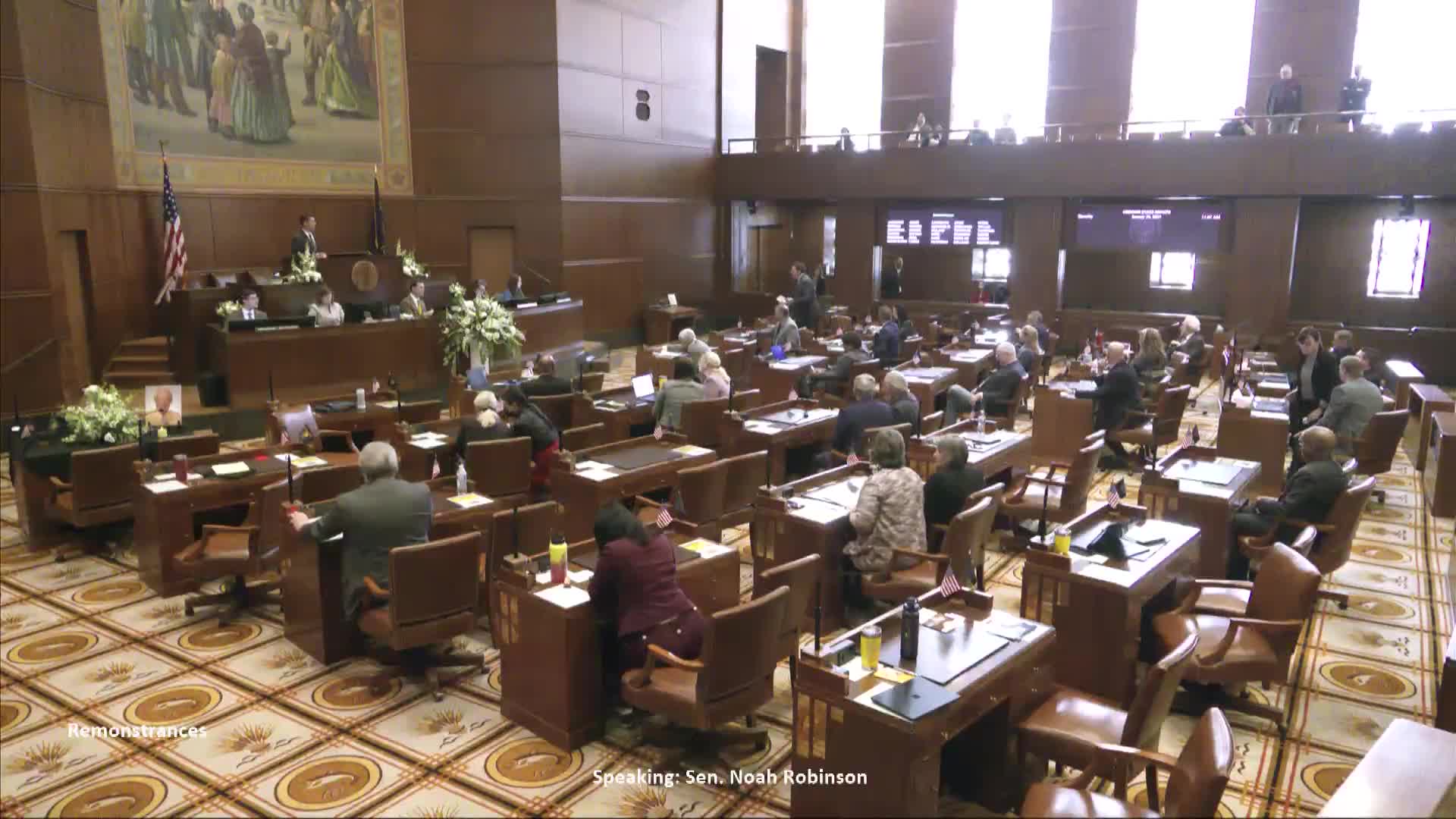
On the Senate floor, Senator Robinson said, "Our public schools are there for 1 purpose. They are to educate children." He framed school choice as a remedy to underperforming outcomes and said parents should not be forced by "bureaucratic pressures" to keep children in specific schools.
Senator Bonham argued that when a state's education system fails a large segment of students it harms state competitiveness and families, and pointed to more than a dozen states that have enacted universal K–12 scholarship programs. "These states have highlighted the most promising avenue for education reform," Bonham said, calling for education dollars to "follow students to their preferred educational setting."
Several other senators elaborated different policy priorities. Senator Weber, identifying her background as an elementary school teacher, criticized Oregon's low recent national assessment results, saying the scores were "unacceptable" and urging the body to "think outside the box" beyond simply increasing funding.
Senator McClain recalled prior open-enrollment policies and urged lawmakers to reinstate or expand similar options so students can attend schools across district lines. Senator Starr urged support for homeschooling and specifically recommended passage of "House Bill 2187" (as referenced on the floor) to relax oversight for home educators, saying, "Children educated by their moms and dads outperform children that are educated in both public and private school."
Senator Andrews highlighted the role of public charter schools, saying about "45,000 students" attend the state's 132 public charter schools and that charters receive "48¢ on the dollar" compared with other public schools. Andrews said charter schools are outperforming other public schools in English language arts and math on the Department of Education's report card and noted growing wait lists for charters.
Senator Linthicum referenced graduation-rate differences tied to CTE participation, saying a student who does not take a CTE class graduates at roughly an 84 percent rate statewide, while those who take two CTE classes have a reported 95 percent graduation rate, and used the example to argue for greater investment in and expansion of CTE programs.
No formal floor action or votes on specific education bills were recorded during these remarks. Several senators referenced potential or pending legislation (including House Bill 2187 as noted on the floor) and called for committee discussion and debate in the Senate education committee.
The exchange combined policy arguments for scholarships or vouchers, expanded charter access and funding parity, strengthened open enrollment, removal of oversight for homeschoolers, and investment in CTE as ways to raise student outcomes. Senators disagreed on emphasis and tone: some speakers stressed systemic failure and structural reforms, while others cautioned against blanket characterizations of educators and highlighted recent graduation-rate improvements tied to CTE.
The floor remarks concluded with senators urging further committee work and legislative proposals to address the issues they raised.