Get Full Government Meeting Transcripts, Videos, & Alerts Forever!
Get email alerts on the State Procurement topic
No spam. Unsubscribe anytime.
DAS officials brief subcommittee on statewide procurement process, equity study
Summary
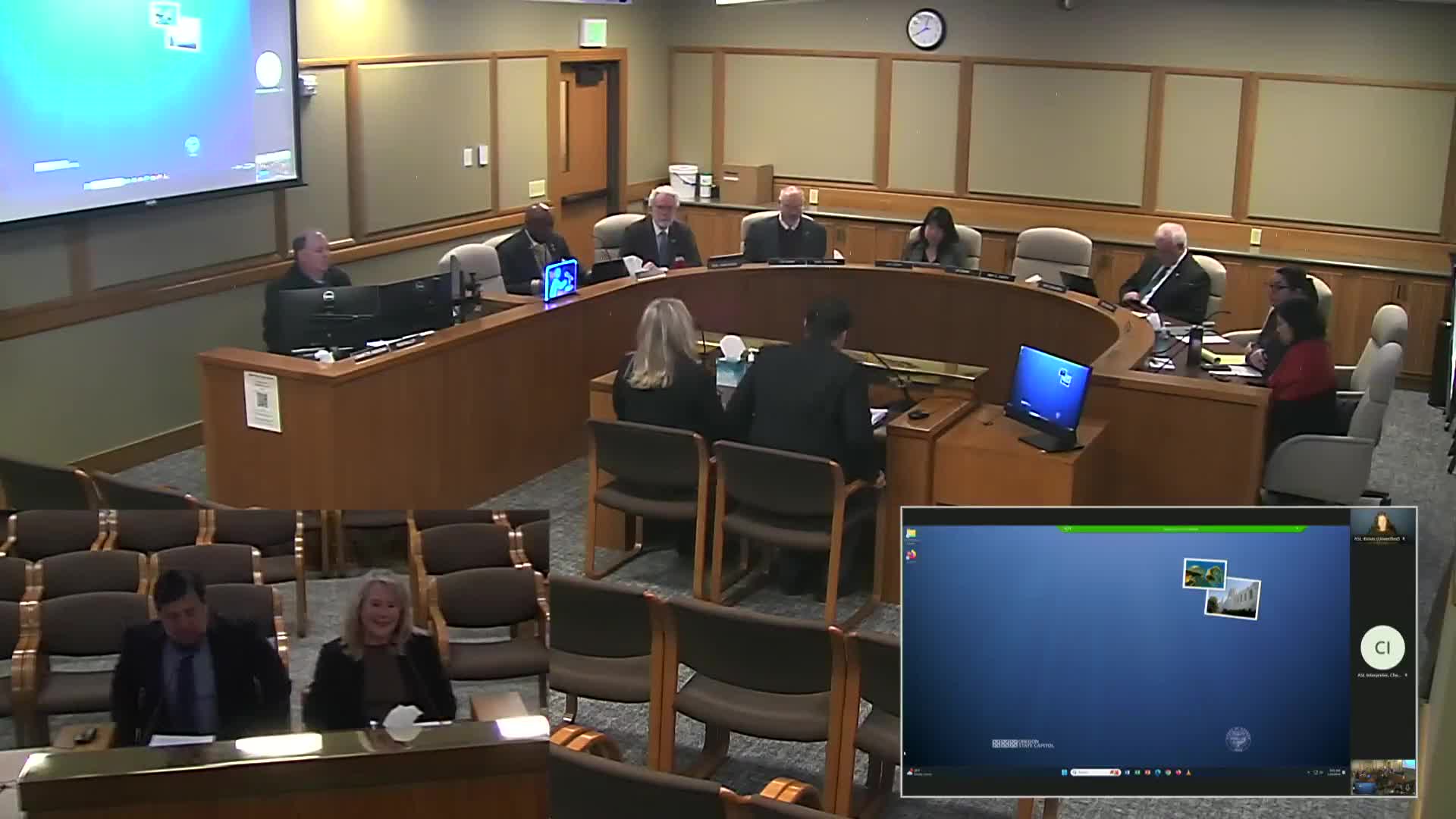
Deputy Director Debbie Dennis and Chief Procurement Officer Steven Nelson of the Department of Administrative Services told the General Government Subcommittee Thursday that Oregon’s statewide procurement system routes buying requests through a required sequence and uses statewide price agreements, training and an electronic procurement platform to manage hundreds of millions of dollars in purchases.
Deputy Director Debbie Dennis and Chief Procurement Officer Steven Nelson of the Department of Administrative Services told the General Government Subcommittee Thursday that Oregon’s statewide procurement system routes buying requests through a required sequence and uses statewide price agreements, training and an electronic procurement platform to manage hundreds of millions of dollars in purchases.
The briefing matters because procurement decisions affect state agency operations, local governments that participate in cooperative purchasing and efforts to direct spending to businesses owned by historically underrepresented groups, said Debbie Dennis, deputy director at DAS.
Dennis and Nelson described the agency’s “buy decision” sequence: agencies first check the state surplus property program, then the Oregon Forward program (contractors that employ people with disabilities), next Oregon Corrections Enterprises, and finally the open market. ‘‘The first place we are expected to go is to our state surplus property program,’’ Dennis said, and agencies ‘‘are required to evaluate the services of Oregon Forward contractors prior to going to the open market.’’ Nelson added that statewide price agreements exist for commonly purchased goods and services so agencies may buy directly from those contractors once the agreement is in place.
Nelson said State Procurement Services handled 314 requests from agencies in 2024 that led to 250 solicitations and 89 contracts. He said the top 10 statewide price agreements together accounted for about $484 million in spend in the referenced year, with the maintenance, repair and operations (MRO) portfolio alone representing roughly $80 million. Vendors in the MRO portfolio include Granger, MSC and Fastenal, Nelson said.
Dennis described programs and tools meant to increase efficiency and equity. The subcommittee heard that OregonBuys, the state’s e‑procurement system, spans vendor access, sourcing, request processing, payments, spend and data reporting, and a price agreement catalog. House Bill 5006 (2021) directed DAS to conduct a disparity study; DAS contracted BBC Research & Consulting to complete the study in November 2023 and said the procurement equity team is now moving to implement the study’s recommendations. ‘‘The study kicked off in October of 2022 and concluded in November of 2023,’’ Dennis said; she offered to provide the committee the study report through DAS’s legislative director.
The committee asked for additional data. Representative Tran asked whether the statewide price agreements favor Oregon businesses; Nelson said DAS seeks local vendors where market availability allows and has programs to identify small and diverse suppliers, but the agency does not routinely generate a state‑of‑origin report without a specific request. Nelson and Dennis said they can provide data on how much spending goes to in‑state vendors and on supplier certifications (veteran‑owned, minority‑owned, women‑owned) upon request through their legislative director.
Committee members pressed for clarity about authority and delegations. Dennis said DAS holds procurement authority for the executive branch as defined in statute but noted more than 600 statutory carve‑outs exist for other agencies. She told the panel that the chief procurement officer has authority to approve sole‑source determinations and delegations; delegated procurement authority for many state agencies exists for lower dollar procurements (Dennis said agencies may conduct certain procurements themselves up to $250,000). Nelson clarified that some statewide constitutional offices and higher education institutions maintain independent procurement authority and rulemaking.
DAS described training and outreach: the statewide training and certification program provided 10 class types and trained 862 procurement professionals during the 2023–25 biennium, and 949 local government entities currently participate in the Oregon Cooperative Procurement Program (ORCAP). Dennis said ORCAP membership has increased by about 16 entities per year over the past three years and that ORCAP members can use statewide price agreements and access procurement training and past procurements for reference.
The session was informational; no formal actions or votes were taken. Dennis and Nelson offered to deliver requested supplemental data to the committee via their legislative director, including the disparity study report and supplier‑breakdown reports.
The subcommittee adjourned after roughly a 39‑minute hearing and scheduled its next budget presentation for Monday, starting appropriation bill hearings.