Get Full Government Meeting Transcripts, Videos, & Alerts Forever!
Get email alerts on the Unemployment Insurance topic
No spam. Unsubscribe anytime.
Oregon hearing examines bill to allow unemployment benefits for striking workers; agency estimates modest cost to UI trust fund
Summary
Lawmakers and witnesses split at a Senate Labor and Business hearing over Senate Bill 916, which would make workers on strike eligible for unemployment insurance; the Oregon Employment Department estimated roughly $5.3 million impact to the UI trust fund over the 2025–27 biennium and $3.5 million in reimbursing-employer costs.
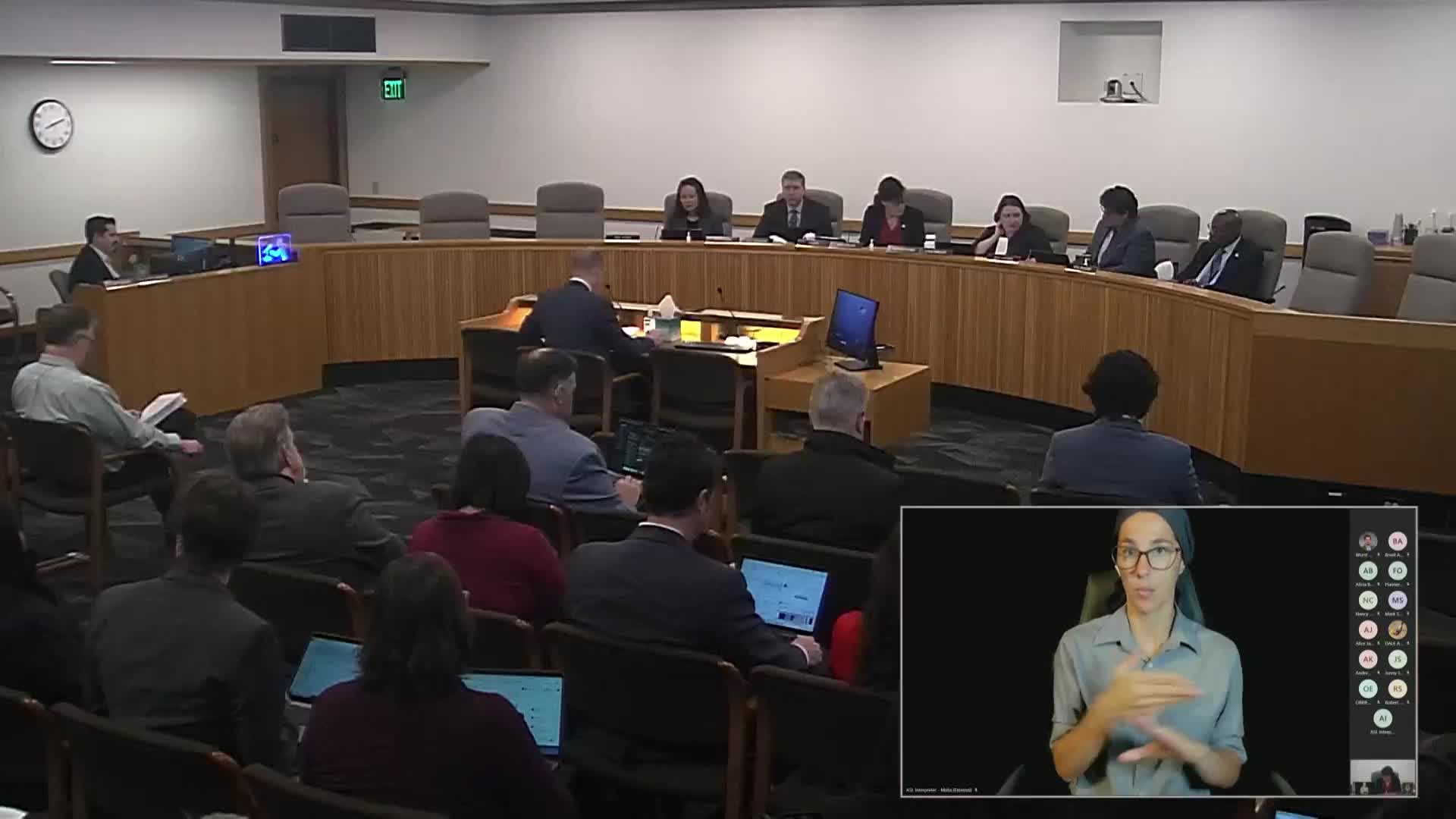
Senate Committee on Labor and Business members on Thursday heard hours of testimony for Senate Bill 916, which would remove an existing statutory disqualification that prevents workers from receiving unemployment insurance (UI) while they are unemployed because of a labor dispute.
The bill would amend Oregon law so that an individual who is otherwise eligible for UI benefits would not be disqualified for any week the Employment Department director finds the person is unemployed because of a labor dispute. The measure also declares an emergency and would be effective on passage.
Why it matters: Supporters said the change would ease a severe financial hardship that can force workers to accept worse terms in negotiations, while opponents warned it could weaken the balance in collective bargaining and put additional pressure on employers and the UI trust fund.
Representative Ben Bowman (House District 25), a sponsor’s supporter, told the committee the bill “repeal[s] the law blocking unemployment benefits to workers on strike” because of a “fundamental imbalance” between corporate power and working people. “This bill will help ensure workers can put gas in their cars, can afford groceries, and not fall into desperate financial distress just for standing up for themselves,” Bowman said.
Representative Dacia Graber (House District 28), who described herself as a union firefighter, said strikes are undertaken only after lengthy negotiations and “are not undertaken lightly.” She told the committee the proposal would treat striking workers “like all workers seeking UI,” preserving the program’s waiting week, partial wage replacement and benefit caps.
Alan Dale, senior deputy legislative counsel and drafter of the bill, explained the statutory mechanics: the bill amends ORS 657.200 and removes subsections that currently disqualify workers for UI during labor disputes; he also described a technical provision (mirrored in House Bill 3021) that centralizes a federal-conformity clause used across UI statutes.
Lindsay Leahy, UI division director at the Oregon Employment Department (OED), said the agency has no official position but offered implementation and fiscal analysis. OED told the committee it could implement the change with existing staff but would need time for rule-making, training and outreach. Based on historical strike patterns and projected strike activity, OED estimated an approximate $5,300,000 reduction in trust-fund balances (including lost interest) over the 2025–27 biennium and an estimated $3,500,000 in costs that reimbursing employers would pay directly to the department in that period. Leahy said those amounts are unlikely to change the state’s projected UI tax schedules.
Supporters at the hearing included labor unions and workers directly affected by strikes. Graham Traynor, president of the Oregon AFL-CIO, said strikes are “the ultimate democratic process” in bargaining and urged support. Donna Marks (BCTGM Local 364), who described a 43-day strike at a Portland Nabisco facility in 2021, said striking put her family at risk of losing insurance coverage. Nurse Gina Ottinger, on strike at Providence St. Vincent Medical Center, said the option of UI during strikes would let health-care workers “fight for the future of health care in Oregon” without immediate financial ruin.
Opponents included employer groups and local-government associations. Amanda Dalton of the Northwest Grocery Retail Association warned that the bill could prolong strikes and cause store closures, delivery interruptions and higher consumer prices. Scott Winkels of the League of Oregon Cities said many public employers are reimbursing employers (not taxpaying) and warned the measure could trigger constitutional unfunded-mandate disputes because public bodies reimburse the UI fund dollar-for-dollar. JL Wilson of the Oregon State Chamber of Commerce said the proposal risks eroding a long-standing social compact in which employers alone fund the UI system.
Committee members asked detailed technical questions about who pays benefits and how experience ratings and tax schedules work. Leahy explained the difference between taxpaying employers (who pay UI payroll taxes and have experience-rated adjustments) and reimbursing employers (mostly public entities that repay benefits dollar-for-dollar). Leahy noted strike activity shifts year to year and that across recent years roughly 60% of multiweek strikes have been associated with taxpaying employers and 40% with reimbursing employers.
What the committee did: The committee opened and closed a public hearing and carried SB 916 over for continued public testimony at the next scheduled hearing on Tuesday, Feb. 11, 2025. No committee vote on the bill occurred Thursday.
Ending note: Committee members asked OED for additional, committee-wide briefings on UI mechanics (experience rating, tax schedules, reimbursing-employer accounting) and several asked staff to prepare a clearer case-study calculation (for example, what a Portland teachers’ strike would have cost a district) for future deliberations.