Get Full Government Meeting Transcripts, Videos, & Alerts Forever!
Get email alerts on the Infrastructure Pavement topic
No spam. Unsubscribe anytime.
Council hears 2025 pavement-management plan: 20 lane miles of mill-and-overlay, expanded sidewalk repairs
Summary
City staff outlined the 2025 Pavement Management Program, which proposes about 20 lane miles of mill-and-overlay and more than 33 lane miles of ultra-thin bonded asphalt surfacing, plus an expanded sidewalk repair program and a mail ballot sales-tax renewal that will fund much of the work.
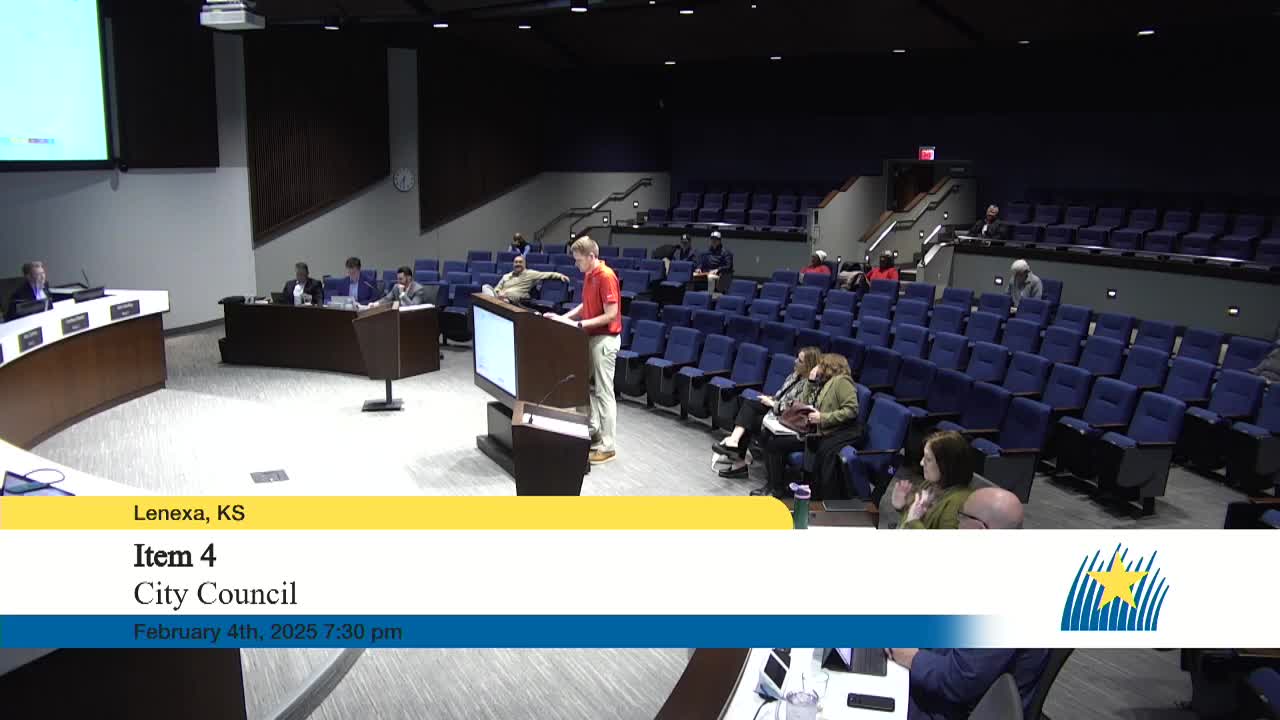
Cody Wolbers, assistant municipal services director, told the Lenexa City Council that the city’s 2025 Pavement Management Program includes slightly more than 20 lane miles of mill-and-overlay work and about 33 lane miles of ultra-thin bonded asphalt surfacing, alongside pavement reconstruction and a multi-subdivision sidewalk-repair program.
Wolbers explained the city uses a Pavement Condition Index (PCI), a 0–100 rating system, to score streets and plan maintenance; Stantec collected the most recent roadway data in May 2024 and staff updated the map for 2024 maintenance. He said about 75% of all Lenexa streets are in excellent, good, or fair condition and that figure rises to about 80% when looking only at arterials and collectors.
Why it matters: staff warned that areas inside the I-435 loop show more fair and poor-rated roads — a pattern staff attributes to a large set of streets having been completed at the same time about eight years earlier. Wolbers said the city aims to keep arterial and collector roads in good condition and will continue a mix of treatments: ultra-thin bonded asphalt surfacing and two-inch mill-and-overlay for arterials, with reconstruction where pavement has deteriorated beyond maintenance.
Wolbers described the ultra-thin bonded asphalt process as internal patching by city crews, followed by a contractor milling 3/8" to 5/8" of roadway, application of an emulsion bonding liquid and placement of a thin asphalt layer. He said that approach is intended to repair localized damage, seal the pavement against water intrusion, and restore a smooth riding surface.
Councilmembers asked specifics: one member asked whether certain gravel-surface streets (Summit Street was cited) will be reconstructed with curb and gutter; Wolbers said those segments will not be converted to curb and gutter because doing so would create additional stormwater infrastructure issues. Councilmembers also raised a past concern from a resident about repayment charges tied to utility damage on a previous project; staff said that is atypical, described standard contractor responsibility and agreed to follow up offline to investigate the specific complaint.
Wolbers said the 2025 sidewalk program will cover four subdivisions west of Lackman Road between south of 79th Street and north of 95th Street (presentation referred generally to the area between 79th/90th/95th corridors); staff noted the 2024 sidewalk work was lighter because crews supported the Little Mill Creek Trail project.
Funding context: staff reminded the council the city will mail a ballot for a 3.08-cent sales-tax renewal that funds most of the pavement-management program; the ballot is scheduled to arrive in mid-March and to be due April 1, Wolbers said. Councilmembers and staff discussed scheduling around the World Cup in 2026, noting arterial resurfacing may be limited in that year so crews can focus on residential resurfacing and avoid major arterial work during the event.
Ending: staff said with additional funding and multi-year planning the city intends to address the concentration of fair and poor pavement inside I-435 over the next two to three years and will return with budget and project details in the usual capital-improvement cycles.