Get Full Government Meeting Transcripts, Videos, & Alerts Forever!
Get email alerts on the Child Exploitation topic
No spam. Unsubscribe anytime.
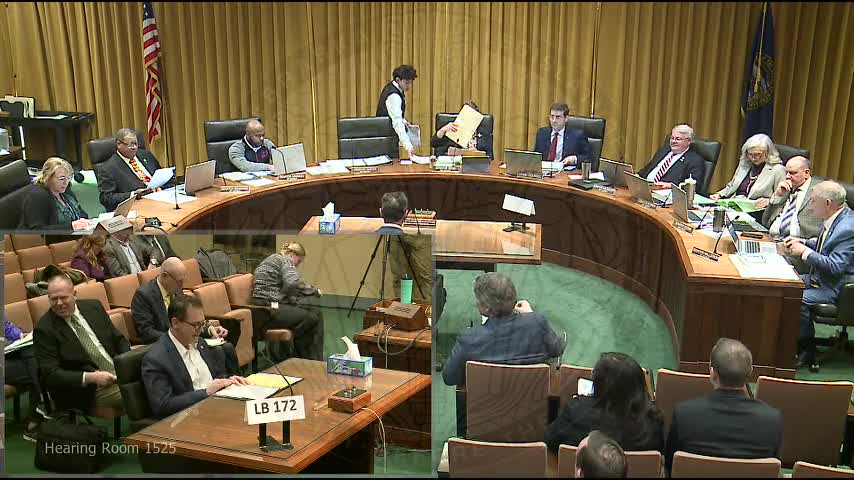
Committee hears LB172: sponsors, law enforcement and advocacy groups back expanding CSAM law to cover deepfakes and AI‑generated images
Summary
Sen. Brian Hardin introduced LB172 to update Nebraska's child exploitation statutes to cover AI‑generated and digitally altered images. Attorney General Mike Hilgers, Nebraska State Patrol, child advocacy centers and prosecutors supported the bill; defense groups raised concerns about scope and unintended consequences for teenage sexting cases.
Lincoln — The Judiciary Committee took extensive testimony on LB172, a bill offered by Sen. Brian Hardin to expand Nebraska law addressing child sexual exploitation to include computer‑generated and digitally manipulated images and to criminalize receipt and generation of certain AI‑created child sexual abuse material.
Hardin told the committee the bill "ensures that all forms of child exploitation are fully criminalized under Nebraska law" and argued that technological advances have enabled offenders to produce images and videos that are effectively indistinguishable from real children.
Attorney General Mike Hilgers testified in strong support, noting the state is "currently engaged in 2 active litigations... against Meta and TikTok here in Nebraska" and arguing that law enforcement urgently needs tools to address AI‑assisted exploitation. "There is no doubt that children under age 18 are seeing utterly inappropriate content," Hilgers said, citing investigators' findings in undercover tests.
The Nebraska State Patrol, represented by Lt. Monty Lovelace, described investigative experience with reports to the National Center for Missing and Exploited Children and told the panel generative AI has already been used in Nebraska schools and communities to create and distribute sexualized images of minors. He said the bill also closes a gap by criminalizing receipt of CSAM where federal law already criminalizes receipt.
Child advocacy groups and prosecutors backed the measure. Ivy Svoboda of the Nebraska Alliance of Child Advocacy Centers cited large caseloads and said the expansion would "enhance protection by expanding the definition ... to include computer generated images." Douglas County investigator Mark Dishaw, who works on child exploitation investigations, noted that digital examiners frequently encounter material and that clarifying the law reduces ambiguity about prosecutability.
Opponents included the Nebraska Criminal Defense Attorneys Association, which urged a narrow carve‑out or affirmative defense to avoid ensnaring teenagers who create or request AI images of themselves or peers. Spike Eickholt asked the committee to consider the sexting context and suggested a narrowly drawn affirmative defense for minors to avoid consigning curious teenagers to felony records.
A university computer vision expert, Benjamin Ragan (neutral), explained technical limits of generative AI and how models rely on large training data sets; he said regulation should consider how models are trained and the feasibility of enforcement.
The committee heard a large volume of public support; the sponsor noted for the record that 77 proponent comments were received, with one neutral comment and no opponent comments filed online. The hearing ended without a vote; the sponsor and supporters said they would work with the committee on technical drafting and a white‑copy amendment already circulated.
Ending: The bill would expand the statute to cover deepfakes and AI‑generated depictions and to criminalize receipt and generation in defined circumstances. Committee members pressed for clarifying language to avoid unintended prosecutions of minors; law enforcement and child protection groups emphasized the bill is intended to close enforcement gaps.