Get Full Government Meeting Transcripts, Videos, & Alerts Forever!
Get email alerts on the Nuclear Energy topic
No spam. Unsubscribe anytime.
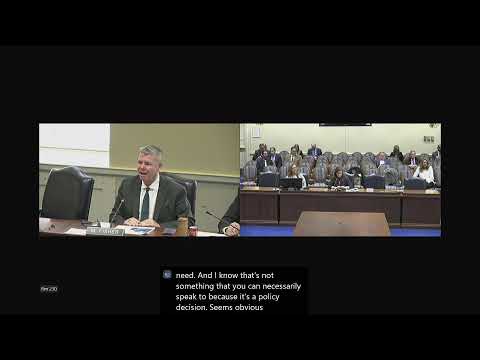
Nuclear Energy Institute briefs Economic Matters Committee on reactor expansion, safety and timelines
Summary
Maria Korsnick of the Nuclear Energy Institute told the Economic Matters Committee that U.S. nuclear capacity remains a major source of reliable, low‑carbon power and outlined small modular and microreactor options, federal incentives and safety and waste questions raised by members.
Maria Korsnick, president and CEO of the Nuclear Energy Institute, told the Maryland Economic Matters Committee on an unspecified date that the United States operates 94 commercial reactors at 54 sites across 28 states and that nuclear supplies roughly 19 percent of U.S. electricity generation.
Korsnick emphasized nuclear’s reliability and long operational life, saying that “the nuclear fleet in The United States has greater than a 90% capacity factor” and arguing that advanced reactors — including small modular reactors (SMRs) and microreactors — can play new roles on the grid and in industry.
Committee members pressed Korsnick on safety, security, waste and timelines. Korsnick described federal policy tools that she said are helping the industry de-risk initial projects, and repeated that current plants are subject to close regulatory oversight and additional safety measures taken after Fukushima.
Why it matters: Committee members framed the briefing as part of Maryland’s review of future generation options and siting questions for data centers, industrial customers and potential reuse of retiring fossil sites. Korsnick’s presentation linked new reactor designs to job creation, possible industrial steam uses and potential partnerships with hyperscalers that are seeking large, reliable blocks of clean electricity.
What Korsnick told the committee - System scale and economic footprint: Korsnick said the U.S. nuclear fleet contributes about $60,000,000,000 to the U.S. economy and supports “close to 500,000 jobs,” figures she presented to illustrate the industry’s scale. - New reactor types and uses: She described a range of designs coming to market within the next decade — from gigawatt‑scale plants to 300‑megawatt SMRs and 1–20 megawatt microreactors — and said those smaller reactors could serve remote mining operations, data centers, industrial facilities that need high‑temperature steam and other non‑electric uses such as hydrogen or sustainable aviation fuel production. - Modeling for decarbonization: Korsnick cited modeling by the contractor Vibrant Clean Energy that, in her description, found an unconstrained, least‑cost decarbonized system with substantial nuclear build‑out and that constraining nuclear raised modeled consumer costs by about $450,000,000,000 in the scenario she summarized. - Industry expectations and timelines: Korsnick said a survey of NEI members showed many current operators expect plants to operate to 80 years with second license renewals, and she said member utilities have signaled interest in adding roughly 100 gigawatts of new nuclear capacity by mid‑century. She said some microreactor designs may enter service in a year or two, that the BWRX‑300 and other SMR designs are moving toward construction permits, and that more significant build‑outs would occur in the 2030s if projects proceed. - Federal and state incentives: Korsnick pointed to recent federal policy, including tax incentives from the Infrastructure Investment and Jobs Act and the Inflation Reduction Act and production and investment tax credits, as well as loan guarantees and early‑mover support mechanisms (for example, demonstration cost‑share and proposals for cost‑overrun insurance) that she described as helping de‑risk first‑of‑a‑kind projects. - Safety, security and waste: On safety, Korsnick reviewed steps taken after Fukushima, including pre‑staging emergency equipment and changes to how safety systems are arranged, and said, “the plants that we have today are extremely safe.” She said cyber protections are long‑standing and that nuclear control functions are maintained in isolated systems (an ‘‘air gap’’). On waste, she said some nations reprocess spent fuel, that U.S. companies are researching potential reuse, and that the United States currently stores spent fuel safely while longer‑term repository solutions remain needed.
Questions from committee members Committee members asked about timelines for SMRs and microreactors, how hyperscalers such as Amazon, Microsoft and other data center operators could partner with states and utilities, workforce and supply chain constraints, coal‑to‑nuclear repowering, water use for cooling, and national security risks including foreign state activity in global nuclear construction markets. Korsnick responded that many designs are being developed and licensed now, pointed to examples such as NuScale and firms pursuing construction permits, and encouraged state consideration of permitting, reliability valuation and workforce planning.
Context and limitations The briefing was informational; committee members did not vote on policy during the session. Korsnick reported industry survey results, modeling outcomes and vendor timelines as presented by industry and consultants; those findings reflect assumptions and scenarios she summarized rather than formal committee or state analyses.
The committee discussion indicated material interest in further study of permitting pathways, siting (including reuse of retiring coal sites), water usage and integration of new reactors with renewables and storage.
Ending Committee members thanked the presenter and signaled follow‑up interest; no formal action was taken during the briefing. The Economic Matters Committee may consider these issues further in future hearings or staff work as members weigh state policy options related to siting, permitting and incentives for advanced nuclear technology.