Get Full Government Meeting Transcripts, Videos, & Alerts Forever!
Get email alerts on the Stride Reform topic
No spam. Unsubscribe anytime.
Maryland bill would tighten STRIDE rules to prioritize safety, limit accelerated gas spending
Summary
A House hearing on House Bill 419 focused on changes to the STRIDE accelerated cost-recovery program for gas utilities, with consumer advocates urging stricter oversight and utilities warning the changes could slow safety work.
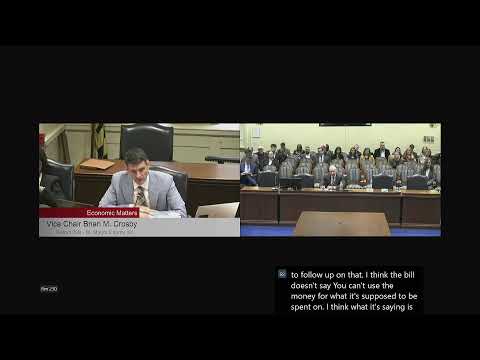
Sponsor (bill presenter) opened the Economic Matters Committee hearing by introducing House Bill 419, the "ratepayer protection act," saying the measure would revise the Strategic Infrastructure Development and Enhancement (STRIDE) law to require utilities and the Public Service Commission to prioritize safety, assess cost‑effective alternatives and provide customer notice before accelerated recovery charges are assessed.
The bill’s supporters told the committee the current STRIDE mechanism has driven large, rapid utility spending that is already appearing on customer bills. "Stride reform is the single most important action Maryland can take to address the massive utility customer bills that folks are facing today," said David Lapp, representing the Office of People's Counsel. Lapp and other advocates said utilities have spent billions under STRIDE and will spend many billions more unless the process is reformed.
Why it matters: Backers — including the Office of People's Counsel, Maryland PERG and consumer advocates — argued that STRIDE, enacted in 2013 as a safety-focused financing mechanism, gave utilities an accelerated path to recover capital spending without clear statutory language requiring prioritization by safety or evaluation of cheaper alternatives such as targeted repairs or leak detection. Supporters said those gaps have helped drive rate increases that are already affecting low‑income and elderly households in BGE territory and elsewhere.
Advocates provided numbers and examples to the committee. David Lapp said utilities have spent "over $2,000,000,000 on gas infrastructure under STRIDE thus far" and that utilities’ distribution revenue requirements have risen sharply since the program began. Emily Skarmas of Maryland PERG said federal data show hazardous gas leaks at BGE rose from about 3,000 in 2014 to about 4,000 in 2023 even while that utility invested in pipeline replacement. Laurel Peltier, AARP’s utility advocate, described callers who say their winter heating costs rose from roughly $1,300 in 2021 to about $1,700 in 2025 and called the bill “a balance between safety and affordability.”
Utilities and contractors opposed the bill as written. Britney Jones of Baltimore Gas & Electric told the committee BGE "respectfully opposes House Bill 419," saying the company already performs risk‑based prioritization and leak‑detection programs and that replacement work has reduced hazardous leaks where it has been completed. Washington Gas and Columbia Gas witnesses told legislators that federal safety guidance and PHMSA recommendations motivated accelerated replacement programs nationwide and argued that repair is not always an appropriate substitute for replacement of old cast‑iron or bare steel mains.
Public Service Commission Chair Fred Hoover said the commission supports amendments to sharpen the STRIDE filings so applications are more explicitly tied to safety and leak prevention. Hoover said the PSC has worked with the bill sponsor and advocates and has amendment language to make the bill clearer and to give the commission flexibility to set notice procedures rather than a fixed two‑year notice in statute.
Committee discussion centered on three areas: whether a tightened statute would unintentionally block genuinely needed safety projects, how much of current rate increases are driven by STRIDE spending, and whether notice requirements would harm urgent replacements. Lawmakers pressed advocates and utility witnesses for concrete fiscal projections; advocates said a precise near‑term reduction in bills cannot be calculated without reviewing specific project filings, while the Office of People's Counsel argued slowing the pace of accelerated recovery would reduce upward pressure on bills over the coming decade.
No formal vote or committee action was taken during the hearing. The PSC signaled it will present amendment language for the bill sponsor and the committee to consider.
Ending: The committee heard extensive testimony on technical tradeoffs between accelerated replacement to reduce long‑term safety and environmental risk and targeted, lower‑cost repairs. Supporters asked for a favorable report to limit what they described as unchecked spending that increases rates; utilities urged the panel not to add barriers that would prevent work they say has demonstrably reduced hazardous leaks. The hearing record closed with the PSC and sponsor continuing to work on amendments for the committee’s further consideration.