
PUC chair outlines standard-offer history, litigation and net‑metering changes as state shifts toward utility procurement
Get AI-powered insights, summaries, and transcripts
Subscribe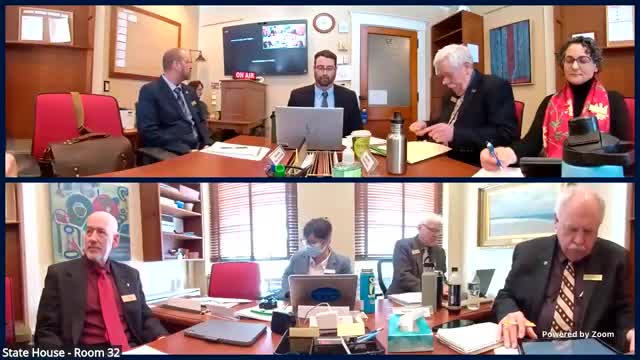
Summary
Ed McNamara, chair of the Vermont Public Utility Commission, briefed the House Energy and Digital Infrastructure Committee on Feb. 7 on the state's standard-offer program and net metering, describing program history, recent price declines, litigation over program caps and the policy overlap with the Renewable Energy Standard.
Ed McNamara, chair of the Vermont Public Utility Commission, told the House Energy and Digital Infrastructure Committee on Feb. 7 that Vermont's centrally administered standard-offer procurement and the state's net‑metering rules have evolved substantially since their inceptions and now face legal and policy tensions with the Renewable Energy Standard.
McNamara said the standard-offer program, created in 2009, was originally a 50-megawatt cap with individual project limits of 2.2 megawatts and generous fixed prices (about $0.30 per kilowatt-hour in early rounds). Competitive procurements introduced after 2012 drove prices down; the most recent PUC reverse-RFP in 2022 produced prices a little over $0.08 per kilowatt-hour, he said. "The price of solar has declined considerably in the last 20 years," McNamara said, noting national cost declines documented by federal laboratory studies.
Why it matters: McNamara said the Renewable Energy Standard (RES), adopted in 2017, requires utilities to procure in‑state renewable generation and has made parts of the standard-offer program redundant for solar. That redundancy, plus the PUC's continued state-administered contracting role, has produced sustained litigation and regulatory scrutiny. "Standard offer is somewhat of a target because it's not typical," McNamara said, explaining that many states rely on utilities to procure renewables rather than the state setting contract terms directly.
Program background and litigation
McNamara described the program mechanics: the PUC sets program rules and hires a third‑party facilitator to run contracts; standard-offer contracts have fixed purchase terms (typically 25 years for solar, 20 years for most technologies and 15 years for landfill gas), with the facilitator allocating contracted generation and associated renewable energy credits to the state's distribution utilities. Certain utilities that were already highly renewable when the program started (Burlington Electric, Swanton Electric and Washington Electric Co‑op) were carved out initially and did not have to take standard-offer power.
He said the program's competitive processes reduced per‑kilowatt costs from the early $0.30 level to around $0.08 by 2022. The program cap was expanded after 2009 (ultimately to about 27.5 megawatts under the 2012 changes, phased in over several years), and many bids were accepted by lottery early in the program when interest exceeded capacity.
McNamara also described an extended legal record testing whether the state's program is preempted by federal law. He said the PUC has defended the program in many proceedings, including matters that reached the federal district courts and the U.S. Court of Appeals, and has relied on the cooperative‑federalism approach upheld by courts when states and federal regulators share authority. He named the federal statute informing those disputes as the Public Utility Regulatory Policies Act (PURPA) and said the cases involved matters at the Federal Energy Regulatory Commission and in federal courts. He told the committee the PUC has consistently argued the program is a lawful state exercise and has prevailed in multiple appeals.
Net metering: deployment, compensation and grid impacts
McNamara summarized net metering history in Vermont: initial authorization in the late 1990s, expansion over time and rule changes in 2017 that created a more adjustable framework (commonly called "net metering 2"). He said Vermont has among the region's largest per‑peak amounts of distributed solar (measured as a share of peak load) and that the state's peak demand profile shifted such that solar's value as a peak reducer has changed.
He explained two common constructs: traditional (behind‑the‑meter) net metering, where rooftop generation directly offsets a customer's load, and group (or virtual) net metering, where a remote project provides bill credits to subscribers. McNamara said group net metering has enabled renters and other residents who cannot host panels to participate but noted that 2024 changes in Act 179 significantly limited group net metering, requiring closer proximity to the load and directing the Department of Public Service to study alternative options for affordable housing.
On compensation, McNamara said the PUC uses adjustable "siting" and "credit" levers and issues an order every two years that sets net‑metering compensation levels for new projects. Those levers have generally been used to lower compensation for new projects in recent years. He described the policy tradeoffs: if a utility can procure in‑state solar for roughly $0.08–$0.09 per kilowatt-hour through competitive procurements, should utilities pay higher compensation for exported net‑metered energy from small rooftop systems? He also said most net‑metering projects transfer their renewable energy credits (RECs) to utilities (which allows that output to count toward RES obligations), and that historically customers who retained RECs did not get that credit toward RES.
Grid integration and cost‑allocation
When asked about distribution and substation limits, McNamara described the longstanding cost‑causation rule used in Vermont: the connecting generator generally bears the interconnection upgrade costs when a new distributed resource triggers a need for line, transformer or substation upgrades. Representative Scott Campbell asked, "The last person in pays the full freight?" McNamara affirmed that, describing an example where a single new generator could push a line or substation beyond capacity and thereby require upgrades that the new interconnection would fund. He cautioned that coordination between distribution utilities and VELCO (the statewide transmission owner) is important because distribution approvals do not always reveal downstream transmission constraints.
Other points and committee questions
McNamara said the standard-offer program has produced mostly solar projects (about 95 percent of standard-offer capacity) with a few farm methane, hydro and small wind projects, and he estimated farm methane installations numbered under a dozen. He noted practical size thresholds (small wind often defined under 50 kilowatts) and the policy goal in earlier law to reserve some capacity for technological diversity (wind, biomass, methane, hydro) rather than letting solar dominate every procurement.
He said projects that fail to meet Section 248 interconnection or siting milestones can be removed from the standard-offer queue and that the PUC granted multiple milestone extensions during COVID and following the bankruptcy of iSun (a parent firm associated with SunCommon), which disrupted several projects.
McNamara emphasized that, from a greenhouse‑gas perspective, Vermont's electric sector is a small share of statewide emissions but is the enabling sector for decarbonizing transportation and heating. "If you want to reduce greenhouse gases, weatherize your house, put in heat pumps, do an EV," he said; he argued those measures often yield larger state‑level reductions than additional distributed solar alone given RES targets.
Ending
McNamara provided the committee with data sources and said he was available for follow-up conversations; the committee indicated interest in reconvening for further technical detail on interconnection, protective devices and how distribution and transmission planning interact with high levels of distributed generation.