Get Full Government Meeting Transcripts, Videos, & Alerts Forever!
Get email alerts on the Hb 495 Amendment topic
No spam. Unsubscribe anytime.
Committee advances amended House Bill 495 after public hearing, adopts 17-part amendment
Summary
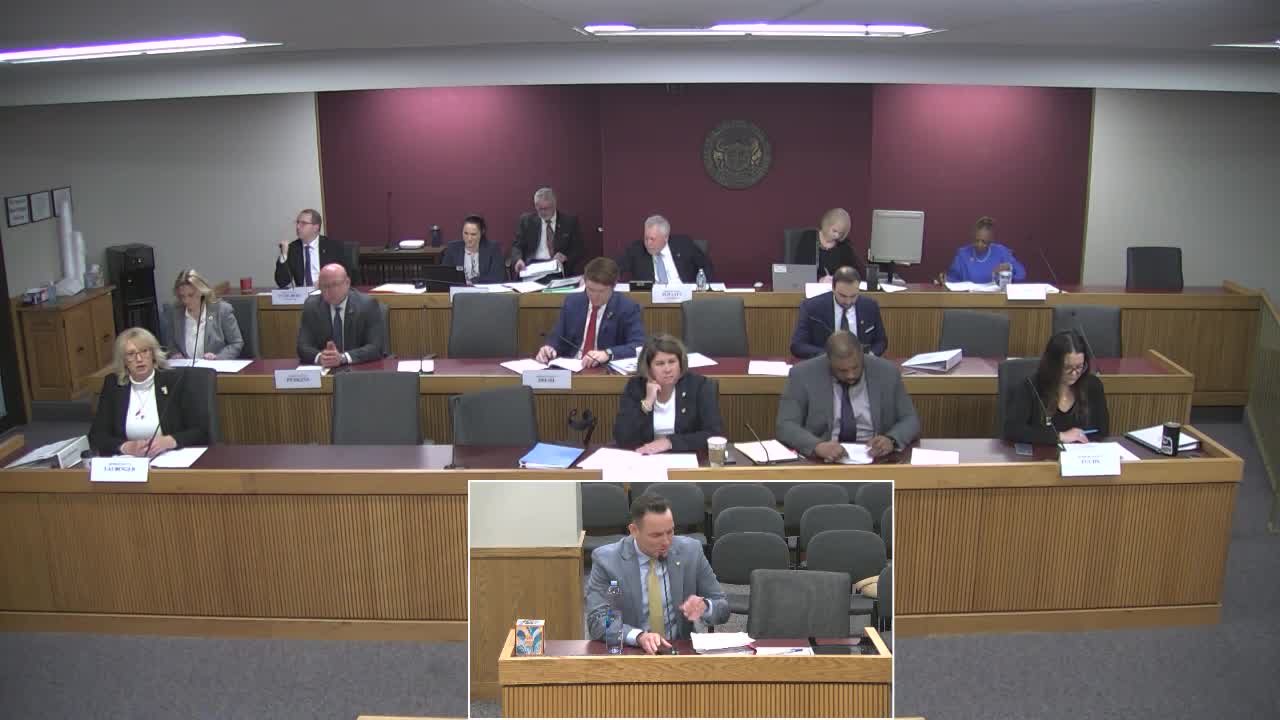
The Committee on Legislative Review held a public hearing and executive session on an amendment to House Bill 495 and voted to adopt House committee substitute number 2, moving the bill out of committee by a 7-3 margin.
The Committee on Legislative Review held a public hearing and executive session on an amendment to House Bill 495 and voted to adopt House committee substitute number 2, moving the bill out of committee by a 7-3 margin.
The amendment, presented by Representative Brad Chris, District 96, adds 17 separate provisions into the bill, including changes to the quo warranto removal process, restoration of an ankle-monitoring requirement removed by a sunset clause, a breathalyzer (ignition-interlock) provision for drivers who register 0.15 blood-alcohol concentration, expanded organized retail theft penalties, requirements that law-enforcement agencies submit information on offenders' immigration status to the state, a prohibition on government-run safe injection sites, changes to criminal-forfeiture language tied to stunt driving and street takeovers, an expanded definition of dangerous felonies, penalties for unlawful roadway interference, reforms to juvenile point-system detention thresholds, and language altering the makeup and transitional governance of a St. Louis police oversight board.
Representative Brad Chris, District 96, outlined the amendment as a package that was developed in negotiations with the governor's office and the attorney general and that was previously considered in the Committee on Crime and Public Safety. He said the amendment incorporates items from a Senate bill, items requested by the governor and attorney general, and cleanup language for state-board provisions. "I support the First Amendment and the right to protest," Chris said when asked about provisions that upgrade penalties for unlawful roadway interference; he added that law enforcement sought stiffer penalties because of recent street takeovers and related public-safety incidents.
The committee spent substantial time identifying where each of the 17 provisions appears in the amendment (page references provided by the presenter ranged across pages 2–23 of the amendment packet). Specific provisions called out during the hearing included:
- Quo warranto removal process: language preventing someone removed from office through quo warranto from seeking the same office again, added after consultation with the attorney general and following audits and quo warranto cases raised in committee discussion.
- Ankle-monitor sunset renewal: restoration of a statutory requirement that monitoring vendors alert victims and law enforcement if a monitored individual breaches a protected perimeter; the presenter described the prior statutory language as having an inadvertent sunset that removed that victim-notification requirement.
- Breathalyzer provision: a measure to allow a breathalyzer (or ignition-interlock device) on a first offense when a driver records 0.15 BAC; the presenter said the provision mirrors steps in more than 30 other states and was originally carried by Representative Mark Sharp.
- Organized retail theft: expanded statutes and penalties for coordinated retail theft and looting; the presenter said the change was intended to ease prosecution for organized shoplifting events.
- Immigration-status data collection: language requiring law-enforcement agencies to submit crime data that "includes information pertaining to immigration status"—specifically whether an offender is a citizen, a lawfully present immigrant, or lacks documentation to show citizenship or lawful presence, the presenter said.
- Prohibition on safe injection sites: a provision preventing a government entity or municipality from operating a supervised consumption or safe injection facility, described by the sponsor as a public-safety measure.
- Criminal-forfeiture, stunt driving and street-takeover enforcement: changes to align criminal-forfeiture language with updated stunt-driving and street-takeover statutes, and expansions of the "dangerous felony" definition to include offenses such as planting explosives or hijacking buses, per the presenter.
- Juvenile point-system changes: an adjustment to the juvenile detention point system to allow cumulative consideration of multiple incidents rather than relying on a single offense to reach a detention threshold, cited by the sponsor as a response to repeat juvenile car-theft incidents in his district.
- State board language and transition director: modifications to state-board appointment language affecting St. Louis and a new, optional transition-director role the sponsor said would help move from mayoral control to the citizen board without disrupting police operations.
Several committee members raised procedural objections and substantive concerns. Representative Terry raised a point of order under Rule 30, saying, "We did not receive these within a 24 hour notice." Representative Joe Dull said the package "has 17 provisions" and called the rushed distribution an "incredibly poor form." Multiple members said they had insufficient time to vet the materials before the hearing. Representative Filch and others questioned making certain protest-related conduct a felony; Filch said she had First Amendment concerns and pressed whether the language could keep unlawful roadway interference at misdemeanor status.
Other committee members expressed support for parts of the package. Representative Houseman, speaking as a resident of the St. Louis region, called several measures "common-sense" steps toward improving downtown safety. Representative Schuch said on the record that she felt safe in the city and explained her view as background to her support for certain public-safety proposals.
After the public hearing, the committee went into executive session. The committee adopted an amendment (identified in the record as ending in "5h") and then voted to roll that amendment into House committee substitute number 2 for House Bill 495. The committee then voted that the house committee substitute number 2 for House Bill 495 be given a "do pass" recommendation; the clerk announced the committee vote as "7 ayes and 3 no's." The record does not show a roll-call list that cleanly maps each name to a vote in the segment where the tally was announced; the clerk identified the tally in the official roll call.
Votes at a glance: House committee actions recorded during the meeting included:
- House Bill 495 (as amended): House committee substitute number 2 adopted and voted "do pass" by committee; tally announced as 7 ayes, 3 noes.
- House Bill 145: House committee substitute adopted and the bill voted "do pass" by committee; tally announced as 10 ayes, 0 noes.
- House Bill 233: Voted "do pass" by committee; tally announced as 10 ayes, 0 noes.
The presenter and several members emphasized that the package was the product of negotiation with the governor's office and attorney general's office and that some language mirrors a Senate committee-approved bill. Multiple members objected to the timing and size of the amendment and asked for more time to study the specific statutory changes and operation-level impacts before floor consideration.
The committee adjourned after completing the roll calls.