Get Full Government Meeting Transcripts, Videos, & Alerts Forever!
Get email alerts on the Pensions Foreign Adversary Divestment topic
No spam. Unsubscribe anytime.
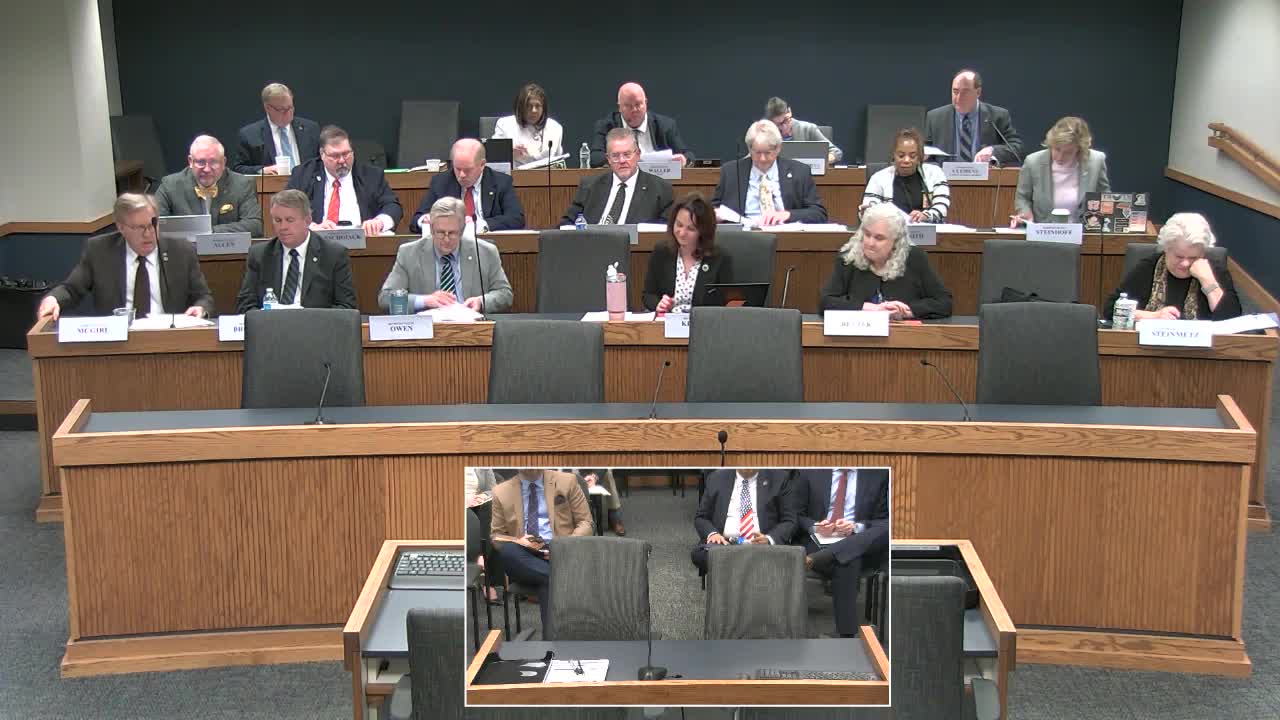
Public hearing on HB 977: proposal would require Missouri public pensions to screen, divest from entities tied to foreign adversaries
Summary
House Bill 977 would require Missouri public pension boards to review holdings for entities flagged by federal national-security lists and divest from certain investments tied to foreign adversaries, with exemptions and phased timelines. Treasurer Vivek Malik and retirement-system officials testified.
House Bill 977, introduced in committee by Representative Hovis, would require public pension boards in Missouri to identify and, with specified exceptions, divest from investments tied to foreign adversaries identified on federal restricted lists.
Missouri State Treasurer Vivek Malik testified in support, saying the bill "would protect Missouri's pension public employer retirement funds from financial and national security threats posed by foreign adversaries." Malik described the measure as requiring public pension boards to review holdings by Dec. 1, 2025, and to divest from restricted investments by Aug. 28, 2026, unless immediate divestment would cause significant financial harm; in that case a limited extension to Aug. 28, 2028, may be available under conditions set in the bill. He said the categories of restricted entities would include companies on the U.S. Department of Commerce entity list, companies identified on the U.S. Department of Defense Chinese Military-Industrial Complex (CCMC) list, entities sanctioned by the U.S. Treasury's Office of Foreign Assets Control (OFAC), and companies subject to China's national intelligence law or otherwise publicly identified as controlled by the Chinese government.
The bill includes exemptions and safeguards intended to limit financial disruption, according to testimony: passive index funds would be exempt from a divestment requirement when divestment would cost more than 10% of restricted holdings; private market funds and certain indirect holdings and actively managed funds would also be excluded from mandatory divestment. The bill provides a financial threshold (transaction costs exceeding $500,000 or substantial secondary-market losses) that can trigger the extension to 2028.
Treasurer Malik said MOSERS (the Missouri State Employees' Retirement System) already moved to an "ex-China" public-equities position: "As of today, over 80% of the transaction to an ex-China portfolio is complete," and he said full divestment by MOSERS was expected by March 2025. MOSERS' executive director Abby Spieler (testifying for information) confirmed that MOSERS follows federal prohibitions and said the bill is consistent with MOSERS' current restricted-entity list and portfolio actions.
Supporters who testified included James Harris of State Armor Action and Neil English of State Shield. Harris cited concerns about transparency, audit standards, and human-rights issues in some foreign markets and said poor returns and lack of reliable audits have harmed investors. English urged the committee to consider tying state policy to federal lists such as the Treasury designation at 15 C.F.R. § 7.4 so the state need not reopen statute each time federal designations change.
Several committee members asked for clarity on how the bill identifies restricted entities and how the lists overlap. Representative Clemens and Representative Steinhoff both raised concerns about naming specific countries in statute and urged flexibility; Clemens said he preferred broader, durable fiduciary language rather than enumerating specific issues in statute. Representative Reuter pressed on the bill's language that would bar investments that "pose a significant risk of being or becoming involved in activities contrary to national security or foreign policy interests," asking who would make that determination and expressing concern about penalizing entities for speculative future behavior. Treasurer Malik and witnesses repeatedly pointed to the four federal lists named in the bill as the operational source for determinations.
Officials from MOSERS and PSRS (public pension systems) told the committee they already have internal compliance processes and follow federal restricted lists; Mike Moorefield (chief counsel, PSRS) described a "belt and suspenders" compliance approach involving board policy, custodial monitoring, and internal investment operations.
No committee vote was taken on HB 977 during the transcript excerpt; the hearing was opened and then closed after testimony and questions.
Why it matters: HB 977 would create a consistent statutory requirement across Missouri public pension systems to screen for investments tied to federal restricted lists and to remove specified exposures. The provisions could affect portfolio management, compliance procedures, and timelines for large public funds.
Next steps: The bill was the subject of a public hearing; committee members sought additional clarifications and possible drafting adjustments to increase flexibility and to tie state requirements to federal designations.