Get AI Briefings, Transcripts & Alerts on Local & National Government Meetings — Forever.
Votes at a glance: key outcomes from the Jan. 28 Senate Commerce & Finance Committee
Loading...
Summary
A roundup of bills and committee votes from the Arizona Senate Commerce & Finance Committee hearing on Jan. 28, 2025, including tax conformity and technical tax bills, property-tax valuation changes, and other items that received committee action.
The Arizona Senate Commerce & Finance Committee voted on multiple bills during its Jan. 28 hearing. Below is a compact summary of the committee’s recorded actions and brief context for each item.
Votes at a glance
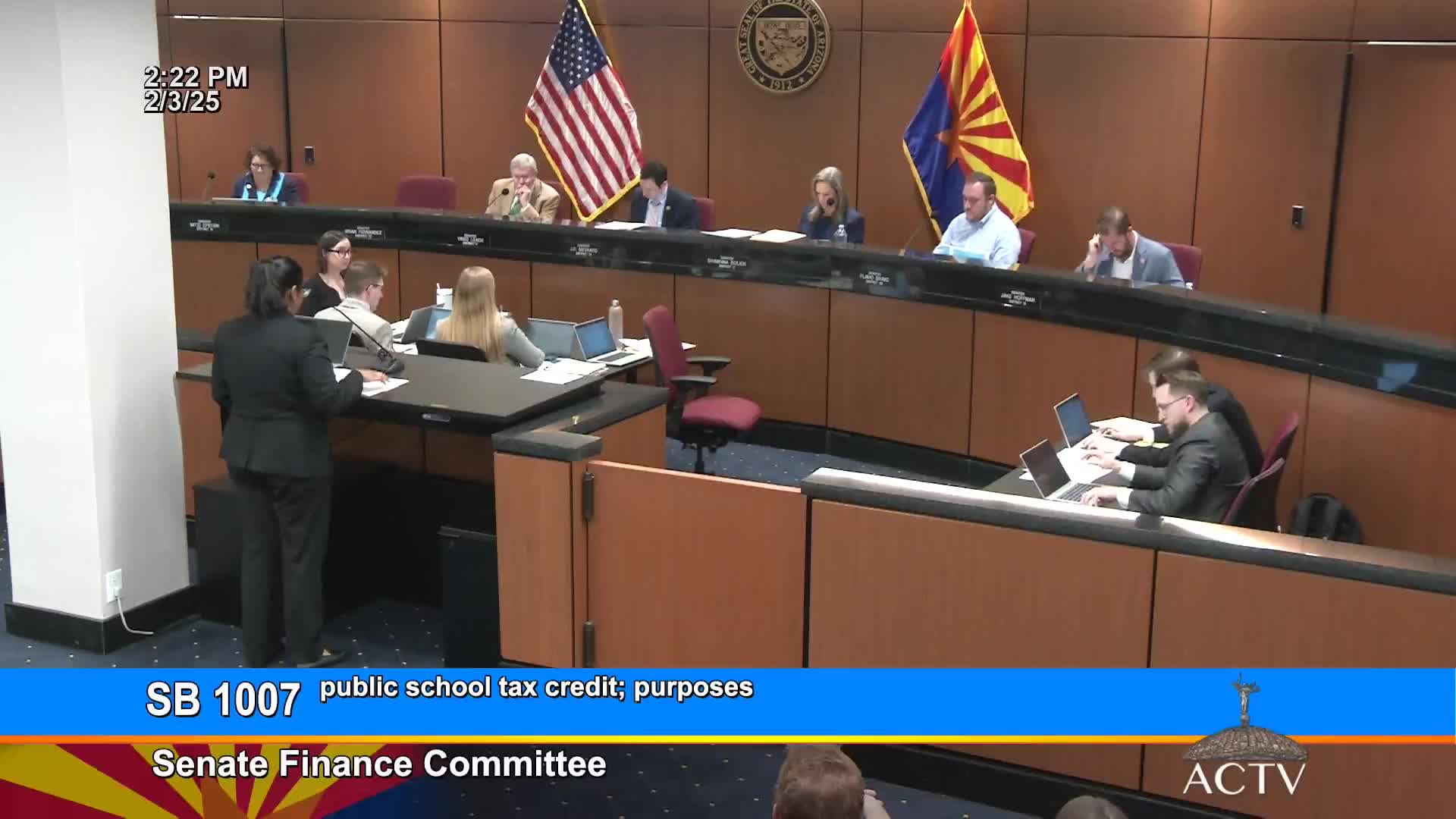
- SB 1007 — Eliminate sunset for expanded public school extracurricular activity fees tax credit uses (e.g., capital items, school meal programs, playground shade). Committee: returned with a do-pass recommendation (committee vote recorded as 5–1). Sponsor: Senator Kavanaugh; supporters included Greater Phoenix Educational Management Council.
- SB 1120 — Clarifies property definitions for creation and boundary changes of certain special taxing districts and adds personal property in district-creation valuation requirements. Committee: returned with a do-pass recommendation (6–0 as amended).
- SB 1224 (12/24) — Adds properties that previously qualified for a statutory senior valuation protection program and later exit that program to the list of circumstances that trigger a Rule B valuation reset. County assessors supported; committee returned the bill with a do-pass recommendation (vote recorded as 5–0 with two nonvotes).
- SB 1122 — Change for statutory annual adjustment of certain property-exemption limits: requires using the Federal Housing Finance Agency House Price Index rather than the GDP price deflator for specific exempt-property assessment limits (affects certain low-income and veteran/homeowner exemptions). Committee: returned with a do-pass recommendation (6–0).
- SB 1155 — Expands an individual income subtraction for active-service compensation to include compensation received for service in the U.S. Uniformed Services (including USPHS and NOAA as appropriate). Committee: returned with a do-pass recommendation (6–0).
- SB 1159 — Raises the claim cap for unpaid wages that can be filed at the Industrial Commission (instead of civil suit) from $5,000 to $12,000; Industrial Commission noted resource implications and requested legislative consideration of staffing. Committee: returned with a do-pass recommendation (6–0).
- SB 1222 — Annual federal tax conformity bill (updates Arizona code to reflect federal Internal Revenue Code language as of 01/01/2025). Committee: returned with a do-pass recommendation (6–0).
- SB 1274 — 2025 tax corrections bill (technical corrections and clarifications to tax statutes). Committee: returned with a do-pass recommendation (6–0).
What reporters and readers should know
- Several votes were unanimous or near-unanimous on technical or conformity measures; these are primarily housekeeping items that align state tax code with federal changes or correct statutory language.
- The more policy-heavy items — SB 1121 (Rule B neighborhood method) and SB 1050 (GPLIT amendment) — generated extended debate and are covered in separate articles. SB 1221 (China divestment) also generated detailed testimony and advanced out of committee.
- The Industrial Commission warned that increasing the unpaid-wages cap will increase caseload and asked for four additional full-time staff and a non-general-fund appropriation to handle the expected workload.
Committee procedure notes
- Where recorded roll calls were available, vote tallies are included. If a bill was amended in committee, the summary notes that amendment.
For follow-up: reporters should request fiscal notes for bills that affect revenues (GPLIT amendment, unpaid-wages cap, senior valuation resets) and ask sponsors for precise statutory language and proposed effective dates.