Get Full Government Meeting Transcripts, Videos, & Alerts Forever!
Get email alerts on the Professional Licensing topic
No spam. Unsubscribe anytime.
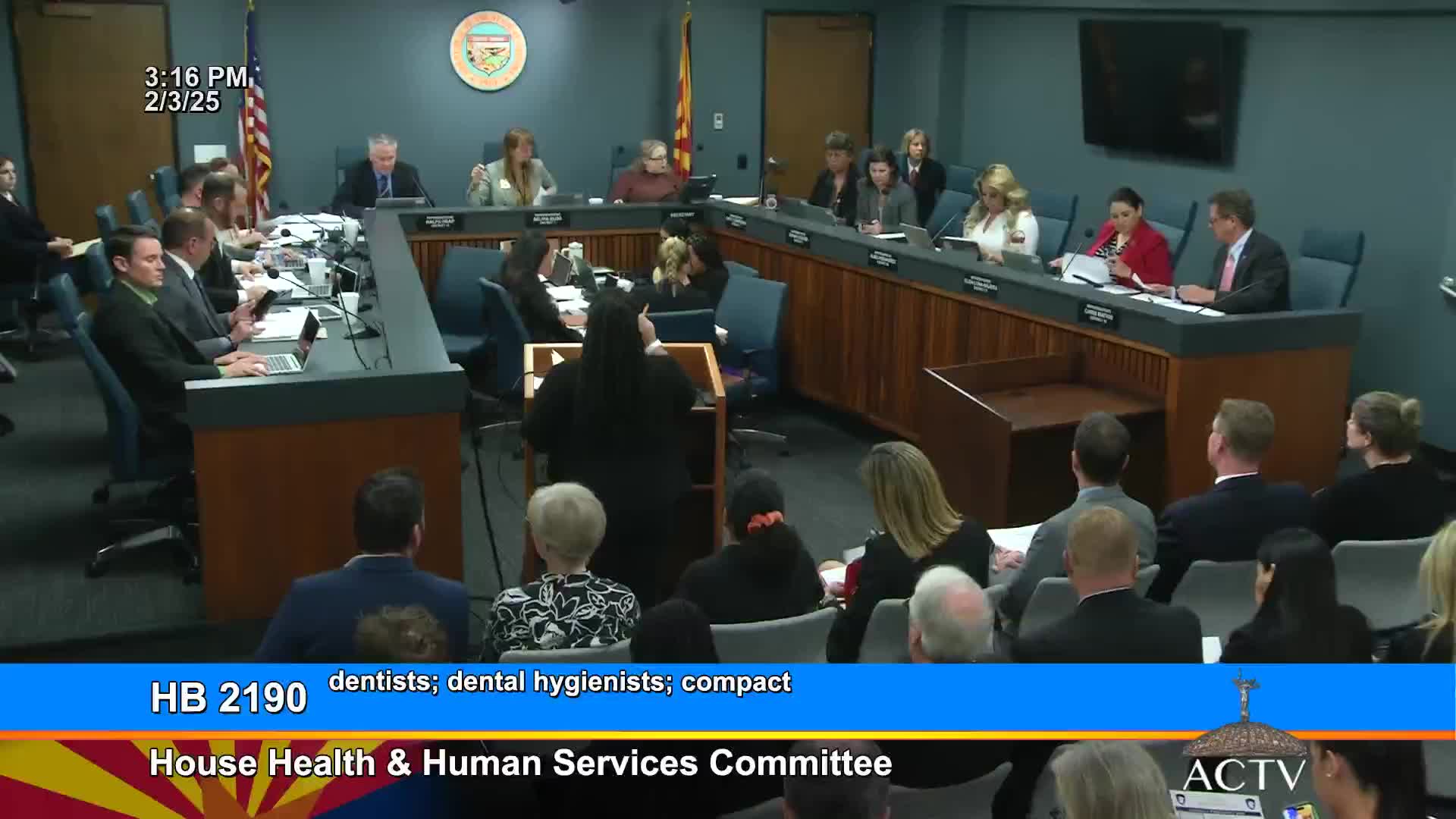
Committee narrowly backs interstate dental compact; state Dental Board opposed on discipline and sovereignty grounds
Summary
After extensive testimony for and against licensure portability, the House Health and Human Services Committee voted 7‑5 to return House Bill 21‑90 with a due‑pass recommendation. The measure would adopt the Dental and Dental Hygienist Compact, allowing practitioners from participating states to obtain a compact privilege to practice in Arizona without a new license.
Sponsor and stakeholder testimony: Rep. (sponsor) told the committee HB 21‑90 would join Arizona to the national Dental and Dental Hygienist Compact to make licensure portable for dentists and dental hygienists across participating states. Supporters, including private dental practice owners and the Arizona Dental Hygienists Association, said portability would address workforce shortages by easing hiring of out‑of‑state providers and reducing the burden of maintaining multiple licenses.
Opposition and board testimony: Ryan Edmonson, director of the Arizona State Board of Dental Examiners, testified in opposition and outlined concerns that the compact would undermine state regulatory authority. Edmonson said Arizona’s existing universal recognition laws already allow fast licensure for many out‑of‑state providers and cited an average five‑to‑six day processing time under the current system. He told the committee the compact commission model—one commissioner per participating state—would shift certain disciplinary and reporting processes to an interstate commission and could create an “unelected taxing authority” that levies fees on states and licensees. Other opponents, including practicing dentists, said the compact may reduce board access to full investigative records and could make reciprocal discipline more complex.
Supporters’ response: Dental hygienists and compact backers said the compact contains mechanisms for reporting adverse actions via a shared database, and that compact privileges can be revoked in remote states. Jesse Arment, representing the hygienists, explained that a revocation in a remote state should be reflected across compact privileges and that the compact’s coordinated database is intended to share adverse‑action information among states.
Why it mattered: Committee members focused questioning on the compact’s disciplinary mechanics, whether Arizona’s existing universal‑recognition laws already achieved the policy goals, and the potential fiscal and patient‑safety tradeoffs. Several members asked for clarity on who would pay commission fees and whether commission rules would preserve state authority.
Committee action: The committee voted to return HB 21‑90 with a due‑pass recommendation by roll call. The final committee tally was 7 ayes, 5 nays, 0 present, 0 absent.
Next steps: HB 21‑90 will proceed to further consideration; members and stakeholders may still seek amendments to clarify commission reporting, fee structures and discipline reporting requirements.