Get Full Government Meeting Transcripts, Videos, & Alerts Forever!
Get email alerts on the Special Education Evaluation topic
No spam. Unsubscribe anytime.
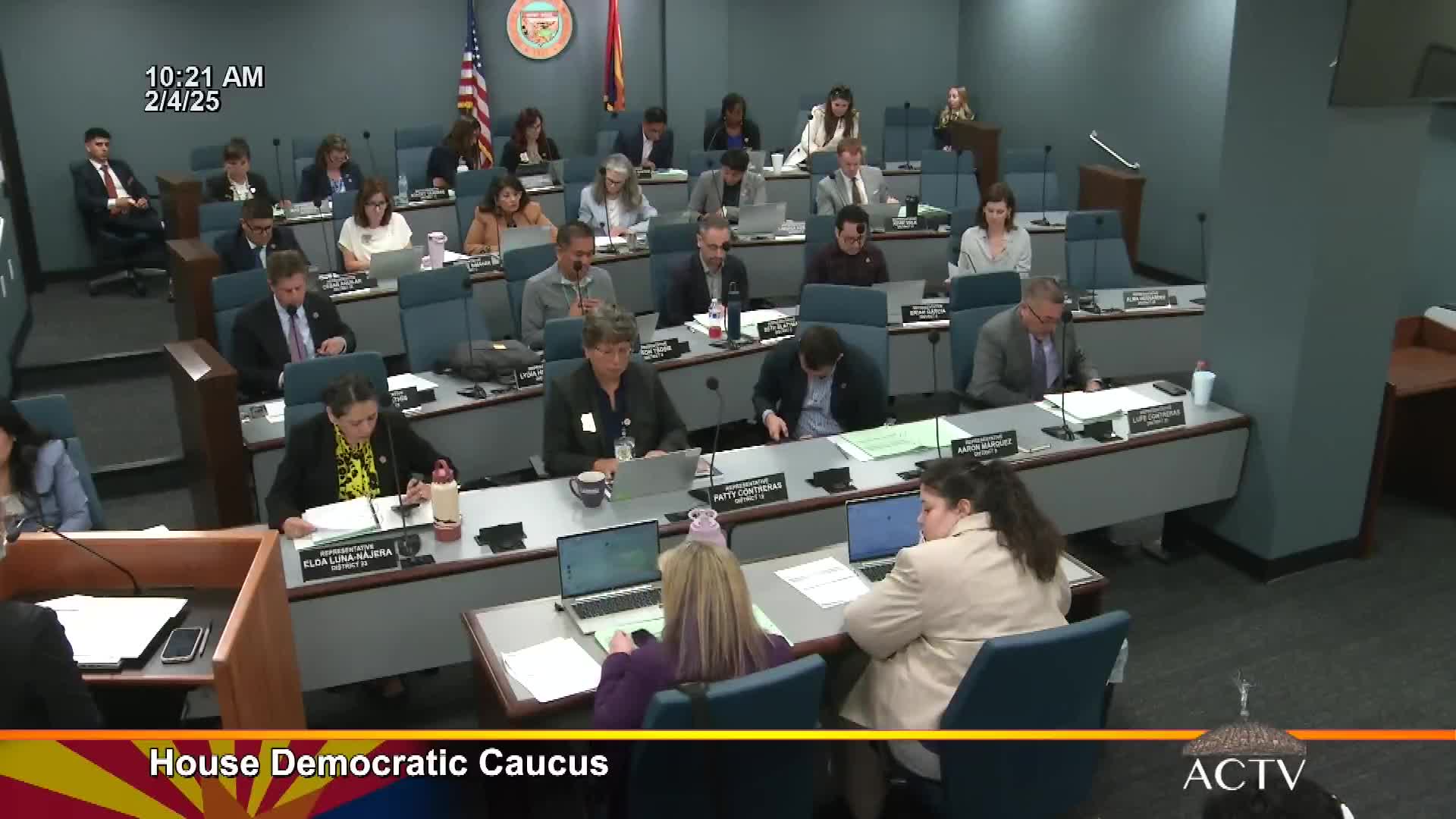
Democratic caucus debates bill to require summer special‑education evaluations; members raise cost and ESA implications
Summary
House Bill requiring school districts to start special‑education evaluations within 15 calendar days for requests made between May 1 and Aug. 15 drew sustained caucus concern about feasibility, district staffing, costs and whether evaluation results could be used to seek Education Savings Accounts (ESAs).
Sponsor Michael (Representative Michael Lynn) told the caucus House Bill 2,375 (as amended) "requires a home school district to begin a special education evaluation or provide written notice of refusal within 15 calendar days for any written special education evaluation request that is submitted by a parent between May 1 and August 15." He added the measure would make the temporary timeline apply specifically "over the summer."
Several members said that timing posed operational problems. A caucus member who identified themselves as a school official said during discussion that "schools are not open in the summer. They cannot start a special ed evaluation within 15 days if the parents request it at the end of the school year." The member noted that school psychologists and related staff often work on 10‑month contracts and are not paid year‑round, and that districts lack capacity to perform evaluations during the summer at the same rate as during the school year.
Representative Michael Lynn and multiple colleagues acknowledged a related federal 60‑day timeline for evaluations once a district accepts an evaluation request during the school year, and said the bill’s 15‑calendar‑day summer timeline was different and would likely impose additional burdens on districts. One caucus member, speaking as ranking member on appropriations, criticized what they described as an approach that could be inconsistent with other legislative priorities: "The Republicans eagerly want to defund services for children with autism and children with Down Syndrome by defunding DDD and AltEX. I think that is heinous and ridiculous…" (remarks summarized in caucus discussion).
Another substantive concern raised in the caucus: the evaluation can be used by families to obtain documentation that could increase ESA funding. Representative Pete Contreras asked for confirmation of the process by which a public‑school evaluation could be used by a family to seek a higher level of ESA funding; the sponsor confirmed that under current statute a private‑school student may receive a public‑school evaluation and use the resulting documentation when applying for ESA adjustments, and that this bill would allow that evaluation to be obtained over the summer specifically.
A caucus member also supplied an approximate cost figure: one participant said the districts’ evaluation costs are "about approximately $500 per student" and that districts are not reimbursed for that cost and instead "are eating that cost." Another member raised questions about whether services that flow from an IEP (speech, occupational therapy, etc.) would automatically follow from a summer evaluation and whether districts would be reimbursed for those services should a student later transfer to an ESA school; the sponsor said he would follow up with additional information.
No committee motion or vote was taken during the caucus meeting. Members asked staff and the sponsor for follow‑up information on funding, timelines and the administrative details for how summer evaluations would be scheduled and funded.
Ending: Caucus members requested additional written information about the operational feasibility, estimated per‑student costs, and the relationship between public evaluations and ESA eligibility before any final caucus position is taken.