Get Full Government Meeting Transcripts, Videos, & Alerts Forever!
Get email alerts on the Water Management topic
No spam. Unsubscribe anytime.
Arizona lawmakers advance package of bills easing water hauling, AMA reviews and Colorado River defense funding
Summary
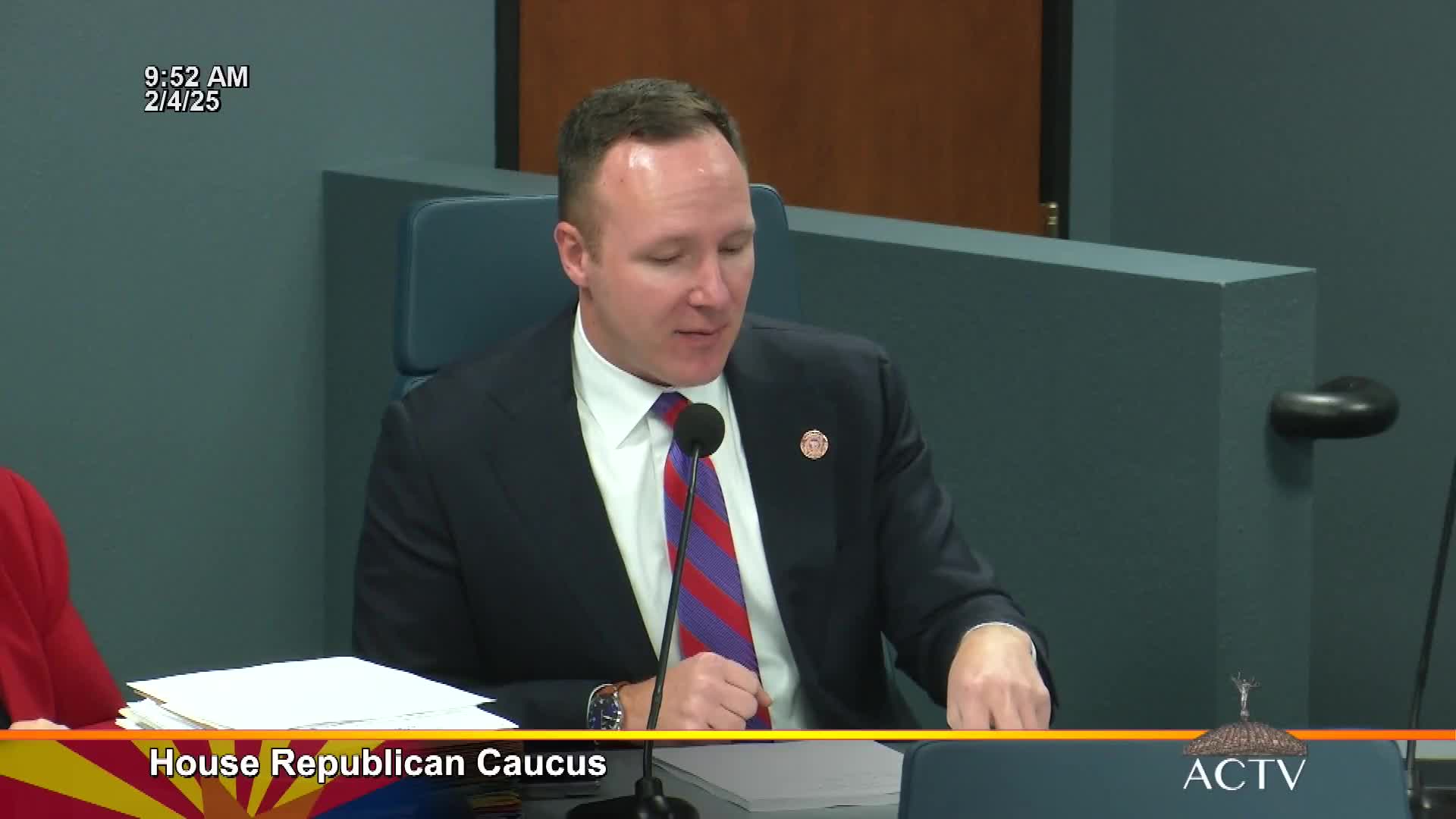
State lawmakers in a Feb. 4 House Republican caucus discussed a package of bills aimed at giving rural Arizonans more tools to manage groundwater, expand options for hauled water and fund the state's Colorado River legal defense.
State lawmakers in a Feb. 4 House Republican caucus discussed a package of bills aimed at giving rural Arizonans more tools to manage groundwater, expand options for hauled water and fund the state's Colorado River legal defense.
The measures include authorization for county improvement districts to build and operate waterworks and standpipes for hauled water; expansion of grant eligibility to cover water-hauled tanks; new review and petition processes for areas designated as subsequent active management areas (AMAs); and a $1 million appropriation to the Arizona Department of Water Resources (ADWR) to defend Arizona’s Colorado River allocation.
Research analyst Corbin Wright summarized one measure, saying the proposal “authorizes a county improvement district to be established for the purpose of constructing and operating water works, or a water delivery system for water hauling,” and that it “adds standpipes to the definition of waterworks.” Chairwoman Gail Griffin, sponsor of several of the bills, said the improvement-district proposal “allows residents who are facing challenges with domestic wells to come together and form, domestic water improvement district so that they can have hauled water.”
Other bills discussed would:
- Add water hauling and tanks for storing hauled water to the list of projects eligible for County Board of Supervisors Water Improvement Program grants.
- Direct ADWR to periodically review areas that were designated as subsequent AMAs and permit removal of an area from an AMA after a public hearing and written findings by the director; ADWR staff described hearings, comment periods and required written findings as part of that removal process.
- Allow registered voters in a subsequent AMA to file a petition to remove the AMA designation at least 10 years after designation; the petition must be signed by at least 10% of registered voters in the area and be filed within 180 days before a general election. If a valid petition is received, the county board must transmit it to ADWR, which has 60 days to examine groundwater conditions and decide whether to cancel the election or proceed with a removal order.
- Extend certain look‑back and eligibility periods used in AMA groundwater-right calculations from five to ten years and apply the change retroactively to Aug. 30, 2022, to accommodate farmers who adopted new water‑saving technologies and may otherwise lose rights under a shorter look‑back window.
- Create a temporary non-expansion irrigation area for up to 10 years in basins outside existing INAs or AMAs, with petition and voting thresholds specified in the bills.
- Approve an emergency appropriation of $1,000,000 from the general fund in FY2026 to ADWR “for defending and enforcing the state's allocation of Colorado River water under the Colorado River Compact of 1922,” staff told the caucus. Chairwoman Griffin said the appropriation is intended to allow ADWR to “challenge the Upper Basin states if need be, to make sure that we have our fair share of Colorado River water.”
One bill (HB2551) was described as an emergency measure extending the deadline to apply for a certificate of grandfathered groundwater right in the newly designated Wilcox AMA, lengthening the filing window from 15 months after designation to 21 months; staff said the change would apply retroactively to Jan. 7, 2025, and the act would be repealed Dec. 31, 2026.
Lawmakers repeatedly framed the package as targeted at rural Arizona farmers, ranchers and households that rely on domestic wells and that lack resources to deepen or replace those wells. Griffin said some counties — Cochise, Yuma and La Paz — already use county-level programs to collect funds for hauled-water infrastructure. Several sponsors and staff emphasized that many of the measures were placed on the third‑read consent calendar at the time of caucus, indicating the dockets were moving by consensus through committee.
No formal committee votes or final legislative outcomes were recorded in the caucus transcript excerpt; staff described procedural next steps such as hearings, director findings and transmittal timelines for petitions to ADWR.
The package contains both statutory changes (defining standpipes as part of “waterworks,” adjusting look‑back years and petition thresholds) and funding requests; sponsors said some provisions would act retroactively to Aug. 30, 2022, where explicitly stated.
Looking ahead, sponsors said ADWR action (for AMA review or removal) and county boards' handling of petitions will determine on-the-ground effects. The appropriation to $1 million to ADWR for Colorado River litigation would require enactment and appropriation language to take effect.