Get Full Government Meeting Transcripts, Videos, & Alerts Forever!
Get email alerts on the School Bond And Levy topic
No spam. Unsubscribe anytime.
Issaquah board approves resolution to pursue $138.7M capital levy as fallback while campaigning for Feb. 11 bond
Summary
The Issaquah School District board voted to adopt a resolution authorizing a six‑year capital levy option and spent the meeting refining and publicizing details of a $231M bond on the Feb. 11 ballot, including cost breakdowns for a new high school, safety upgrades and oversight measures.
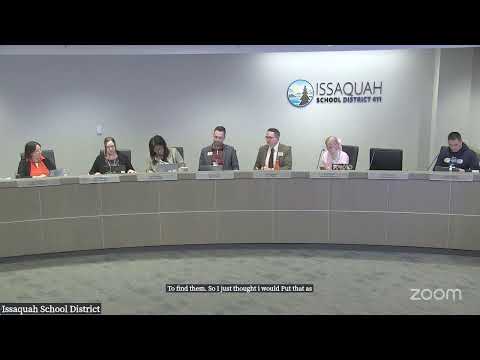
The Issaquah School District Board of Directors on Jan. 23 approved a resolution authorizing a six‑year capital levy option — $138,700,000 — as a fallback plan while the district campaigns for a February 11, 2025 bond measure that the board previously placed on the ballot.
Board members, district staff and student representatives spent the meeting presenting and debating details of the February bond package and describing how a levy would work if the bond does not receive the 60% voter approval needed for a bond. The board adopted the levy resolution by voice vote; the motion passed (the board president declared “the ayes have it”).
The bond package on the Feb. 11 ballot was described by district staff as a focused measure intended to address districtwide safety and security upgrades, relieve high school overcrowding and allow immediate work on a shovel‑ready new high school project. Presenters said the package had been reduced from earlier proposals and aimed to maintain a projected tax rate of $3.09 per $1,000 assessed value for 2025.
Chief of Finance and Operations Martin Turney told the board the bond package totals roughly $231.6 million as presented at the meeting and that the new high school project’s total cost is currently projected at $292.7 million. Turney said the district has spent approximately $20 million on the new high school so far and has $90 million in unspent bond funds plus $44 million in 2022 capital construction funds (totaling about $134 million) available to apply to the project, leaving roughly $138.7 million reflected in the package to complete work.
Turney also reviewed project components the district has included to address neighborhood concerns around the new site. He listed negotiated accommodations made with the adjacent Providence Point community and said those items add “just under $16,000,000” in estimated project cost.
District communications director Mark Sherwood reviewed the campaign timeline and outreach plan, including a mailed voter pamphlet, digital messaging, student videos and public events: a financial forum on Jan. 21 and a schools board town hall on Jan. 23. Sherwood said the district plans a project oversight committee composed of public members and district staff to provide transparency on budgets and construction progress.
Board members and student representatives pressed staff on several technical points during discussion. Several directors argued the board should present headcount data (total students physically present at campuses) rather than FTE for public communication because headcount better reflects the visible overcrowding at campuses and at events. Staff acknowledged the distinction and said some of the comparative data available from peer districts was in FTE, which is why both views have appeared in presentation slides.
Directors and students also discussed project cost escalation since initial planning began in 2016; Turney presented a timeline showing the new high school cost rising from earlier estimates to current figures because of market escalation and permitting delays. Board members asked whether the district could use levy proceeds to front‑fund construction; staff replied that current state law prohibits using non‑voted local general obligation debt for new construction and noted Senate Bill 5095 (introduced this session) would change that language if enacted. If the law remains unchanged, Turney said the district could use reserves and existing bond funds to begin work but might face timing and cash‑flow constraints.
Several public commenters addressed the board. Parent Kevin Nichols urged passage of the bond and said the bond would preserve the district’s tax rate while addressing capacity and safety needs. Student representatives who attended the legislative conference described how funding issues affect classroom experiences and said they support measures that preserve program quality and safety.
After extended discussion about timing and alternatives if the February bond fails, the board voted to approve the levy resolution as a contingency. Several directors framed the levy option as a last‑resort but responsible plan to preserve the new high school funding and other capital priorities if the February bond does not reach the 60% threshold.
Votes at a glance - Motion to approve the consent agenda as presented — passed (voice vote). - Motion to approve adoption of resolution authorizing a six‑year capital levy in the amount of $138,700,000 — passed (voice vote). - Motion to adopt 2025–26 district budget development guidelines — passed (voice vote). - Motion to accept Monitoring Report: Operational Expectation 9 (Communicating with the Public) — passed (voice vote). - Motion to change March board meeting date to March 13, 2025 — passed (voice vote). - Motion to hold the winter board retreat (March 2025 dates) — passed (voice vote). - Motion to schedule a district day on the hill in Olympia (day trip) — passed (voice vote).
Nut graf: Why this matters The board’s action creates a two‑track strategy: (1) campaign for a $231M bond aimed at safety, high school capacity and oversight, and (2) prepare a six‑year $138.7M capital levy as a backup if the bond fails to reach the 60% supermajority required for bonds in Washington state. The outcome affects the timing of construction, potential tax impacts and how quickly the district can address overcrowding and campus safety.
Context and next steps District staff said ballots for the Feb. 11 election will be mailed in early February and that election certification would follow later in the month. The district will hold a financial forum and a town hall for community questions ahead of the vote and continue digital and in‑person outreach. If the bond fails, the district plans to pursue the levy option; staff warned the levy route could delay construction and might increase exposure to further cost escalation unless legislative changes permit different financing tools.
Ending Board members asked staff to refine presentation materials (clearly labeling headcount vs. FTE), to publish project‑by‑site cost breakdowns on the district website and to continue efforts to build community awareness before the Feb. 11 election. The board also directed staff to continue legislative outreach on the statutory limitation that currently prevents use of non‑voted LGO debt for new construction.