Get Full Government Meeting Transcripts, Videos, & Alerts Forever!
Get email alerts on the Law Enforcement Funding topic
No spam. Unsubscribe anytime.
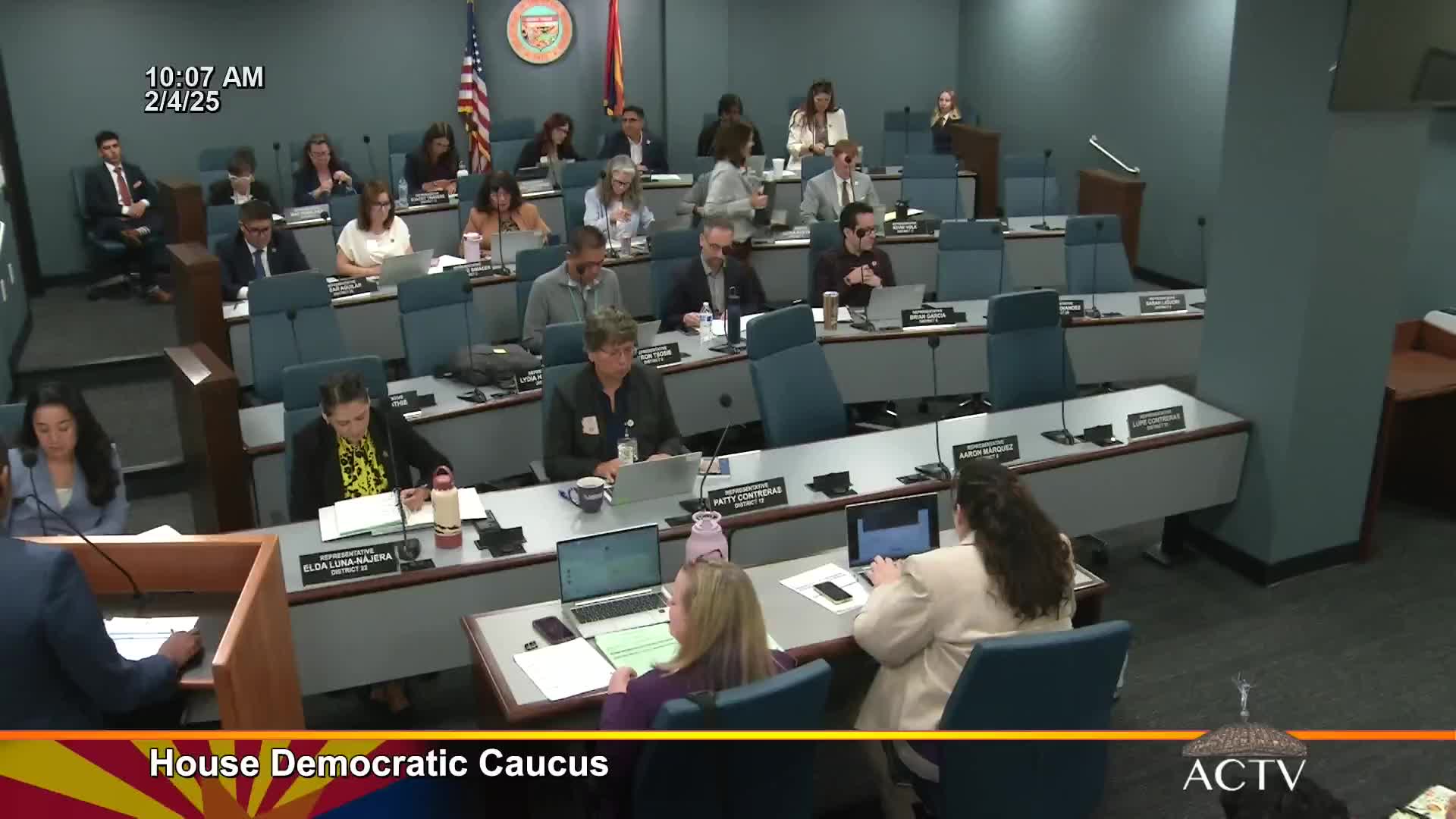
Arizona Democratic caucus debates bill that would bar cities from cutting police operating budgets below prior year levels
Summary
Representative Israel told the caucus House Bill 22‑21 would bar cities and towns from reducing a law‑enforcement agency’s annual operating budget below the previous year’s level except where municipalities lack the funds, while opponents warned the measure is overly prescriptive and could discourage one‑time investments in public safety.
Representative Israel, sponsor of House Bill 22‑21, told the caucus the bill "prohibits a city or town from reducing a law enforcement agency’s annual operating budget below the previous year's amount," while allowing an exception "if they do not have funds required." Representative Israel said the bill also withholds state-shared revenues “until the reduction has been increased to the previous year's amount.”
The bill prompted pushback from members who said it did not account for legitimate local budgeting decisions. Ranking Member Cruz warned caucus members that the proposal “is penalizing local municipalities if they do not keep up with the current funding,” and urged colleagues to speak privately with public‑safety committee members about concerns.
One caucus member, speaking during discussion, described HB 22‑21 as “a very prescriptive measure that only looks at the previous year spending,” and said that focus on a single year creates a “very strong disincentive” to accept one‑time funding infusions for police departments because municipalities may be unable to sustain those higher spending levels in subsequent years. The same member also noted the bill references overall spending rather than sworn‑officer counts, and said that could encourage municipalities to move non‑sworn positions into police budgets rather than expand sworn officer ranks.
Supporters framed the bill as a protection against efforts to “defund the police,” while critics emphasized local budget flexibility and unintended consequences. No formal motion or vote was recorded during the caucus discussion.
Clarifying points raised in the meeting: the bill’s budget floor is measured against the prior fiscal year only (not a multi‑year average); it contains a financial enforcement mechanism tied to state shared revenues; and the exception language applies when a city or town "does not have funds required" to sustain the prior year's level, as the sponsor stated.
The caucus discussion did not settle members’ disagreements. Sponsors said they were available for follow‑up questions; critics asked for additional analysis on how the bill would affect municipal budgeting and the makeup of police department staffing.
Outside the caucus, the bill will follow the normal committee and floor process before any enactment or changes.
Ending: Members asked staff to share additional data and invited committee staff to meet privately with interested lawmakers to discuss municipal budget dynamics and policing‑related spending metrics.