Get AI Briefings, Transcripts & Alerts on Local & National Government Meetings — Forever.
Committee advances bill banning solicitation or congregating on medians, ramps and other unsafe locations
Loading...
Summary
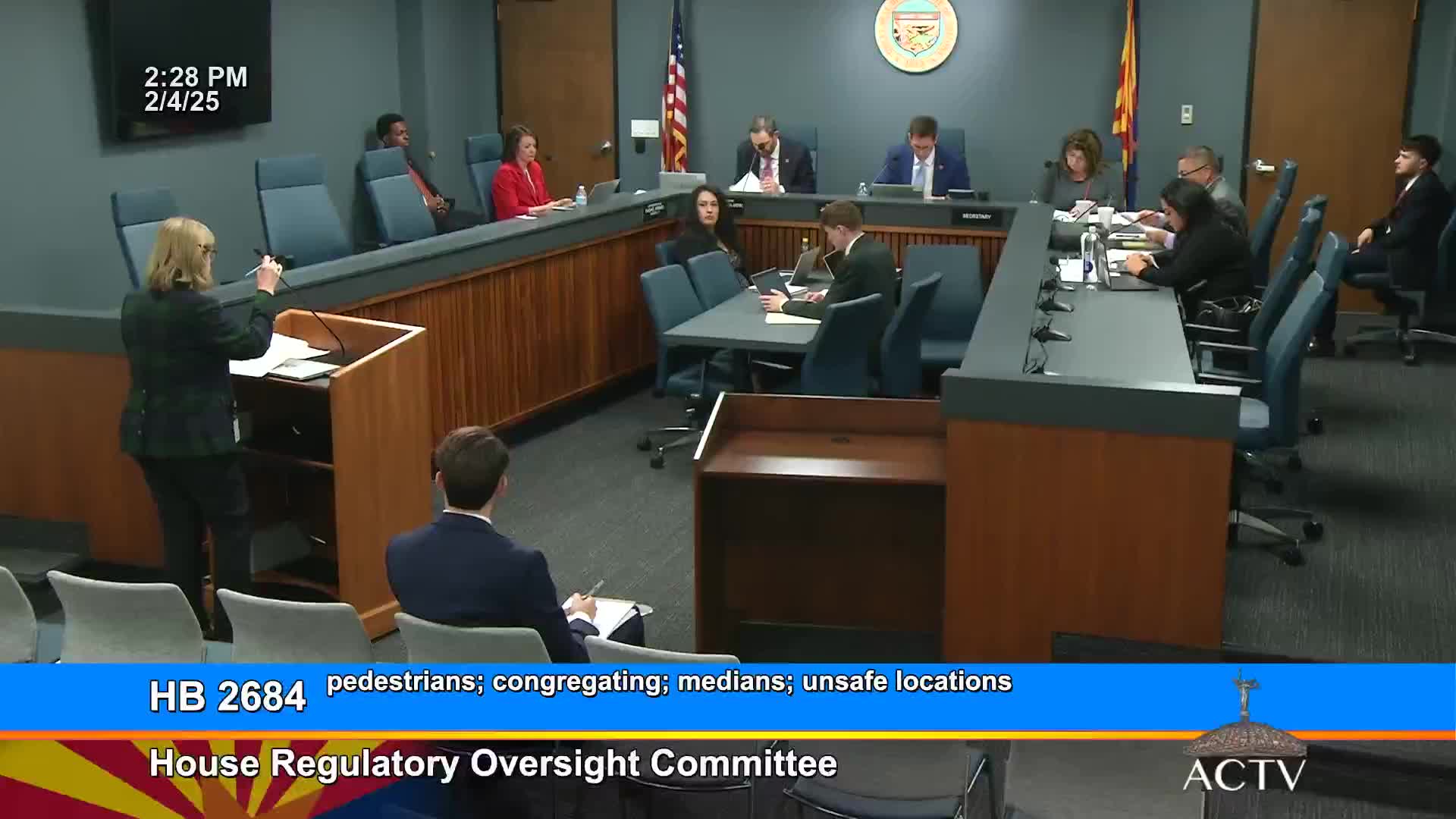
The Arizona House Committee on Regulatory Oversight voted 3-2 to advance House Bill 2684, which would make it unlawful for pedestrians to congregate or solicit on traffic medians, freeway ramps or other locations lacking sidewalks.
The Arizona House Committee on Regulatory Oversight voted 3-2 to advance House Bill 2684, a measure that would prohibit pedestrians from congregating or soliciting on painted or raised traffic islands or medians, on exit or entry ramps of controlled-access highways, or in other locations where there is no sidewalk or safe corridor for pedestrian traffic.
Sponsor Representative Collin, who said the bill was revised after a prior veto by the governor, described the measure as a public-safety effort. Committee staff briefed members that the bill sets graduated penalties: a first offense may receive a warning at officer discretion, a second offense would be a civil traffic violation, and a third offense would be a class 1 misdemeanor punishable by up to six months in jail and a fine of up to $2,500.
Representative Collin framed the bill as targeting unsafe locations — for example, freeway exit ramps, gravel shoulders, or narrow painted medians where pedestrians have no safe place to stand. “You shouldn’t be allowed to stand on the overbridal of a freeway on the exit ramp in traffic,” the sponsor said, adding that he had reduced penalties after the governor vetoed a prior version. He cited national pedestrian-fatality data from the Governor’s Highway Safety Association showing rising pedestrian deaths and Arizona’s elevated rates as context for the proposal.
Opponents, including Natalia Brown of Rural Arizona Action and Gael Esposito speaking for the ACLU of Arizona, told the committee the bill is overbroad and raises First Amendment and equity concerns. Brown said the measure would “criminalize poverty” and disproportionately affect unhoused people and veterans in rural communities that lack shelter capacity. Esposito said courts have treated streets, sidewalks and similar spaces as traditional public forums and cited decisions including McCraw v. City of Oklahoma, Cutting v. City of Portland, Reynolds v. Middleton, Martin v. City of Albuquerque and Frisbie v. Schultz as authorities finding medians and streets to be protected public fora; she argued the bill is a content-based restriction because it singles out solicitation and therefore would face strict judicial scrutiny.
Committee members asked both legal and practical questions. One member asked whether the bill would prohibit standing on a median only momentarily to cross at a crosswalk; staff and the sponsor reiterated that sidewalks and safe corridors remain lawful places for speech and solicitation, and that the bill targets painted or raised medians, ramps and locations without sidewalks. Another member asked staff to confirm whether a parade permit or permitted protest would be unaffected; the chair requested technical review from committee counsel before floor consideration.
The committee returned HB 2684 with a due-pass recommendation by a recorded vote that resulted in three ayes and two nays. The sponsor said he expects the bill to be sent to the governor and hopes for executive approval; opponents said they expect legal challenges if the bill becomes law.