Get Full Government Meeting Transcripts, Videos, & Alerts Forever!
Get email alerts on the Alzheimers Awareness topic
No spam. Unsubscribe anytime.
Senate panel advances $750,000 bill to continue statewide Alzheimer’s awareness campaign
Summary
Senate Bill 12‑10 would appropriate $750,000 to the Department of Health Services to continue an Alzheimer’s public‑education campaign. The Alzheimer’s Association and affected residents described campaign reach and outcomes; committee gave the bill a due‑pass recommendation.
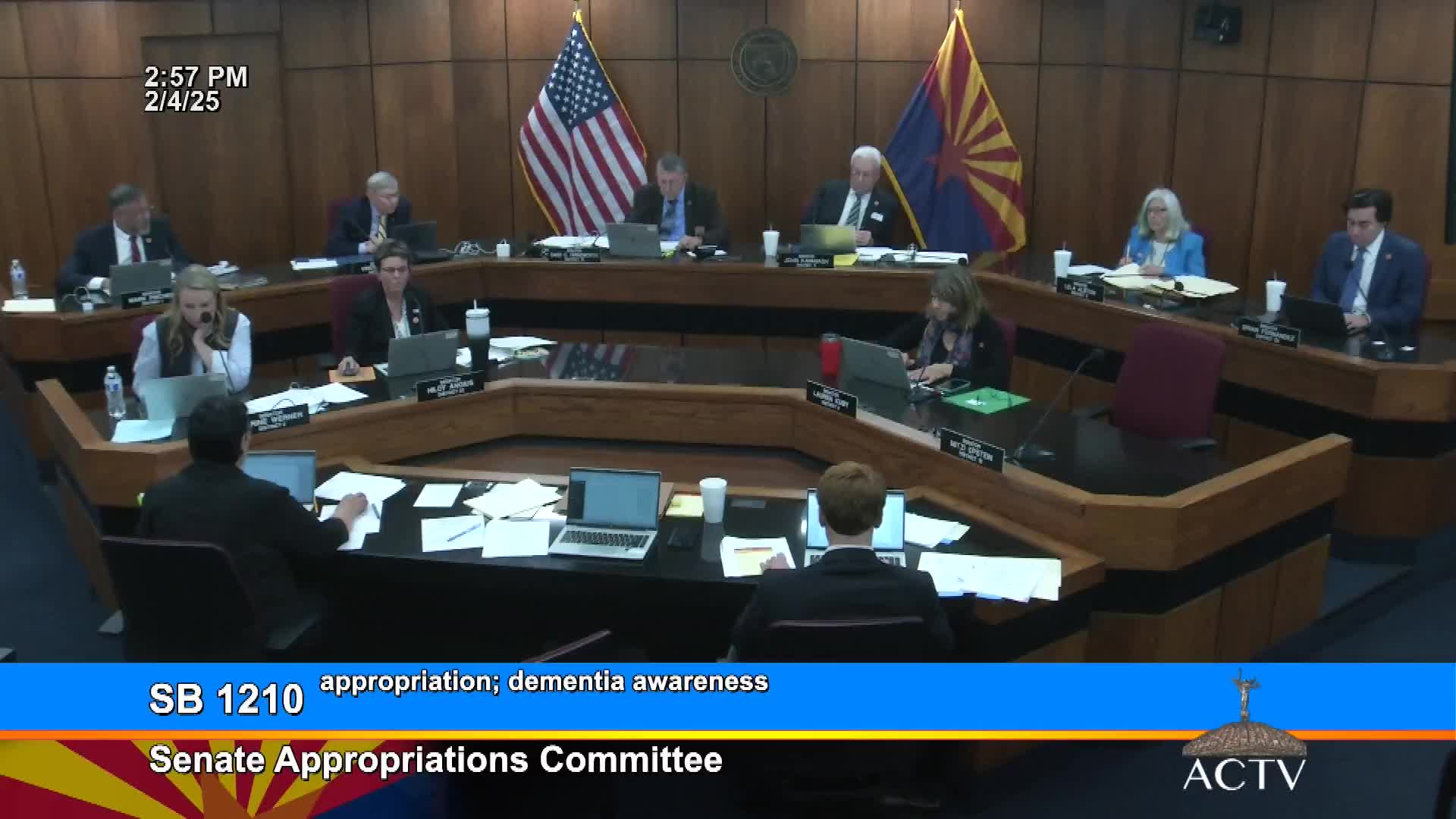
Senate Bill 12 10, which would appropriate $750,000 in fiscal year 2026 to the Arizona Department of Health Services for a public education campaign to raise awareness of Alzheimer’s disease, received a due‑pass recommendation from the Senate Appropriations Committee after testimony from the Alzheimer’s Association and people living with the disease.
Sponsor testimony and witnesses described the program launched in March 2024 and presented interim metrics the campaign reported: a 22% increase in calls to the Alzheimer’s Association 24/7 helpline, a 48% higher attendance rate in education presentations and support groups, and outreach through community partners. Chapter executive Terry Spitz told the committee that the campaign recorded “roughly 50.4 million total impressions” across web, TV, print, radio, streaming and outdoor media and cited 39 million outdoor impressions; the association also reported working with 88 community partners.
Leonard Chaitis, who said he was diagnosed with early‑onset Alzheimer’s, urged continued funding and described obstacles to diagnosis and daily living. Tori Roeberg, Arizona director of government affairs for the Alzheimer’s Association, emphasized that earlier detection and education increase access to treatment, support services and planning options for caregivers.
The committee recorded a 9‑0‑1 vote to recommend the bill pass. The bill’s purpose is awareness and outreach; witnesses said the campaign focuses on rural areas and communities of color that may have less access to messaging and services. No statutory changes were proposed.