Get Full Government Meeting Transcripts, Videos, & Alerts Forever!
Get email alerts on the Rule Ratification topic
No spam. Unsubscribe anytime.
Committee advances ballot referral to let legislature overturn costly agency rules
Summary
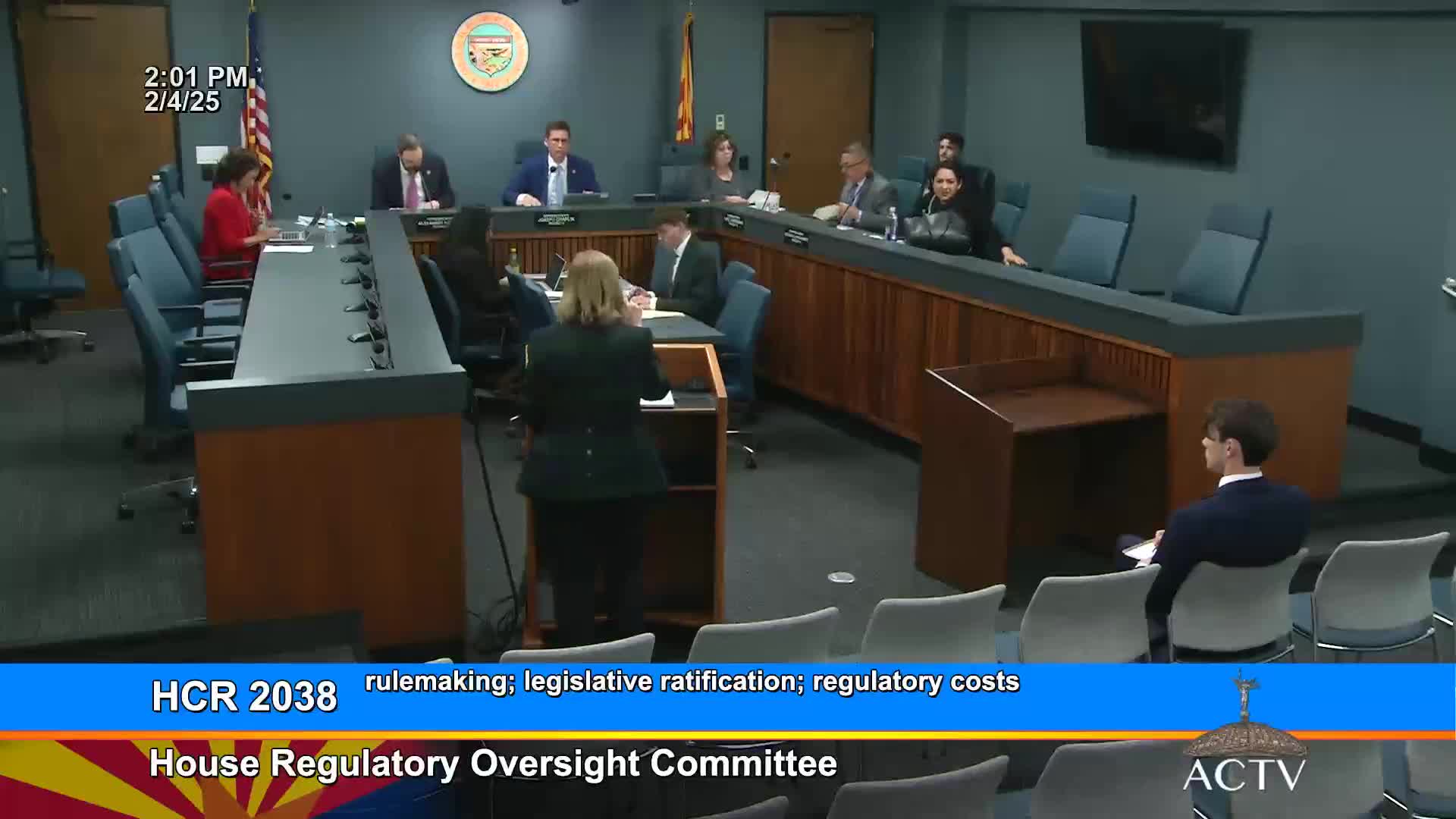
The Arizona House Committee on Regulatory Oversight voted to send House Concurrent Resolution 2038, as amended, out of committee with a due-pass recommendation. The measure would require legislative ratification of agency rules that impose large costs on taxpayers and place a related question on the next general-election ballot.
House Concurrent Resolution 2038, a proposal to let the Legislature revoke administrative rules that impose large costs on taxpayers, was advanced out of the Arizona House Committee on Regulatory Oversight on a 3-2 vote after members adopted a committee amendment.
The measure, sponsored by Representative Collin, would direct the Office of Economic Opportunity (OEO) to assess whether a proposed administrative rule would increase regulatory costs by more than $500,000 over five years; if so, the rule could not take effect unless the Legislature ratified it. The resolution also authorizes the Legislature, by concurrent resolution, to eliminate any rule it finds will cost taxpayers more than $1,000,000 annually and contains a separability clause and direction to the Secretary of State to submit the proposition to voters at the next general election.
The Culloden committee amendment removed the bill’s first section and was offered to streamline language; Representative Collin told the committee the prior ballot referral in 2024 failed in part because its text was “written for lawyers” and confused many voters. “When in doubt, when confused, vote no,” Collin said, arguing the rewritten language is shorter and clearer.
Matt Furidi, who identified himself as representing the Opportunity Solutions Project, testified in favor of both the bill and the Culloden amendment. Furidi said the resolution would allow the Legislature to act on “costly regulations after they’re in effect” and gave the example of a Department of Agriculture rule requiring large egg producers to convert to cage-free operations as the sort of regulation that could exceed a $1,000,000 impact threshold.
Opponents on the committee pressed a separate point: several members said voters had already considered a similar referral in 2024 and that returning the question to the ballot — even with clarified language — raises questions about when the Legislature should override prior voter referrals. Representative Contreras argued the prior referral had been to the voters and cautioned about changing voters’ decisions. Representative Collin responded that the prior referral’s failure by a narrow margin suggested confusing language, not lack of public support for the underlying concept.
The committee recorded roll call on the final motion to return the resolution with a due-pass recommendation. The roll call shows Representative Contreras voted Nay and Representative Hernandez voted Nay; Representatives Kessel, Vice Chairman Culloden and Chairman Chaplec voted Aye. The committee report to the full House will reflect HCR 2038 as amended and recommended for a due pass.
The amendment adoption and the committee’s due-pass recommendation are procedural steps that send the referral onward; the resolution itself would still require additional legislative steps and, if passed, voter approval to become functionally operative.