Get Full Government Meeting Transcripts, Videos, & Alerts Forever!
Get email alerts on the Committee Actions topic
No spam. Unsubscribe anytime.
Senate Government Committee advances audits expansion, DEI ban, recycling and election rules; approves constitutional tax threshold referral
Summary
The Arizona Senate Committee on Government voted Feb. 4 to recommend passage of several measures expanding audit authority, limiting use of diversity, equity and inclusion programs in state hiring, tightening municipal recycling guidance, changing public-comment timing rules and authorizing private suits over alleged electioneering with public resources.
The Senate Committee on Government met Feb. 4 and voted to advance multiple bills and a constitutional referral affecting audits, state hiring practices, local recycling requirements, public-comment rules and who may sue over the use of public resources in elections. The committee recommended passage of bills including SB 13-23 (authorizing performance audits by the Office of the Auditor General), SB 13-40 (adding the Department of Law to regular JLAC review), SB 12-56 (prohibiting use of diversity, equity and inclusion programs for state hiring/training/promotion), SB 13-13 (restrictions on municipal recycling recommendations), SB 10-36 (private right of action for alleged misuse of public resources to influence elections), SB 12-43 (open-call timing for public comment) and a constitutional referral SCR 1008 (requiring a two-thirds vote to increase certain municipal or county assessments, taxes or fees).
Why it matters: The package touches several oversight and accountability tools at the state and local level. Sponsors said changes will increase transparency and curb waste or politicized use of public resources; opponents said some measures would politicize oversight, preempt local control, or invite costly litigation.
Most consequential was debate over SB 13-23, the bill that allows the Auditor General, at the request of the Joint Legislative Audit Committee (JLAC), to perform performance audits of agencies and political subdivisions that receive taxpayer money. Sponsor Senator Finchem told the panel the change would let auditors “go on the inside” so they could check not only whether funds were spent but whether they were used for their intended purposes; he cited an embezzlement case in Santa Cruz County and said performance audits could provide earlier detection. Committee discussion focused on the risk that JLAC nominations for audits might be politicized, on the Auditor General’s current staffing and whether additional appropriation or outside contractors would be needed, and on how JLAC would screen nominations so audits are not pursued “willy-nilly.” Senator Finchem said nominations would go through JLAC and that the committee — not a single official — would authorize audits.
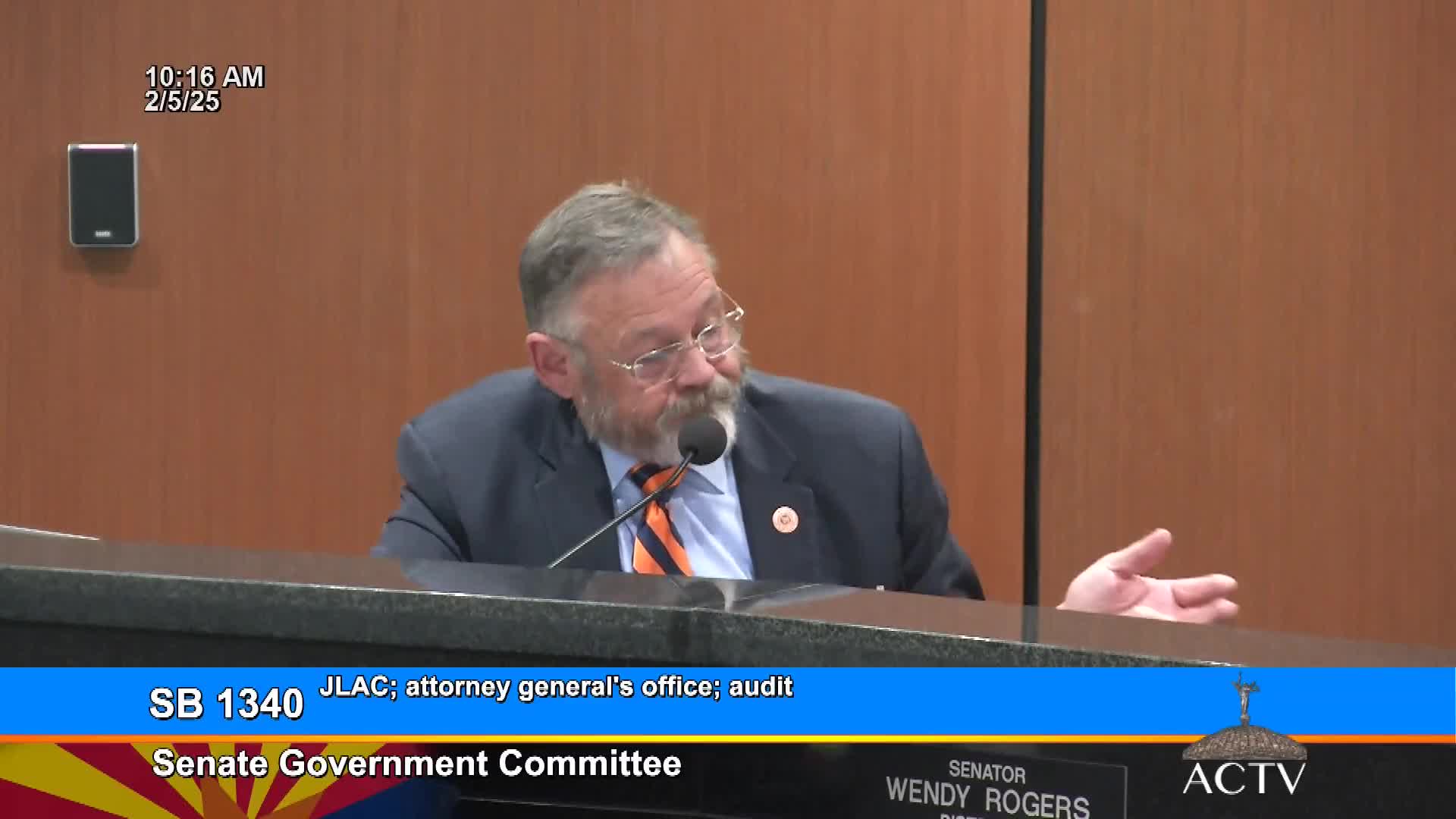
SB 13-40 requires a review of the Department of Law (the Attorney General’s office and the Department of Law operations) at least every 10 years, with a first review due by July 1, 2027. Sponsors described the item as a “cleanup” bill to add the department to the set of auditable entities; committee members questioned whether the language should more clearly state that the Auditor General — not JLAC itself — conducts audits and asked whether the timing would mean the current officeholder would be reviewed. Supporters said the review would examine operations and fiscal stewardship, not litigation strategy or privileged litigation documents.
On SB 12-56, the committee advanced a prohibition on requiring participation in diversity, equity and inclusion (DEI) programs for hiring, training or promotion in state agencies and forbidding contract participation conditions tied to DEI. The bill also tasks the Arizona Department of Administration with monitoring state hiring for compliance. Supporters (including a read statement from State Treasurer Kimberly Yee) framed the change as defending merit-based hiring; opponents warned the bill’s language could unintentionally bar some mandated or post-incident trainings (for example, harassment response or other personnel trainings) and said the language was too broad.
SB 13-13 would bar a city, county or other political subdivision from recommending or requiring that residents place a product in a recycling bin unless the product is being “actively recycled” (defined in the bill as reprocessed into a new product). Sponsors said the municipal recycling system currently results in large volumes of materials shipped abroad, burned or landfilled and that limiting recommendations to materials that are demonstrably reprocessed would reduce environmental harm and curb costly virtue-signaling programs. Opponents said the bill could freeze current recycling lists and hamper local innovation and education campaigns unless the bill’s language is clarified; chair and sponsor stated the bill does not prevent adopting new technologies and that municipalities may update their lists when markets or reprocessing capability change.
SB 10-36 (as amended) creates a private right of action allowing a resident to sue in superior court if a city, town, county or school district uses public resources to influence an election in violation of existing law. Supporters said existing enforcement through county attorneys or the attorney general has been insufficient and time sensitive violations can escape enforcement; opponents warned the change would invite frivolous and repetitive litigation and increase costs for local governments carrying out routine public education about ballot measures. The committee adopted an 8-page amendment clarifying jurisdictional language and closing some previous drafting gaps, and then voted to advance the bill as amended.
SB 12-43 requires that if a public body offers an “open call to the public,” that open call be made at the beginning of a meeting before official business and that the body accept requests to speak until the call ends; if an open call exceeds 30 minutes the body may resume it later in the meeting. The bill also specifies that a prayer, pledge or recognition of a person or organization is not “official business” for the purposes of the open call requirement.
The committee also recommended passage of SCR 1008, a constitutional referral that would, if approved by voters, statutorily prohibit a municipal council or county board of supervisors from increasing an assessment, tax or fee without a two-thirds vote. Supporters said the change protects taxpayers and ensures a higher consensus for tax increases; opponents — including the League of Arizona Cities and Towns and the County Supervisors Association — said it would shift authority away from local voters and local elected officials, impose a supermajority constraint that would make raising revenue for essential local services harder, and could compound revenue shortfalls cities already face.
Votes at a glance: SB 13-23 — due pass recommendation (committee vote: 4 ayes, 3 nays). SB 13-40 — due pass recommendation (4 ayes, 3 nays). SB 12-56 — due pass recommendation (4 ayes, 3 nays). SB 13-13 — due pass recommendation (4 ayes, 3 nays). SB 10-36 (as amended) — due pass recommendation (4 ayes, 3 nays). SB 12-43 — due pass recommendation (4 ayes, 3 nays). SCR 1008 (as amended) — due pass recommendation (4 ayes, 3 nays).
Committee members and witnesses noted follow-ups and clarifications needed: staff and sponsors said bills may need drafting tweaks (for example clarifying that JLAC authorizes audits carried out by the Auditor General, and clarifying whether SB 13-13’s “actively recycled” language is read to lock in current lists or to allow updates as markets change). Sponsors acknowledged potential resource needs for the Auditor General’s office to perform performance audits and suggested outside contractors or additional appropriations might be required.
The committee’s recommendations were procedural steps (committee-level due pass recommendations) that send the measures forward in the legislative process. Further floor debate, committee fixes, fiscal notes and potential amendments remain possible as bills continue through the legislature.