Get Full Government Meeting Transcripts, Videos, & Alerts Forever!
Get email alerts on the Gender Definitions Legislation topic
No spam. Unsubscribe anytime.
Arizona House advances bill to define 'male' and 'female' in state law after heated floor debate
Summary
The Arizona House moved House Bill 2062 forward after a long floor discussion about definitions of sex and gender. Sponsors said the bill clarifies statutory language and data collection; opponents said it would harm transgender and nonbinary Arizonans. A division vote in the chamber recorded 33 ayes and 25 nays on the committee recommendation.
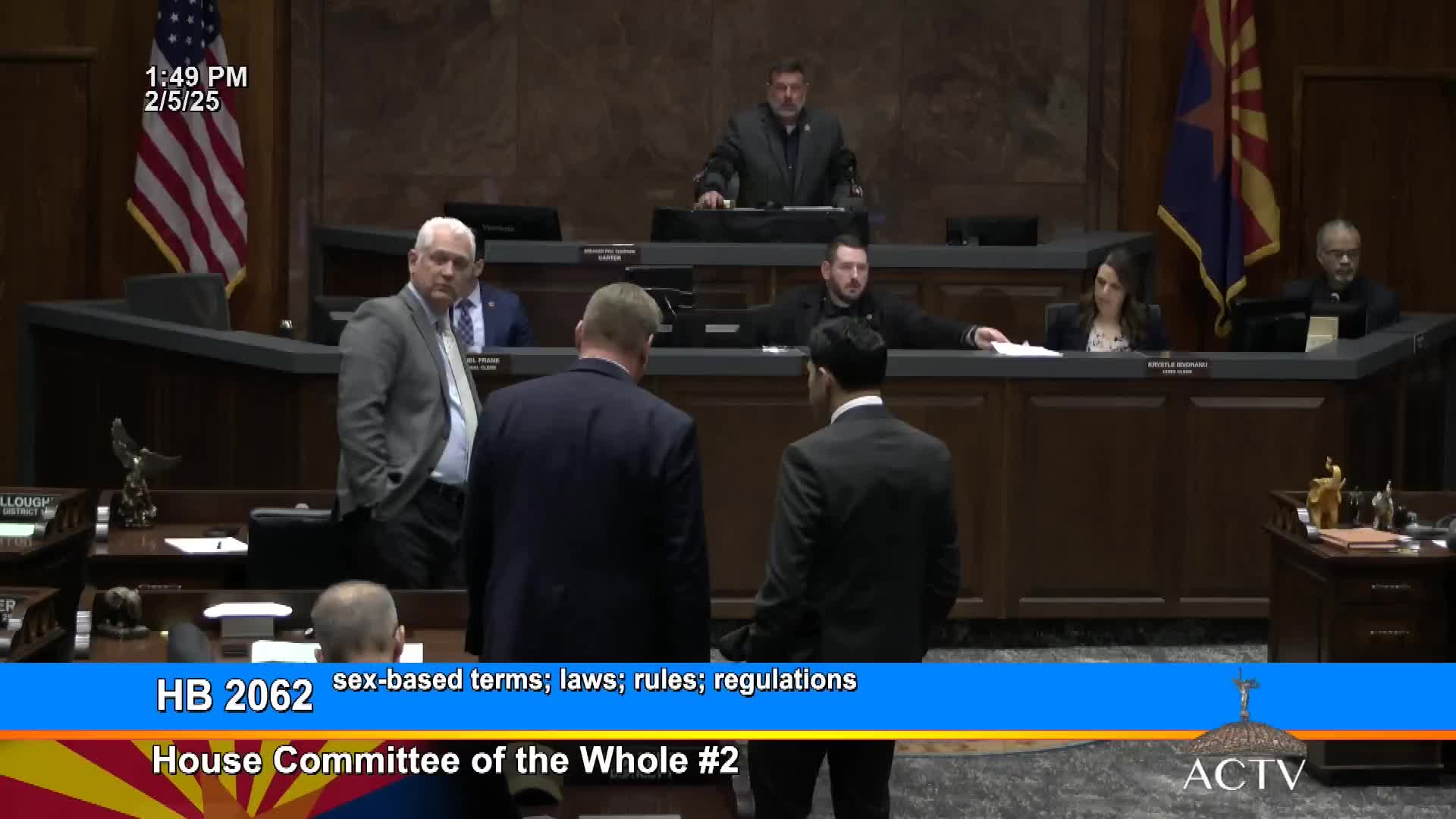
The Arizona House of Representatives on Wednesday advanced House Bill 2062, which would clarify the statutory meaning of terms such as “male,” “female,” “man” and “woman,” after roughly 25 minutes of floor debate and a division vote that the clerk recorded as 33 ayes and 25 nays.
Supporters, led by the bill sponsor, said the measure is intended to align public records and government-collected data with biological sex and to protect single-sex spaces. Representative Fink (House sponsor) said the measure is “just clarifying and reinstating what those statutes mean in regards to men, women, male, female,” and that it “does not create any new restrictions on the transgender community, nor does it prevent agencies from collecting data on gender identity in addition to data on biological sex.”
Opponents described the bill as harmful to transgender, intersex and nonbinary people and urged colleagues to vote no. Representative Patty Contreras said emotional remarks on the floor: "As a member of the LGBTQIA community ... I must speak out against HB 2062." She added that bills of this type “force us into the shadows” and tied such measures to threats faced by transgender Arizonans. Representative de los Santos called the bill “offensive” and “harmful,” warning that it could gum up the legal system and tie the hands of the people the Legislature serves.
The debate covered three broad points: (1) definitions and the legal need for objective statutory language, as described by supporters; (2) the bill’s potential effects on the daily lives and legal protections of transgender and nonbinary people, as argued by opponents; and (3) assurances from the sponsor that the bill would not prohibit agencies from collecting gender-identity data in addition to biological-sex data.
Floor procedure included adoption of a committee amendment earlier in the Committee of the Whole to unify language on voting places and other technical changes, and then the sponsor’s motion that HB 2062 as amended receive a “do pass” recommendation. After members called for a division vote on the committee recommendation for HB 2062, the clerk counted 33 ayes and 25 nays. Later, Representative Patty Contreras moved to amend the committee report to show that HB 2062 failed to receive a due-pass recommendation; that substitute motion failed on a roll call vote (25 ayes, 31 nays). The House then adopted the Committee of the Whole report and referred the bill to engrossing.
Clarifying comments from the floor included the sponsor’s statement that the bill is limited to defining statutory terms and will not limit an individual’s ability to identify or seek private accommodations, and questions from members asking whether the bill would affect intersex Arizonans and whether it infringes on self-determination. Representative Fink answered that protections for intersex people already exist in Arizona statutes and reiterated that the bill “is just clarifying and reinstating what those statutes mean.”
The bill drew sustained public-floor attention and a number of lawmakers from both parties spoke on constitutional, legal and moral grounds. While supporters cited public-health, civil-rights enforcement and data-integrity reasons for the change, opponents said the effect would be to erase and stigmatize a vulnerable population.
Next steps: Because the House adopted the Committee of the Whole report, HB 2062 as amended was referred to engrossing for further processing by the House journal and final steps before it proceeds to the Senate or other procedural stages of the legislative process.