Get email alerts on the Committee Votes Roundup topic
No spam. Unsubscribe anytime.
Judiciary and Elections Committee advances bills on hunting ranges, voting rules and child-protection measures
Summary
The Arizona Senate Judiciary and Elections Committee on Jan. 29, 2025, advanced a package of bills affecting hunting near homes, early‑voting timelines, ballot tracking and child‑protection law, approving several measures with amendments and directing sponsors to refine technical language with affected agencies.
The Arizona Senate Judiciary and Elections Committee on Jan. 29, 2025, voted to give due-pass recommendations or pass a range of bills affecting hunting rules, voting operations and child-protection law.
Why it matters: The measures would change how Arizonans may hunt near occupied structures, shorten the early-ballot mailing window for some elections, require new public accountability on ballots and voting records, alter jury-service options tied to election work, and create a narrow civil-liability exception intended to make it easier for families of certain child victims to seek damages.
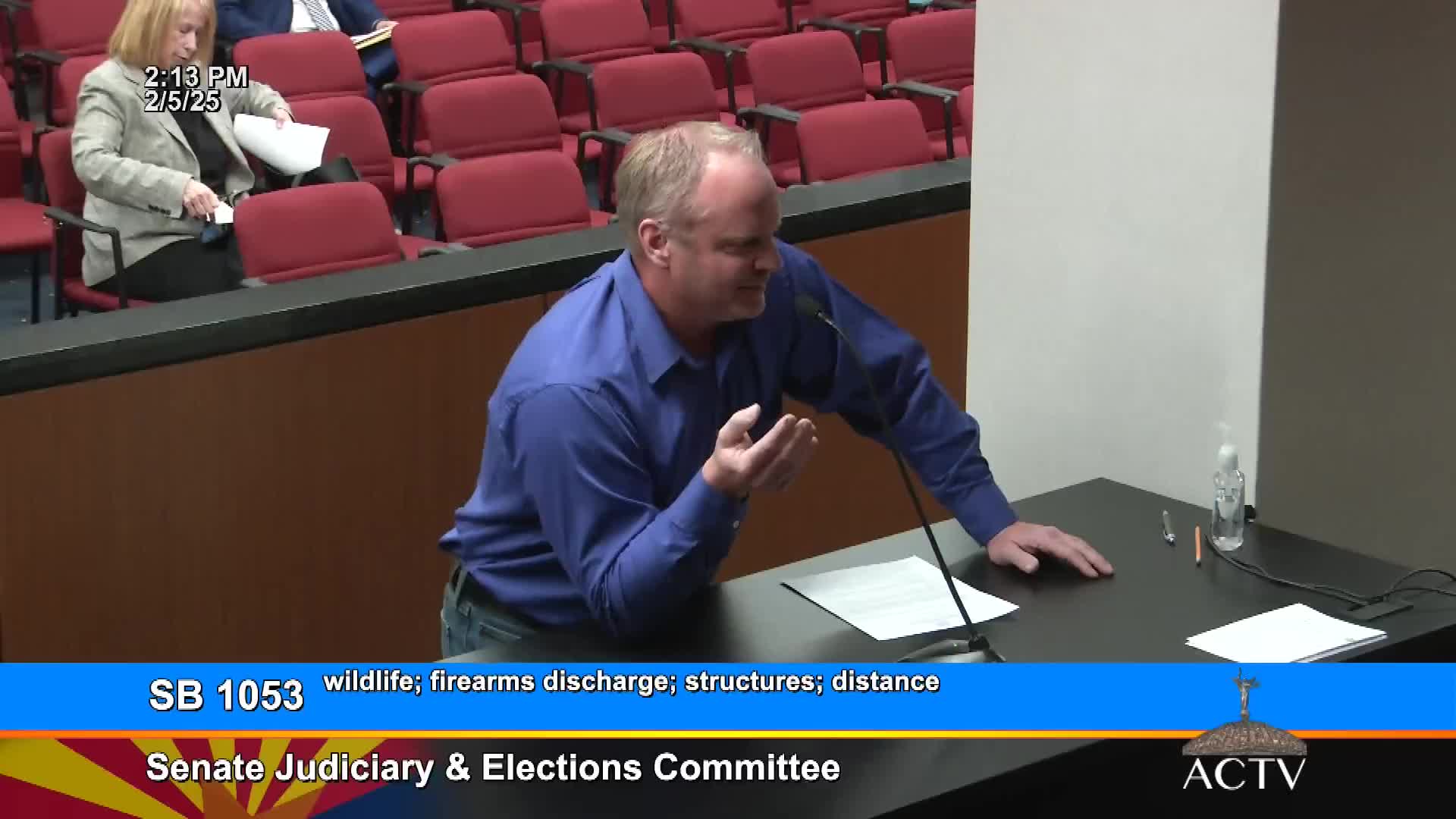
SB1053 — hunting and firearm discharge: Staff described Senate Bill 1053 as narrowing the expanded protection for small-game hunting by allowing the discharge of a shotgun loaded with bird or game shot or a device that fires an arrow within one-eighth mile (about 220 yards) — rather than the current quarter mile (about 440 yards) — of an occupied farmhouse, residence, cabin or similar structure while taking small game. The bill preserves the quarter-mile restriction for rifles and shotguns loaded with buckshot or slug shells while taking big game and would remove a county’s authority to adopt a stricter local ordinance within that quarter-mile radius.
Jeff Orovitz, the bill originator from Flagstaff, told the committee he framed the bill around opening hunting access that has been lost as development encroaches, saying, "my family has been hunting for a very long time." He described his research comparing other Western states and said many set limits around 150 yards or thereabouts. Testimony and committee questions focused on ballistics and unintended consequences: some senators warned the statutory rewrite as drafted may have removed prohibitions on discharge of high‑powered rifle rounds near residences. Ed Sanchez, legislative liaison for Arizona Game and Fish, said the department needed to work with the sponsor on clearer drafting. Michael Infanzon, a private testifier, gave ballistics ranges from his experience — "birdshot is typically 35 to 50 yards; slugs about 150 yards" — and asked the committee to clarify how landowner consent would be verified.
Outcome: The committee gave SB1053 a due‑pass recommendation (4 ayes, 2 noes, 1 not voting). Committee members and staff agreed to pursue drafting clarifications and a possible amendment to limit the change to shotguns used for bird hunting and to explicitly preserve other firearm restrictions where intended.
SB1063 — jury summons and election worker option: Senate Bill 1063, amended in committee, would let a qualified juror summoned within a designated pre‑election window opt to serve as a temporary election worker for the 30 days immediately before a general election and until final ballot counts are complete. The sponsor’s amendment set timing windows for when jurors can be offered that option, required the jury commissioner to submit contact information no later than 90 days before the election and gave county party chairpersons 10 days to strike prospective workers from the list. The amendment also allowed electronic training for appointed workers.
Supporters, including sponsor Senator Finchem, said the change would broaden the pool of available poll workers; Jen Morrison of the Arizona Association of Counties said her organization supported the concept but asked for drafting changes so county clerks retain operational control (for example, appointment of clerks rather than judges as poll managers) and to avoid mandating a one‑size‑fits‑all implementation. Committee discussion focused on balancing county flexibility, party involvement and operational details such as when a juror’s civic duty would be considered fulfilled.
Outcome: As amended, SB1063 received a due‑pass recommendation (4 ayes, 3 noes).
SB1152 — early ballot mailing window: Senate Bill 1152 would reduce the number of days before an election when early ballots may be mailed from 27 to 21 days. Student and rural advocates spoke in opposition. Milagros Eredia of the Arizona Students Association told the committee, "First‑time voters, especially students, need time to research candidates and ballot measures," and urged a no vote. Testimony from rural advocates and county elections officials described delivery delays in remote areas — including examples where ballots route through other states or major hubs — and warned a shorter mailing window could disproportionately affect rural voters and voters who rely on mail delivery.
Jen Morrison of the Association of Counties said the bill was premature given other, concurrent changes to early‑ballot processing and urged caution.
Outcome: The committee gave SB1152 a due‑pass recommendation (4 ayes, 3 noes). Several senators said they would seek floor amendments to address rural mail‑service concerns.
SB1271 — ballot numbering and tracking: Staff explained SB1271 would require individually numbered ballots and batch tracking, a public master log for pre‑numbered batches, and a reporting requirement for county recorders on ballot counts and categories. The bill includes a transfer of $6,000,000 from a prior state treasurer appropriation to the Secretary of State to defray implementation costs for FY 2026. Committee members asked technical questions about definitions and implementation; the sponsor said it carried over language from prior years. The committee did not take final floor action on the bill at the meeting (discussion continued and a vote was delayed for further drafting).
SB1280 — cast‑vote records and prompt posting: Senate Bill 1280 would require county recorders to make certain election records public within one hour after polls close, including a cast‑vote record and the name, voter identification number and party registration (if applicable) of each person who voted in the election, and would prohibit randomizing or altering original record files.
Sponsor and supporters described the bill as a transparency measure. County officials and elections staff testified that current processes — signature cures, provisional ballots and post‑election processing — mean the full universe of counted ballots is not finalized immediately, and that a statutory definition of "cast‑vote record" is needed because not all ballot‑count systems produce the same electronic artifact. Jen Morrison told the panel, "Within an hour in our current election system, if the goal is to have the right number, you will not have the right number because Arizona has a cure period and Arizona is still processing ballots after election day." The discussion centered on operational feasibility, how to define the record, and whether posting an early "received ballots" universe (distinct from the final certified canvas) could meet the sponsor’s transparency goal while avoiding misinterpretation.
Outcome: SB1280, as amended in committee language to address some concerns, received a due‑pass recommendation (4 ayes, 3 noes). Sponsors and county officials agreed to continue technical conversations and propose implementing language on the definition and timing.
SB1106 — "Ava’s Law" (civil liability exception for certain sexual offenses against minors or persons with disabilities): Sponsor Senator Miranda described SB1106 as a narrow change to the governmental‑immunity statute intended to remove immunity when a public employee commits a sexual offense against a minor or a person with a disability and the public entity failed to perform statutorily required background checks or failed to report. The committee considered a sunset amendment making the change prospective and subject to a two‑year review.
Gretchen Jacobs, Ava’s mother, and other family advocates and clinicians testified in support. Jacobs described the bill as "a carefully crafted solution to narrowly close a loophole in our state's governmental immunity laws that was never contemplated, let alone intended." The Arizona Judicial Council and county representatives testified they were neutral on policy but requested appropriations for court implementation and noted historical pilot data showed jury outcomes were similar to judicial outcomes on related matters; the council asked for funding to cover juror mileage, staffing and facilities if new jury duties expand.
Outcome: The committee passed SB1106 as amended (7 ayes, 0 noes). The amendment creates a two‑year sunset so the Legislature can review early implementation.
SB1199 — jury trials in parental‑rights termination proceedings: SB1199 would permit a parent to request a jury trial in a hearing to terminate parental rights; the bill includes reporting requirements and a court data study. The Administrative Office of the Courts and county groups remained neutral but emphasized the need for funding. The committee discussed a historical pilot in which juries terminated parental rights at about the same rate as judges; courts warned jury trials add substantial cost and logistical complexity.
Outcome: SB1199 received a due‑pass recommendation (4 ayes, 3 noes). Committee members asked the sponsor to work with the courts on fiscal details.
SB1244 — abduction of a child from state custody: Senate Bill 1244 narrows the class of persons whose taking of a child from a state agency is treated as a felony; the amendment restored adoptive parents to the protected class and left the offense as a misdemeanor for adults with a biological family relationship in some circumstances. Department of Child Safety (DCS) staff testified they were concerned the bill’s language as written could be too broad if it reaches distant relatives who do not have an established caretaking role; the sponsor said he would continue stakeholder conversations to refine the family‑relationship language.
Outcome: As amended, SB1244 received a due‑pass recommendation (4 ayes, 3 noes).
SB1295 — criminal impersonation and synthetic media: The bill makes it unlawful to use a computer‑generated voice recording, image or video of another person with intent to defraud or harass; the committee adopted an amendment preserving existing felony penalties for other impersonation crimes while criminalizing malicious use of synthetic media. Sponsor discussion cited cases in which fraudsters used voice reconstructions to extort family members. The committee considered intent and first‑amendment carve‑outs for parody, criticism and clearly non‑fraudulent uses.
Outcome: SB1295, as amended, received a due‑pass recommendation (4 ayes, 3 noes).
Other bills with committee action: SB1035 (county authority to set higher hourly compensation for appointed capital post‑conviction counsel) and other technically focused measures also received due‑pass recommendations; the committee recorded several 7–0 votes on narrower bills.
What's next: Several sponsors agreed to work with county elections officials, the Arizona Judicial Council and agencies to refine technical language — on ballistics and consent verification for hunting, on definitions and timing for election records, and on family‑relationship scope for child‑custody abduction language — prior to floor votes. Funding questions (court costs, ballot‑tracking systems) were repeatedly raised; committee members signaled intentions to seek clarifying floor amendments before final adoption.
Ending: The committee closed after taking the recorded votes listed below and agreed to continue stakeholder talks on several items before floor consideration.