Get Full Government Meeting Transcripts, Videos, & Alerts Forever!
Get email alerts on the Missing Indigenous Person Alerts topic
No spam. Unsubscribe anytime.
Arizona committee advances bill to create Missing Indigenous Persons alert system
Summary
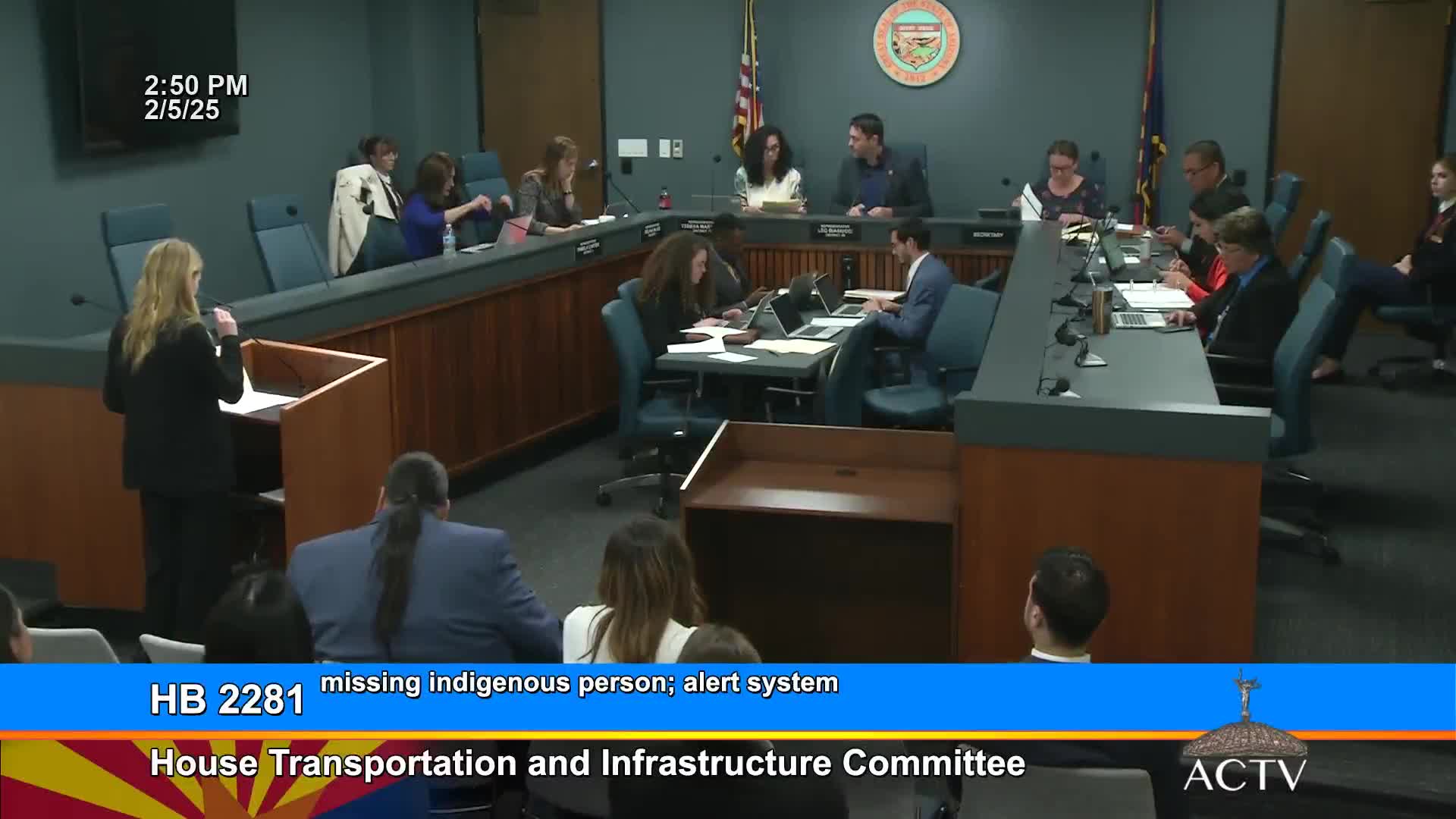
The House Committee on Transportation Infrastructure gave House Bill 2281 a due-pass recommendation to add missing indigenous persons to the state's vulnerable-population alert definitions and authorize the Department of Public Safety to issue alerts when criteria are met.
House Bill 2281, which would add indigenous people to the state's definitions of vulnerable persons and authorize the Arizona Department of Public Safety (DPS) to issue a Missing Indigenous Person alert, received a due-pass recommendation from the Committee on Transportation Infrastructure after public and tribal testimony.
The bill, carried in committee by State Representative Teresa Martinez of Legislative District 16, directs DPS to activate the federally authorized emergency alert system for a missing indigenous person when the investigating law-enforcement agency has used all available local resources, determined the disappearance occurred under unexplained or suspicious circumstances, and believes the person is in danger or in the company of a potentially dangerous person — and when there is information that "if disseminated to the public, could assist in the safe recovery of the missing indigenous person." Representative Martinez described the measure as a narrow change to the vulnerable-person definition so that tribal members may be included in statewide alerts.
The bill drew testimony from tribal leaders. Steven Roe Lewis, governor of the Gila River Indian Community, told the committee the proposal is modeled on the AMBER Alert system and said the alert could improve chances of recovery when tribal members leave reservation lands and cases become "more complicated and more difficult." He said his community's victim-services department had found early notifications helpful on reservation lands and urged a coordinated, multi-jurisdictional response when members go missing off reservation.
Representative Martinez framed the bill as addressing delays caused by jurisdictional confusion between tribal, state and federal agencies. She said, "Because of this confusion, we lose valuable time, and every second we waste further separates us from our loved ones." She added the change "only helps the definition of vulnerable people to include tribal indigenous people."
Committee members asked whether other states have similar alerts and how activation would work in practice; Megan Delartino, representing the Gila River Indian Community, told the panel that four other states have included indigenous people in vulnerable-population alerts. Martinez and members said they plan to work with DPS on operational details.
Formal action: a committee member moved that House Bill 2281 be returned with a due-pass recommendation; the committee recorded a vote in favor. The secretary reported the motion passed by a committee tally of 7 ayes, 0 nays, 0 not voting, 0 absent.
Why it matters: Advocates and tribal leaders told the committee that Native American and indigenous populations are reported missing or victimized at rates higher than the general U.S. population and that a state-level alert could overcome time lost to jurisdictional uncertainty and coordination delays. The bill does not change tribal jurisdiction or federal responsibilities; it adds a mechanism for the state to use its emergency-alert authority when criteria described in the bill are met.
Next steps: The committee gave HB 2281 a due-pass recommendation; the bill will move to the next stage of legislative consideration.