Get Full Government Meeting Transcripts, Videos, & Alerts Forever!
Get email alerts on the State Employee Pay topic
No spam. Unsubscribe anytime.
State employees targeted for grouped raises in governor’s FY26 budget; lawmakers press JLBC and ADOA on details
Summary
JLBC and ADOA briefed the House Appropriations Committee on the governor’s FY26 employee pay proposals—targeted and systemwide increases that include a proposed $17 minimum hourly rate and targeted raises for correctional officers, firefighters and customer‑facing staff.
(Note: The following article covers the JLBC/ADOA presentation and committee questioning on state employee salary proposals.)
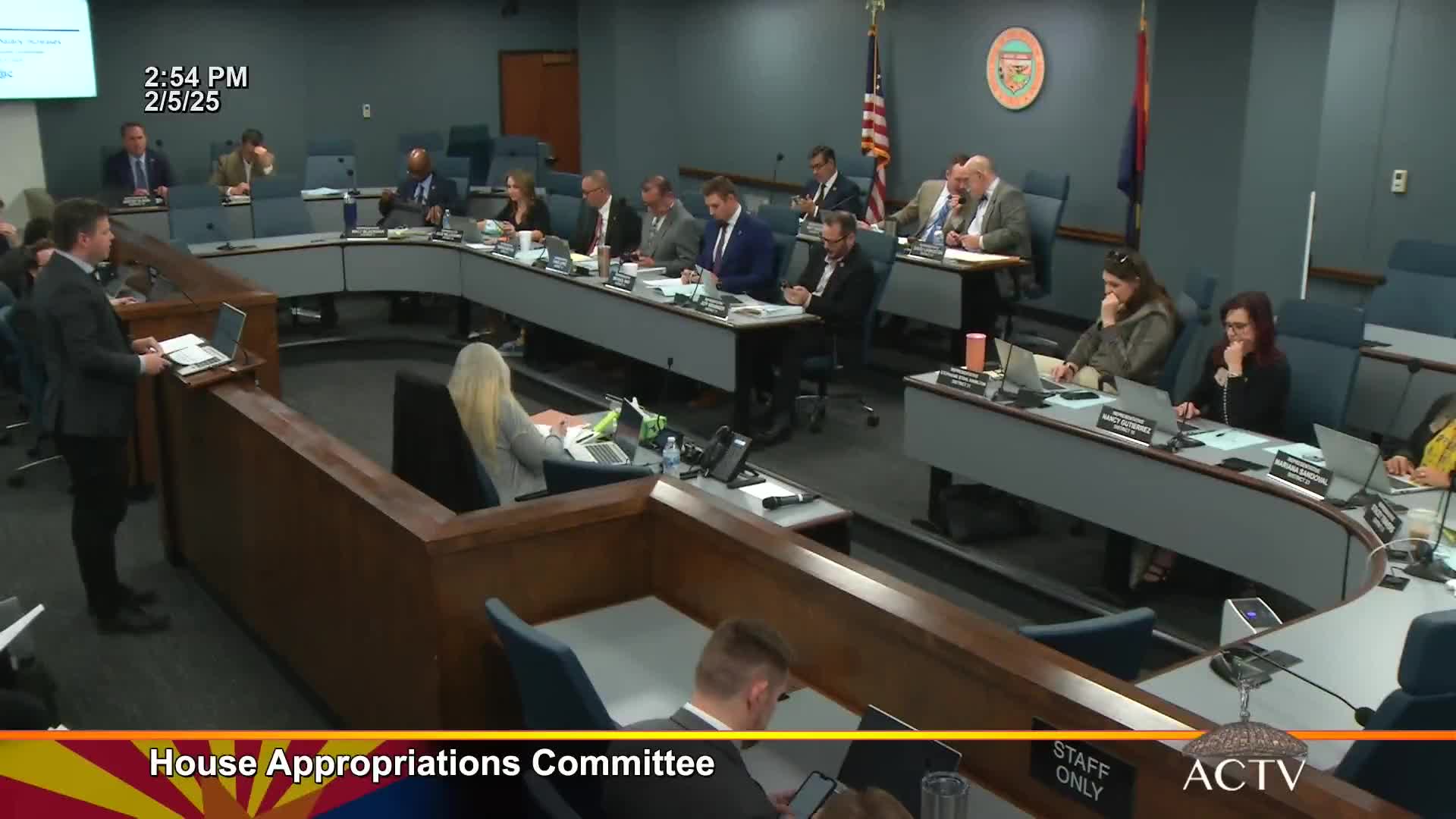
The House Appropriations Committee heard Feb. 5 presentations from JLBC staff and the Arizona Department of Administration on the governor’s FY26 employee pay proposal, which combines targeted increases for selected job classes with a set of broader, smaller raises across agencies.
Jeff Paulson of JLBC summarized the governor’s proposal as a package divided into 10 categories, including a 5% public-safety pay adjustment for correctional officers, a 5% law enforcement certification adjustment, a 15% firefighter increase for limited state firefighter positions, 10% increases for customer-service roles, and a proposed statewide minimum hourly salary of $17 for state employees. Paulson said the ADC adjustment for correctional officers would increase the average frontline officer’s base salary by about $2,100 under the proposal, and that the governor’s general fund cost for the ADC correctional officer portion is roughly $21.2 million.
Paulson and ADOA Chief Financial Officer Jacob Wingate described how some categories are funded differently across funds and agencies: the executive’s calculations used human resources fund-source codes in the state HR system as a starting point, and JLBC warned it would follow up to check whether the executive’s fund-sourcing assumptions under- or over-state federal shares for agencies such as DCS, DES and ACCESS. "We would recommend the Executive provide more details on how they determine their fund sourcing," Paulson told the committee.
Committee members asked several follow-up questions the presenters could not fully answer on the spot, including: which specific job codes are included in the “customer service” category; how private prison per-diems would have to be adjusted to reflect a 5% correctional-officer increase (Paulson provided a rough estimate of about $4.1 million for the private vendors); and whether vacancy savings intended to fund pay increases for vacant positions would instead be used for overtime. Paulson said roughly $3 million of the governor’s $5.7 million vacant-position funding is directed at ADC corrections officer vacancies and that agencies commonly use vacancy savings for overtime when vacancies remain unfilled.
The $17 minimum proposal drew particular scrutiny. Paulson said the executive included a $17 minimum and a separate 2% across-the-board increase for other employees; committee members and JLBC staff discussed compression effects — for example, an employee currently earning $17 who receives only the 2% raise would get a 34-cent hourly bump while a lower-paid worker could receive a much larger absolute increase when moved to $17. "We just know that, it was, primarily, for the $17 any compression as a result of the $17 minimum," Paulson said.
ADOA said it had gathered input from agency HR leaders and market data to identify retention and turnover problems and that its priorities included public-facing roles, clinical health care and public safety. "We provide statewide centralized administrative functions, including a statewide HR function," Jacob Wingate said, describing ADOA’s role in classification and compensation work.
JLBC flagged two other fiscal topics for committee follow-up: (1) fund-sourcing concerns where the executive appears to rely on federal funds for salary increases in agencies with federal matches — JLBC said the executive’s share calculations for DCS and DES appeared to overstate the federal share and understate the general fund need; and (2) the financial status of the State Home for Veterans Trust Fund, which JLBC staff said may have deficits and that the committee should review implications of adding recurring expenses to a fund reportedly in poor condition.
No formal action on the pay package was taken at the hearing. Committee members asked JLBC and ADOA to supply additional line-item and fund-source detail, job-code lists for categories such as customer service, agency director salaries, detailed vacancy overtime projections, and the methodology behind the executive fund-sourcing assumptions.
Why this matters: The package would redistribute roughly tens of millions of dollars from the general fund and non‑GF sources and could shift costs between state, federal and other funding sources. Lawmakers signaled they will probe the fund sourcing and the budget’s treatment of vacant positions and overtime as they negotiate the FY26 plan.