Get Full Government Meeting Transcripts, Videos, & Alerts Forever!
Get email alerts on the Election‑administration topic
No spam. Unsubscribe anytime.
Committee backs bill creating 'non‑electioneering' designation for voting sites
Summary
The House committee advanced HB 2448, which narrows emergency polling‑place designations and adds a non‑electioneering designation; the measure was amended, discussed by election officials and county representatives, and returned with a due‑pass recommendation.
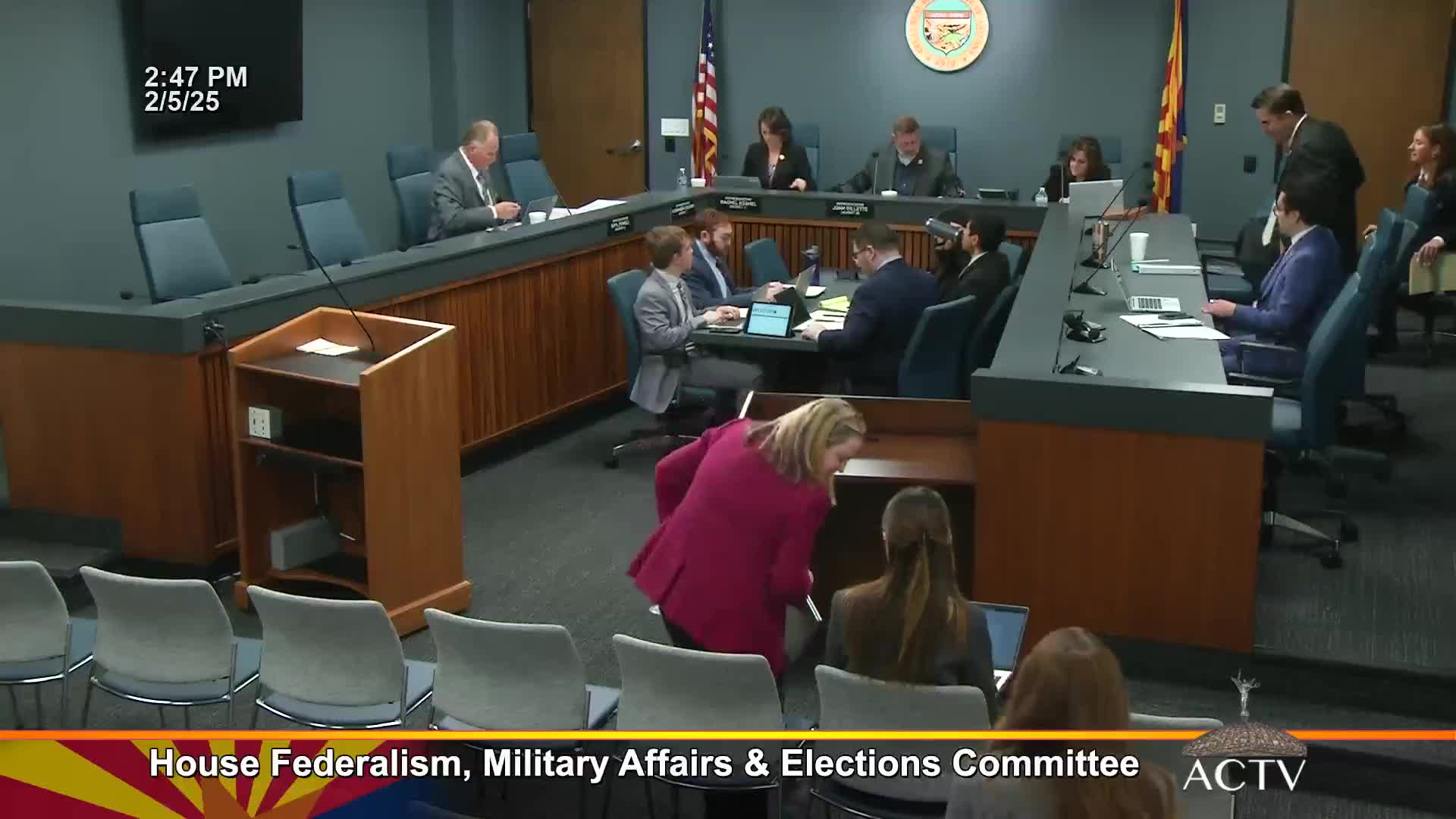
The House Committee on Federal and Military Affairs advanced House Bill 2448 on a 4‑to‑1 voice vote with two members recorded present, sending the measure on with a due‑pass recommendation.
The bill, as amended, removes one existing mechanism for labeling polling sites as "emergency" locations and establishes an option to designate a voting location as a "non‑electioneering" site while also requiring government‑owned buildings to serve as voting locations when requested and publicly accessible.
Committee staff told members the original bill "removes the ability of the county recorder or officer in charge of elections to grant emergency designations to polling places" and said the chairman's amendment "establishes the option to designate a voting location as a non‑electioneering voting location" while preserving the ability to use an alternative designation when a non‑government facility becomes necessary.
Representative Carbone, the bill sponsor, described personal incidents at polling locations and framed the bill as an effort to protect First Amendment activity on public property. "I was asked to leave. If I didn't leave, I would have been arrested," Representative Carbone said, recounting an encounter he said occurred at a city hall polling site.
Jen Morrison of the Association of Counties spoke in support of the amended language and said the change preserves election officials' ability to secure sites while avoiding the public confusion caused by the term "emergency." "We definitely need to preserve that ability," Morrison said, adding the revised language better reflects election practice by using a non‑electioneering label rather than a term that suggests natural disasters.
Committee members questioned how the change would affect privately owned polling locations such as schools or churches. Representative Marquez noted existing law allows private property owners who host polling places to limit signs and electioneering; Representative Carbone agreed that private institutions have been able to restrict electioneering in practice, and the amendment preserves an option for counties to request non‑electioneering designations when needed.
The committee adopted a five‑page amendment in the chairman's name dated Feb. 4, which adds the non‑electioneering option and the requirement that government buildings serve as requested voting locations when publicly accessible. After discussion and public testimony the committee voted; the roll call included four yes votes, one no and two members recorded as present, giving HB 2448 a due‑pass recommendation.
The bill will proceed to the next House committee or floor consideration per the chamber's scheduling rules.