Get Full Government Meeting Transcripts, Videos, & Alerts Forever!
Get email alerts on the Education Audit topic
No spam. Unsubscribe anytime.
Auditor General flags recurring control weaknesses, fraud risks in Florida school districts and state colleges and universities
Summary
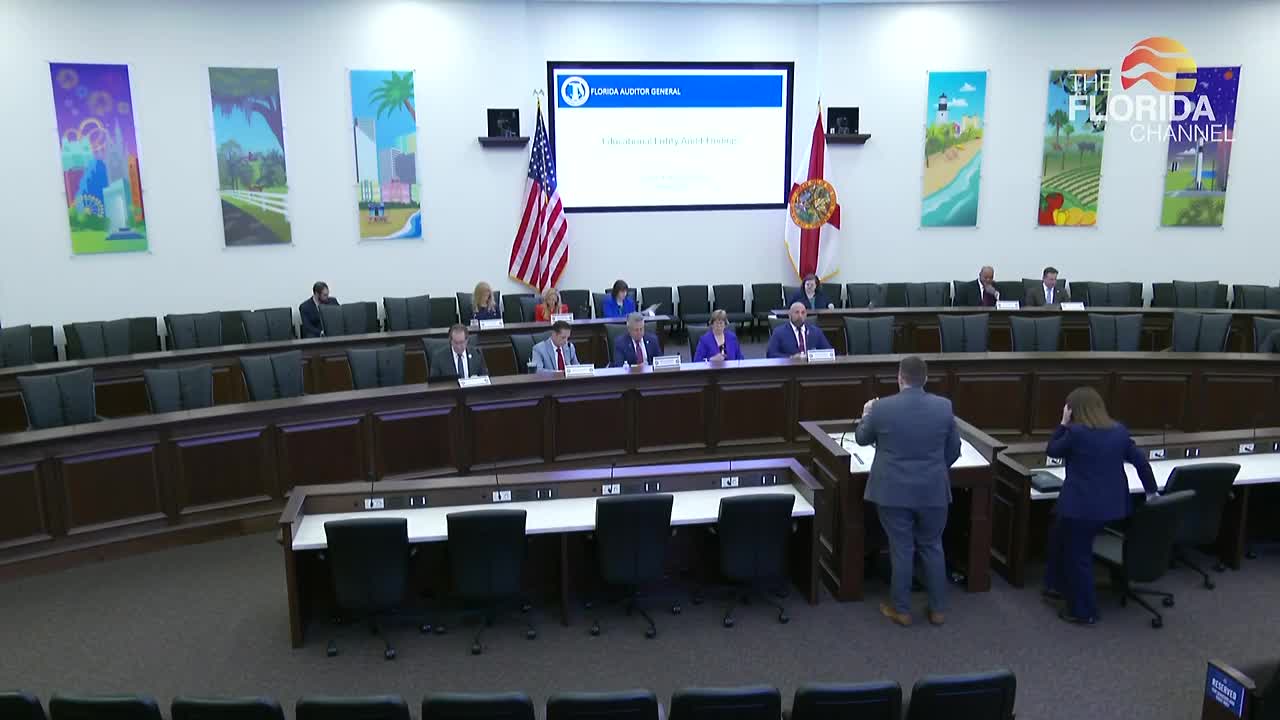
Ted Waller, audit manager for district school board financial, federal and operational audits, and Jamie Hoelscher, audit manager for college and university audits, told the joint legislative item committee that the Auditor General’s Office found repeated control weaknesses across school districts, colleges and universities that increased fraud and reporting risk.
Ted Waller, audit manager for district school board financial, federal and operational audits, and Jamie Hoelscher, audit manager for college and university audits, summarized findings the Auditor General’s Office identified across K‑12 districts, state colleges and public universities during the office’s current three‑year audit rotation.
The presentation detailed repeated control weaknesses that, the auditors said, increase fraud and reporting risk and in some cases led to actual losses: missing documentation that school resource officers received required crisis‑intervention training; purchasing‑card program weaknesses including excessively high card limits and late cancellations; successful vendor‑banking change frauds; untimely background screenings and incomplete reporting to the Florida Department of Education’s disqualification list; and untimely or missing bank reconciliations.
Why it matters: the auditors told the joint legislative item committee that weak procurement, personnel and information‑technology controls can lead to misstated financial reports, potential misdirected payments and risks to student data and safety.
Key findings and examples
- School safety training: “We noticed that some of the districts do not have documented verification of this training being held by these school resource officers prior to them performing work for the school district,” Ted Waller said. In one district the auditors reviewed ten SROs; two had verifiable training records and eight did not.
- Purchasing and purchasing‑card (P‑card) controls: auditors found missing cardholder agreements, inappropriate card limits and late cancellations. Waller said auditors identified two individuals with P‑card limits of $2,000,000; after the auditors raised the issue the limits were reduced. At one district 30 P‑cards were canceled late, in many cases about a year after an employee separated.
- Vendor banking‑information changes and fraud: Jamie Hoelscher said University of Central Florida disclosed a fraud where an email‑based vendor‑change scam led to a $107,000 payment. Waller urged districts to require independent verification of vendor banking changes.
- Personnel controls: auditors found lapses in five‑year background screening cycles (one district tested 30 individuals and found 11 had not been rescreened for six to 13 years), incomplete affidavits of separation and failures to refer employees to the FDOE disqualification list when required.
- Information‑technology access and deactivation: auditors reported unnecessary access to student records and delayed deactivation of accounts after separation; one district had 15 former employees with active access up to 140 days after separation.
- Emergency drills and resiliency education: State Board of Education rules require an initial active‑threat drill within the first ten days of school and additional drills every 45 school days; auditors found some schools did not meet those timing requirements. Districts also lacked documentation showing required resiliency instruction had been delivered to grades 6–12.
- Capital outlay and construction reporting: the Florida Department of Education requires districts to submit cost‑of‑construction reports used to compute statewide student‑station averages. Auditors found inaccuracies in reported project costs and student‑station counts, and instances where districts did not hold required public meetings or maintain required reports when using district staff for construction work.
- Colleges and universities: Hoelscher told the committee the audit cycle reviewed six universities (four finalized, two preliminary) and 13 colleges. Examples included: FAMU deficiencies in bank and investment reconciliations; FAU underreporting a carry‑forward balance by about $77,000,000 because budget amounts rather than actuals were used; UF procurement concerns tied to a consulting agreement totaling about $6,000,000 (auditors described two tranches of roughly $4.7 million and $1.7 million with McKinsey & Company named as the consultant); and North Florida College reporting unauthorized transfers that led to a law‑enforcement referral involving a few hundred thousand dollars.
Committee reaction and context
Several committee members described the auditor findings as alarming and urged follow up. Senator Wright said the repeated nature of findings “is really concerning” and asked the auditors whether similar problems recur annually; Waller acknowledged some findings repeat across cycles. Senator Pizzo and others pressed for clarity about the $6 million consulting contract at UF and whether audits can quantify related costs and outcomes.
Auditor General context and reports
Waller said the Office issues a yearly summary of significant findings and financial trends; the most recent issued report, he said, covered fiscal year 2022‑23 and was released in September 2024. He also described the audit rotation and scope: in the current cycle auditors reviewed 26 of 67 district school boards, 13 of 28 colleges and 6 of 12 universities.
Ending: the auditors encouraged districts and institutions to tighten controls—particularly around vendor changes, P‑card management, timely bank reconciliations and personnel screening—to reduce fraud risk and improve reporting. Committee members asked the auditors for follow‑up information and for public access to the underlying reports on the Auditor General’s website.