Get Full Government Meeting Transcripts, Videos, & Alerts Forever!
Get email alerts on the My Safe Florida Home topic
No spam. Unsubscribe anytime.
My Safe Florida Home: program stats, process and homeowner eligibility explained
Summary
The Department of Financial Services’ My Safe Florida Home program reported tens of thousands of inspections and hundreds of millions of dollars reimbursed to homeowners who upgrade wind mitigation features; the program uses the 18‑02 inspection form and offers a low‑income track that waives matching requirements.
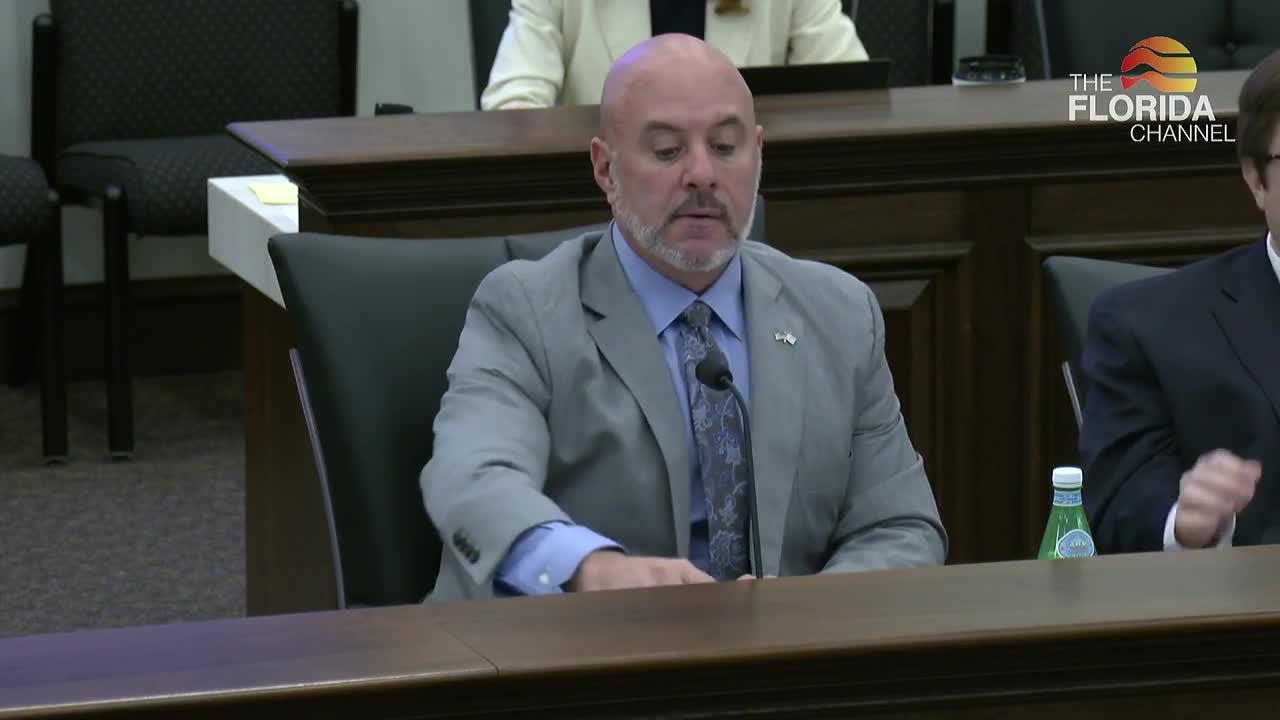
Steven Fielder, program director for My Safe Florida Home (MSFH) at the Florida Department of Financial Services, briefed the Senate Banking and Insurance Committee on program mechanics, eligibility and outcomes through the end of December 2024 (Fielder provided an updated January figure in Q&A).
Fielder said inspections began Nov. 18, 2022, after a 2022 special session funded the program. The program uses the Office of Insurance Regulation’s 18‑02 wind mitigation inspection form, digitized by the department for MSFH. Inspections validate which mitigation measures a home needs and are used as the basis for grant reimbursement when work is completed. “Once you pass the inspection portion of the program, then the homeowner can apply for a grant,” Fielder said.
Program outcomes and consumer costs Fielder provided the committee a series of program statistics capped at December 2024: he reported roughly 9,000 initial inspections and that the department had obligated funds and completed reimbursements through December equal to roughly $240 million; he added in committee Q&A that the January 2025 tally rose to approximately $276 million and that about 29,000 homeowners had been reimbursed by that later point.
Eligibility and mechanics MSFH covers site-built single‑family homes (the statute was amended in 2023 to include some townhomes). Eligible work is roof and opening protections (nailing patterns, hurricane clips, secondary underlayment and opening protection for doors/windows). The statute directs eligible items; Fielder summarized the construction changes as, in plain terms, more nails in plywood, hurricane clips, and a water-protective layer beneath shingles.
Low‑income track and insured-value reporting A low‑income track waives the requirement that homeowners submit proof of insured value when applying; otherwise, applicants must provide their homeowners insurance declarations page to validate insured value. After post‑work inspection, homeowners submit receipts and seek reimbursement. Fielder said the inspection fee has historically been around $100 but that the program has periodically funded inspections or offered other supports. MSFH also reports to insurers so that homeowners who complete mitigation work can pursue premium discounts.
Why it matters MSFH is a central state mitigation grant that creates a pathway for homeowners to harden houses and obtain insurer-recognized documentation for discounts. Fielder told the committee that of the homeowners who completed the process and for whom the program could measure premium changes, about 12,570 saw premium reductions; the average discount among those recipients for combined years reported was roughly $9.43 per month (Fielder framed this as an average of reductions reported among participants, not a guaranteed household savings).
Ending Fielder said the program requires licensed contractors, a pre‑ and post‑inspection workflow and online account management for applicants; he noted the program paused initial inspection applications while waiting for additional funding but maintains a notification list for homeowners who want updates.