Get Full Government Meeting Transcripts, Videos, & Alerts Forever!
Get email alerts on the Disaster Recovery topic
No spam. Unsubscribe anytime.
Florida emergency management details 2024 storm response, rolls out FROC and Elevate Florida programs
Summary
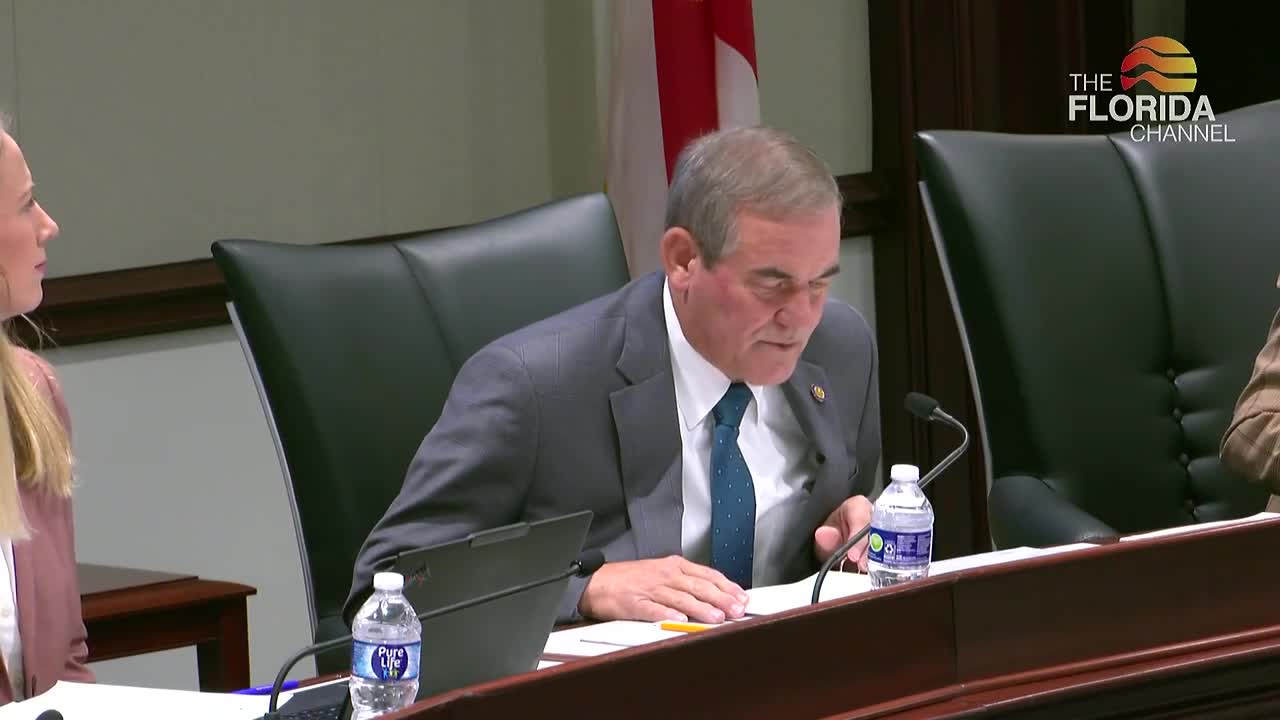
Kevin Guthrie, executive director of the Florida Division of Emergency Management, told the Senate Committee on Community Affairs that the state has moved quickly to restore services and begin recovery after the 2024 hurricanes and is launching new programs to reduce future federal clawbacks and speed reimbursements.
Kevin Guthrie, executive director of the Florida Division of Emergency Management, told the Senate Committee on Community Affairs on an emergency-management briefing that the state has moved quickly to restore services and begin recovery after the 2024 hurricanes and is launching new programs to reduce future federal clawbacks and speed reimbursements.
Guthrie said the state provided food, water, search-and-rescue teams and logistical support after Hurricane Debbie, Helene and Milton, and reported large-scale infrastructure work: "We had full power restoration to over 307,000 customers within four days" after Debbie and restored roughly 1.2 million customers within seven days after Helene, he said. For Milton, Guthrie said the state restored power to about 3.4 million customers and deployed tens of thousands of line workers from across the U.S. and Canada.
Guthrie told the committee that FEMA public-assistance obligations for Debbie included about $146.1 million with an additional $36.2 million in development, and he said the state expects roughly $45.4 million in hazard-mitigation grant funds tied to that storm. He also described large logistical efforts: "We deployed over 12,200 linear feet of flood control devices," 48 pumps and "deployed 97 generators to critical infrastructure," and said the state has removed millions of cubic yards of upland and waterway debris, attributing the figures to state operations.
Nut graf: Guthrie emphasized that the Division is shifting from reactive recovery to a proactive, state-managed approach to reduce risk and speed federal reimbursements. He described two major initiatives—FROC, a data-standardization and risk-scoring dashboard for local governments, and Elevate Florida, a state residential mitigation program—to accelerate reimbursements and improve resilience.
FROC: proactive documentation and procurement review
Guthrie described FROC (the Florida Risk Reduction and Obligation Calculations initiative) as a state-managed digital toolkit that standardizes FEMA-required forms and collects data from responders at the point of activity. He said about 500 local governments have adopted the standardized forms voluntarily so far and that the state now reviews procurement and contract language ahead of disasters to avoid later FEMA disallowances. "We now look at every procurement and every contract from any city or county ahead of the disaster happening," Guthrie said. He added that the program assigns a risk score to participating jurisdictions and that, in Guthrie's example, if a jurisdiction scores 85 and FEMA obligates $100 million for a debris project, the state would release $85 million upon receipt of obligation paperwork.
Hazard mitigation and Elevate Florida
Guthrie told the committee the Division currently manages approximately $4.8 billion in mitigation funds across multiple federal programs and described the Hazard Mitigation Grant Program and BRIC (Building Resilient Infrastructure and Communities) as key federal sources. He said the state expects a notable allocation for Flood Mitigation Assistance—"approximately $400,000,000 in this particular silo"—and that Florida is prioritizing elevation and reconstruction work with an initial Elevate Florida rollout of $400 million focused on properties covered by flood insurance. "Our goal is to have people elevated in homes, especially manufactured homes, as soon as July of 2025," Guthrie said, adding he hopes to spend the tranche in 12–18 months.
Manufactured homes and tie-downs
Senators asked about manufactured homes; Guthrie said modern manufactured housing has stronger wind-resistance standards than older units and that Elevate Florida can be used to elevate or reconstruct where appropriate. On mobile-home tie-downs he said the program pays for additional tie-downs only—"This particular program for mobile and manufactured homes is only for a tie down," he said—and emphasized limits on replacing a homeowner's square footage: the state will generally replace housing within 10% of the original home size.
Debris removal, contract rates and reimbursement
Portia Griffith, identified in the presentation as the Division's debris technical specialist, warned that FEMA itself "has no role in debris whatsoever... other than reimburse it," and said debris removal is a local responsibility that FEMA later reimburses. Griffith and Guthrie described market pressures in the debris-hauling industry, noting haulers may leave regions where federal or Corps rates are higher. Guthrie said the Division and state DOT temporarily aligned pay rates to stabilize the market but warned that higher rates offered by other jurisdictions or the U.S. Army Corps of Engineers can draw contractors away.
Sheltering and regional approaches
On congregate and special-needs sheltering, Guthrie said sheltering remains the most complicated operational problem after power restoration, especially when keeping schools available for students. He said the state used regional shelters and leased warehouses to house people in some areas, and noted Florida currently has a small number of regional shelters (which he named) that can accept large populations in multiple-county events.
Mutual aid and urban search-and-rescue reimbursement
Guthrie said state-level missions now make jurisdictions whole faster: when a local jurisdiction requests state resources and the mission is declared a state mission, the Division will pay deployed teams and has reduced payment timelines from many months to roughly 45 days in typical cases. "We will then make that city or county whole," he said.
Questions and next steps
Committee members pressed for more specifics about building-code limits, tax or insurance effects after mitigation projects, and assistance for niche populations (for example, houseboats). Guthrie said some topics (insurance and Office of Insurance Regulation assessments) are outside his agency's authority and promised follow-up where appropriate.
The committee adjourned by voice consent at the close of the hearing.
Ending: Guthrie closed by thanking the committee and stressing the Division's commitment to continuous improvement and state-led risk reduction.