Get Full Government Meeting Transcripts, Videos, & Alerts Forever!
Get email alerts on the Building And Code Safety topic
No spam. Unsubscribe anytime.
Brighton study session reviews residential sprinklers, housekeeping and timeline for code updates
Summary
City staff introduced residential sprinkler information and proposed housekeeping updates to the city's building code; council asked for cost, incidence and implementation details and no policy change was adopted.
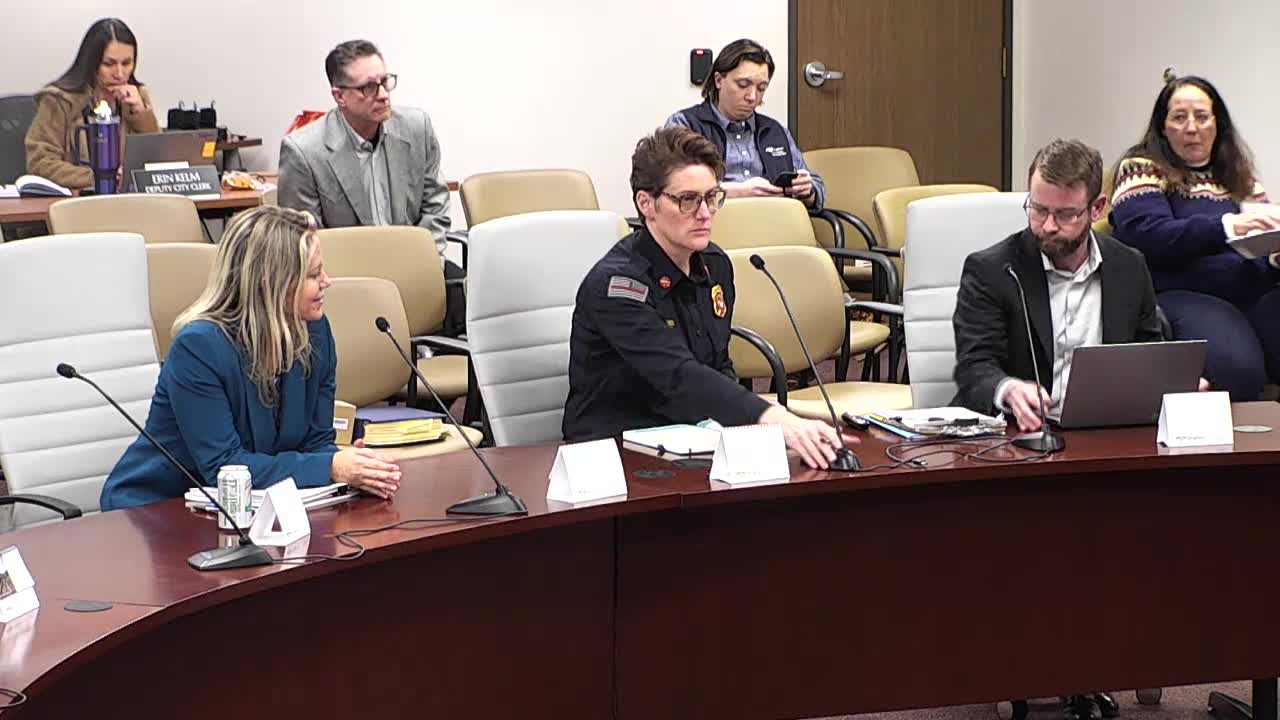
City staff briefed the Brighton City Council in a study session on Jan. 28, 2025, on residential fire sprinklers and a set of housekeeping amendments tied to the city's adopted 2021 building codes. Andy Ulmer, the city's chief building official, and Division Chief of Prevention Elizabeth Bojarnick presented safety data and technical details; the council asked staff to return with cost, incidence and implementation information before any formal change.
Ulmer told the council that residential sprinklers were placed in the model fire code about 15 years ago and said the systems' principal benefits are life safety and reducing firefighter exposure. "They save lives. They save firefighter lives. They prevent firefighter cancers," Ulmer said. He also described other benefits cited in national case studies, including reduced property loss and lower overall water use in many jurisdictions that adopted sprinklers.
The presentation focused on three threads: the safety case for residential sprinklers, technical details about how residential systems operate and how the city's code-update process would proceed. Ulmer said a typical residential sprinkler head activates at about 45 degrees (the glass bulb bursts) and discharges on the order of 8 gallons per minute from a single head; he described residential systems as "multipurpose" piping that shares domestic water supply lines rather than a separate, constantly standing reservoir. Ulmer also said that accidental discharges are comparatively rare in single-family settings and most commonly result from mechanical damage in storage/rack situations in commercial properties.
Council members raised questions about cost, retrofit obligations and insurance effects. Mayor Pro Tem observed that Colorado legislation (identified in the meeting as "House Bill 25 10 30") could require certain accessibility and code items statewide, potentially limiting the value of local effort to remove or alter national-code provisions. Council member Peter Snyder and others asked staff to provide local data on the number of residential fires in Brighton and to survey insurance carriers about premium impacts; staff reported a State Farm underwriter estimate of about a 5% premium discount in cases where sprinklers are present (roughly $125 on a $2,500 annual premium in the example cited) but said they would gather more insurer responses.
Ulmer and Bojarnick emphasized that staff were not asking the council to adopt a local retrofit requirement at this meeting. They said that, if the city proceeds, the typical approach discussed at the meeting would apply sprinklers to new single-family detached houses built after code adoption and to new construction in subdivisions, not to routine remodels or existing houses unless the building is effectively replaced. "I'm gonna bring all the facts to you," Ulmer said, adding staff would return with more precise cost estimates and comparative case studies.
The building-division portion of the presentation also outlined proposed housekeeping amendments to clarify Chapter 15 and to align local administrative language with the national I-Codes (International Codes). Staff recommended a consolidated update schedule so the city can adopt the National Electrical Code and the 2024 I-Codes together in 2026, to reduce repeated plan revisions for builders and to keep city rules current.
No formal action was taken. Council members asked staff to return with: local residential-fire incident counts for the city limits, additional insurance-industry responses, contractors'maintenance estimates, and more detailed cost-benefit and infrastructure examples (including the Scottsdale example cited by staff), ahead of any future code-adoption decision.
Staff indicated likely next steps: a future study session focused on residential sprinklers and, separately, an ordinance or resolution to adopt the code housekeeping and timing proposed for 2026.