Committee advances revisions to Denver noise ordinance, expands festival exemptions and alters enforcement tools
Loading...
Summary
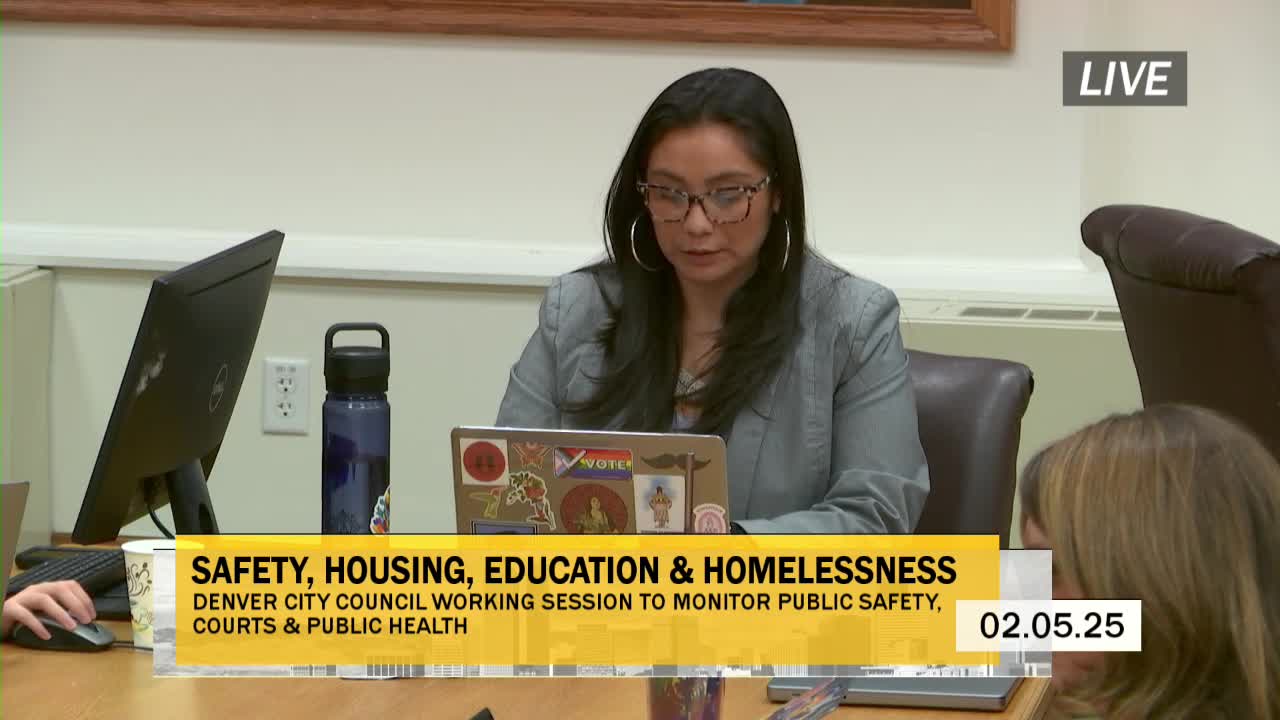
Denver’s Safety, Housing, Education and Homelessness Committee on Feb. 5 voted to forward proposed revisions to Chapter 36 of the Denver Revised Municipal Code — the city’s noise ordinance — to the full City Council after a presentation by the Department of Public Health and Environment.
Denver’s Safety, Housing, Education and Homelessness Committee on Feb. 5 voted to forward proposed revisions to Chapter 36 of the Denver Revised Municipal Code — the city’s noise ordinance — to the full City Council after a presentation by the Department of Public Health and Environment (DPHE).
DPHE staff said the proposal updates definitions and enforcement methods that the department says are out of step with the city’s growth, while also creating new limits for recurring private- and public-property events. “We believe that these proposals are measured in our approach and we think that they strike the right balance in protecting public health while also realizing that we have a growing city that has noise producing activities,” Bridal Doyle, Noise Program Supervisor, said during the presentation.
The department identified seven major updates. Key changes include: moving the permitted start time for some waste-hauling activities from 7 a.m. to 6 a.m.; expanding a festival exemption to cover qualifying events on private property that are open to the public; raising the exemption sound level for permitted events from 80 to 85 decibels; limiting qualifying private-property events at a single location to eight per calendar year with a 30-day cooling-off period after multi-day events; changing construction enforcement outside exempted hours from Table A decibel measurements to a “plainly audible” standard enforceable with time-stamped video; clarifying that preexisting land uses set allowable noise levels for later arrivals; prohibiting the use of engine compression (jack) brakes within city limits; and moving noise-variance approvals to an administrative process within the department while preserving notice and appeal rights.
The festival exemption change would allow events held on private property to qualify for the higher 85 dB allowance only if they are properly permitted and open to the public. DPHE staff said the higher decibel level was chosen because 85 dB aligns with workplace exposure guidance and “we didn’t raise the exposure beyond a point where there should be concern of physical injury,” Paul Rudessil, Noise Program Senior Analyst, said in the presentation.
On construction activity, DPHE said enforcement outside exempted hours will rely on the plainly audible standard and resident-submitted time-stamped video evidence, rather than sending inspectors to capture decibel measurements tied to Table A. “What we’re doing is we’re going to a plainly audible and we intend to enforce then as we do with waste stream activities or waste haulers where we can enforce on a time stamped video,” Rudessil said.
The department also proposed removing “psychological complaints” (reports of headaches or similar subjective symptoms) from the ordinance’s definition of noise, which staff said has created burdens in past appeal proceedings and sometimes required complainants to take time off work to testify.
Council members pressed staff on enforcement and notification. Council President Sandoval thanked DPHE for the long process and asked several technical questions; Megan Waples of the City Attorney’s Office clarified the appeals path for variances: an applicant may appeal a department denial to the Board of Public Health and Environment, but neighbors do not have a direct appeal right from a board-granted variance under current law. “Someone can petition for a variance from the board, and there’s not an appeal from that,” Waples said, explaining that the draft keeps the applicant’s appeal rights but does not add a separate appeal for neighboring landowners.
Council members raised concerns about the 6 a.m. start time for private waste haulers. DPHE and a city staff member responding on behalf of public works said the ordinance change would not require the city’s contracted collection schedules to change and that the earlier hour primarily affects private haulers; public-works staff said they do not plan immediate service changes. Nicholas Williams, speaking for city operations, said, “we don't anticipate making any service changes on this,” and that the flexibility might help align future collection with school schedules but would not alter current city routes immediately.
Committee members also discussed snow-removal exemptions and fireworks enforcement. DPHE staff said snow-removal exemptions will mirror existing snow-removal rules so the code will defer to the operational rules used by snow-removal authorities. On fireworks, DPHE said they would not enforce consumer fireworks and that permitted public displays remain under fire-department permitting.
DPHE described its stakeholder process, which began in 2018, paused during the COVID-19 pandemic, and resumed in 2022; the department said it held 17 stakeholder meetings in the last two years, solicited roughly 1,000 survey responses and reviewed hundreds of public comments. The department also noted it reviewed noise ordinances from similar cities to shape proposals.
At the end of the presentation, the committee chair sought a motion. “Councilman Hyde has moved, and President has seconded,” the chair said. A roll-call vote was waived and members signaled approval by voice/thumbs up; the committee forwarded the proposal to the full City Council. The chair also noted five consent items on the committee agenda would move to the full council after no objections were raised.
The committee discussion included several implementation details that DPHE said would remain in administrative guidance or permitting conditions: notifications to council offices and registered neighborhood organizations (RNOs) within 200 feet of projects, and standard conditions negotiated with communities on large projects (for example, hotel vouchers for residents exposed to elevated construction noise levels, with requirements that vouchers be pet friendly). DPHE said violations of variance conditions would still require board action to revoke or suspend a variance after the department initially enforces conditions.
The department provided contact information for follow-up questions and the committee chair said the matter will return to the council calendar for full consideration. The committee also set a note that next week’s meeting will start at 10:15 a.m.
Ending: The vote forwards these proposed code changes to the full City Council for consideration; the ordinance revision remains a proposed action and would require council approval and any subsequent rulemaking to go into effect.