Get Full Government Meeting Transcripts, Videos, & Alerts Forever!
Get email alerts on the Downtown Development Authority Ddda topic
No spam. Unsubscribe anytime.
Denver committee advances amended DDDA cooperation agreement; second reading set for Feb. 18
Summary
The Finance and Governance Committee voted to advance a proposed amended cooperation agreement with the Denver Downtown Development Authority that establishes evaluation criteria and funding processes for downtown redevelopment projects. The bill will be considered by full council on Feb. 18.
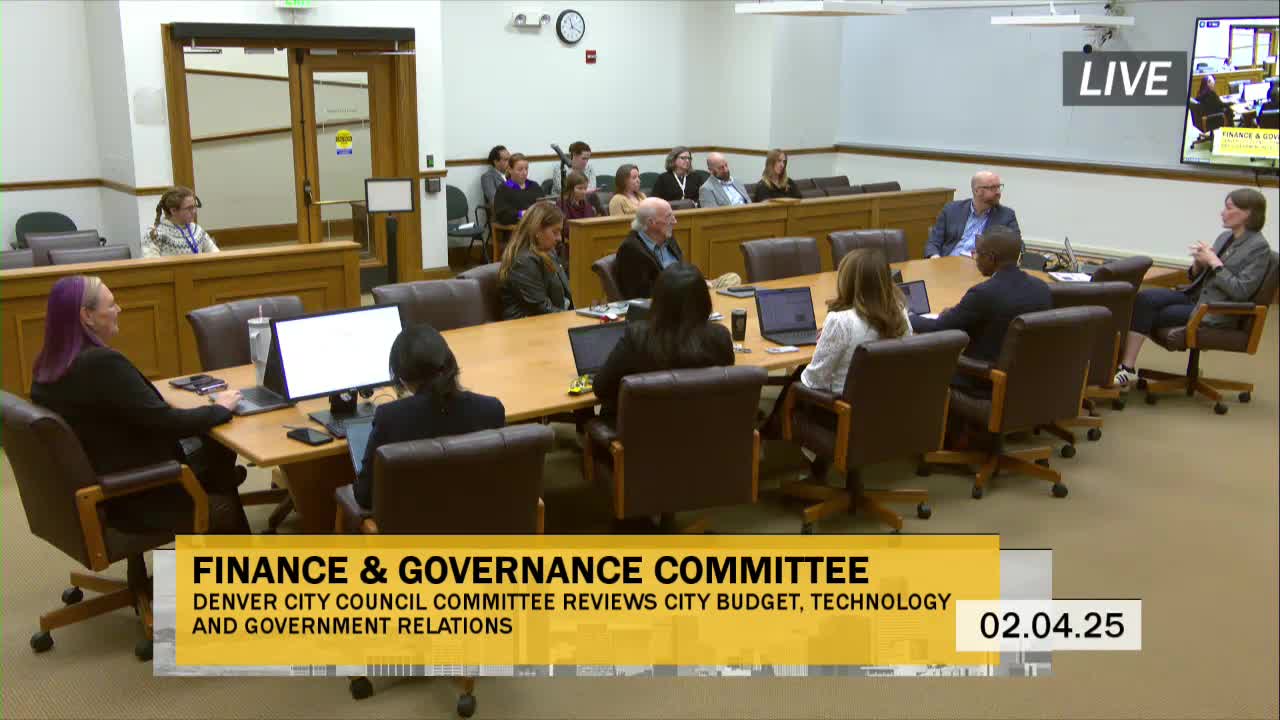
The Finance and Governance Committee of the Denver City Council on Feb. 4 advanced a proposed second amended and restated Denver Downtown Development Authority (DDDA) Plan of Development cooperation agreement, moving the measure to the full council for a second reading on Feb. 18.
The agreement, presented by city staff, lays out application and approval processes and specifies evaluation criteria and funding types — including tax-increment performance payments, loans and lump-sum reimbursements — to support catalytic downtown investments. Councilmember Darrell Watson moved the committee motion and Councilmember Paul Cashman seconded it; the committee advanced the item to the council floor with no roll-call tally recorded in the meeting transcript.
Why it matters: The cooperation agreement implements the DDDA plan of development and the city’s approach to awarding a portion of tax-increment revenues and other gap financing to projects intended to spur economic activity in downtown Denver. Voters approved a bonding/debt capacity for downtown investment on Nov. 5 (the transcript cites $570,000,000 and more than 77% electoral support), and the agreement governs how those and other district resources may be allocated.
City staff said the city will administer applications, score projects against five major criteria categories, and make funding recommendations to the DDDA board, which will then review and return recommendations to the city. Donna Wilder, who identified herself as staff with the Department of Finance, said the five evaluation categories are financial, feasibility, policy objectives, readiness and activation impact. Mike Hartman, chief of staff at Denver Economic Development and Opportunity, said staff will underwrite pro forma assumptions rather than accept applicants’ projections at face value, and will track actual outcomes after funding is awarded: “it’s important that we look at the key assumptions that drive the economic outcomes for the pro forma models,” he said.
The policy-objectives category includes affordable housing levels, sustainability and climate benefits, equity and accessibility, economic diversity, livability and nondiscrimination and minority/women’s business enterprise involvement, staff said. City staff described a “REME” score used to estimate pedestrian foot traffic, job creation and the economic longevity of a project to assess activation impact.
Funding rules explained in the briefing include a typical cap of 20% of total project costs for gap funding, with a provision that the city and DDDA may exceed that cap for projects demonstrating extraordinary public benefits or strong alignment with plan goals. Staff also described three funding forms the agreement anticipates: tax-increment performance payments tied to actual tax increment produced, loans for projects that require up-front capital, and lump-sum reimbursements tied to milestones such as certificate of occupancy or execution of a lease.
Staff noted process timelines: once the board issues recommendations to the city there is a review cadence that could take up to 42 calendar days in that stage; overall evaluation-to-approval timelines will depend on project complexity but staff estimated a typical complete process could take two to three months. Projects requesting more than $500,000 would require City Council approval, staff said; smaller awards could be approved without council action but any later, material increase past the $500,000 threshold would require returning to the approval process and likely to council.
Council President Sandoval, who also serves on the DDDA board, said the board has gained more formal authority under the current proposal and praised the effort to balance board and city roles: “when this first proposal came before us, the DDA Board had no authority. And so now I feel like the Board does have authority, and that feels better for me,” Sandoval said.
Committee members asked about scoring weightings, compliance checks (including wage-theft history and other prequalification questions, which staff said are listed in the appendix to the application materials), board composition and timing. Staff confirmed the statute allows the board to expand up to 11 members as boundaries expand and noted that mayoral recommendations for board appointments are subject to city council confirmation. Brad Deaton, from Steve Durden’s office, said the state statute describes broad eligibility categories (property owners, lessees, residents) but does not prescribe more detailed aspirational qualifications; advising such specifics would be a local policy decision.
Staff also announced that a registration-of-interest form opened the day before the meeting and that an interactive public map is available showing city-owned properties the city expects to petition for inclusion in the district. Staff said inclusion in the district is a requirement for receiving DDDA funding and that they expect to bring petitions for inclusion in the spring. The DDDA board approved the amended cooperation agreement at its Jan. 30 board meeting, staff said.
Next steps: The committee advanced the bill to the full City Council; staff said a second reading is scheduled for Feb. 18. Staff also noted anticipated board vacancies in July 2025 and said the city will work through the boards-and-commissions appointment process as the district grows.