Get Full Government Meeting Transcripts, Videos, & Alerts Forever!
Get email alerts on the Budget Transparency topic
No spam. Unsubscribe anytime.
Denver finance staff demo Workday-based spending dashboard as council urges deeper drilldowns and quarterly data
Summary
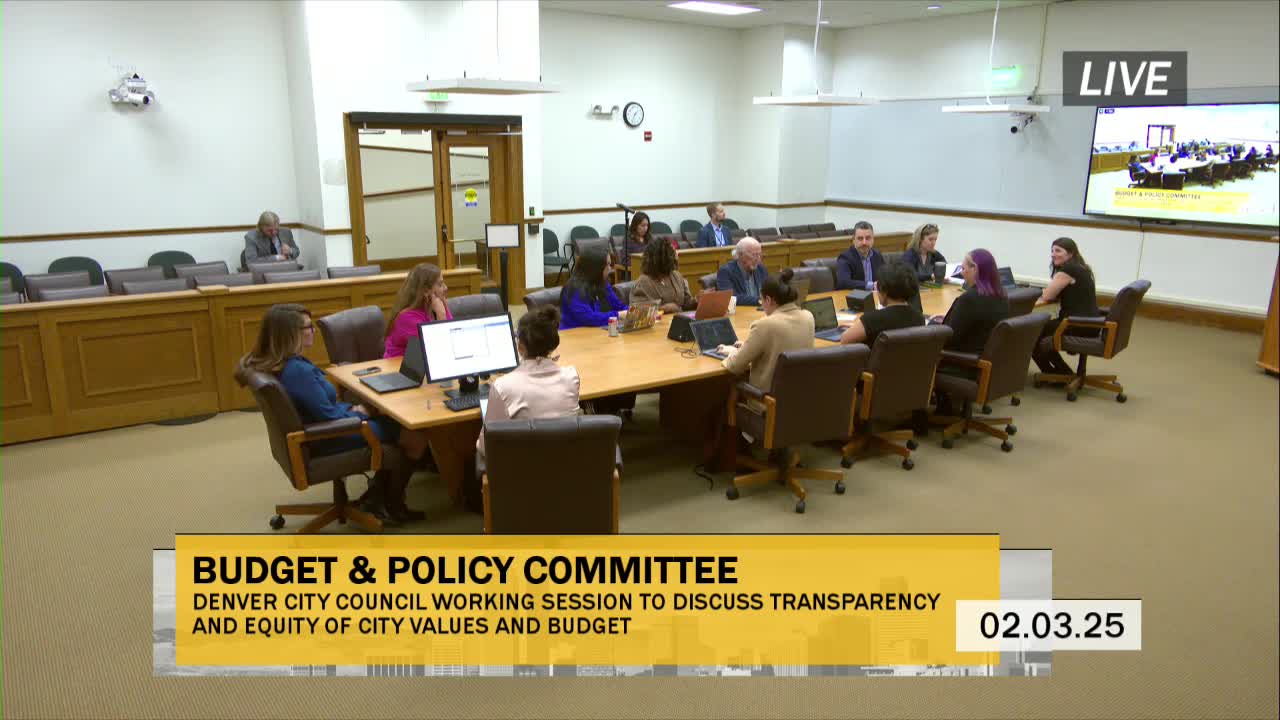
City finance staff demonstrated a draft, Workday-driven dashboard intended to give Denver City Council and the public easier access to agency budgets and expenditure details, and council members responded with a mixture of praise and requests for deeper drilldowns and clearer context.
City finance staff demonstrated a draft, Workday-driven dashboard intended to give Denver City Council and the public easier access to agency budgets and expenditure details, and council members responded with a mixture of praise and requests for deeper drilldowns and clearer context.
"Workday is a system of record for the City. So, that means that is the official source for our financial record," said Bill Rydell, City Controller in the Department of Finance, as he described the enterprise system that holds payroll, procurement, grants and the general ledger. Deputy Chief of Staff Stephanie Carianas Adams and Lisa Martinez Templeton, the city's chief economist and data scientist, joined Rydell to show a proof-of-concept dashboard built from Workday data and other public sources such as Transparent Denver.
The dashboard demo showed agency budget totals, fund-level spend versus budget and filters by cost center and account code (personnel, services and supplies, capital equipment, internal services). It used 2023 data in the demo. Rydell told the committee that Workday already stores large volumes of transactions: "we pay about 110,000 vendor invoices every year," "over 330,000 paychecks," roughly "over 40,000 purchasing and travel card transactions" and "over 50,000 accounting transactions," all of which can be the source for reporting and drilldown.
Why it matters: Council members said the tool could make oversight more efficient but warned that high-level figures without transaction context would generate follow-up questions for agency staff. Councilwoman Amanda Sawyer praised the effort but said the demo raised operational questions: "It shows the budget was 74, and in 2023 ... 3 11 city services spent 56,000 of the $74,000 that was approved," and that without more context "the first thing I want to do is email tech services and ask where the other, you know, $18,000 went." Sawyer and others asked for features that would let the council trace underspends and encumbrances, view supplier-level payments and see contract IDs tied to invoices so council members could match spending to prior votes or contracts.
Staff response and technical limits: Martinez Templeton said the demo was intentionally limited and could be expanded: the dashboard can filter to the level of "track-level cost centers" and could be configured to show more granular transaction lists. Rydell and Martinez Templeton told the committee that the system already includes links and "hyperlinks" from summary lines to invoices, vendors and supporting documents and that the team could build additional drilldowns and supplier/line-item views, but warned that adding many layers of detail can make reports "unruly." Rydell also described internal controls: budget checks prevent agency spending from exceeding approved appropriations and approval workflows enforce separation of duties.
Auditing and timing: Councilmembers asked about external audit controls, timing of reported data, and whether the city can perform frequent "hard closes." Councilmember (last name Hines/Heinz in the transcript) asked whether Denver is externally audited; Rydell said the city engaged CLA for the current year and BDO for the prior three years and that the Auditor's Office manages that contract "per charter." He said external auditors are given view-only roles and sample transactions are traced from budget to payment. Rydell also said the city performs monthly "soft closes" but the final year-end close process takes longer: "from when the books close on December 31 till we actually run our first trial balance, it's usually around March 1."
Frequency, automation and staff time: Councilmembers repeatedly recommended quarterly updates; several asked that the dashboard show the reporting period prominently. Finance staff said that once the dashboard is built and QA'd, the data feed can be automated and ongoing maintenance should require minimal staff time, although the initial build is staff-intensive. Finance suggested starting with simpler agency pages and adding more complexity where council members need it.
Requests for additions: Specific council requests captured in the discussion included (1) a simple top-line comparison of budget versus actuals, (2) the ability to drill to supplier-level payments and individual expenditures, (3) inclusion of contract numbers or references next to payments so council members can match spending to prior authorizations, (4) clearer labels for encumbrances and obligations versus paid actuals, and (5) quarterly refresh cadence and a clear date stamp on reports.
What the dashboard currently links to publicly: Rydell and Martinez Templeton noted existing public resources that pull from Workday: Transparent Denver's "checkbook" (vendor payments search), the budget book, comprehensive annual financial report (ACFR), a condensed citizen report, and online contract listings associated with the clerk and recorder.
Next steps and caveats: Staff said this is a starting point and asked councilmembers to try the draft, identify the priority questions they want answered, and the team will scope deeper drilldowns where useful. Multiple councilmembers said they would share the dashboard internally with their staff and follow up with list of desired filters and views. No formal action or vote was taken; staff did not propose or request a charter change or new appropriation during the presentation.
The presentation and follow-up discussion ran for the committee's scheduled meeting time; council members asked staff to return with refinements and to consider a quarterly refresh cycle and clearer definitions so that high-level figures do not lead to unnecessary agency inboxes full of clarifying requests.