Get Full Government Meeting Transcripts, Videos, & Alerts Forever!
Get email alerts on the Economic Development topic
No spam. Unsubscribe anytime.
Denver agency lays out small‑business toolbox and urges council action as city faces net job losses
Summary
Denver Economic Development and Opportunity told the council committee it has grants, tax credits and technical services to retain and attract businesses, but agency leaders warned the city is losing ground to peer cities, flagged permitting and affordability as barriers, and called for council collaboration on policy and process changes.
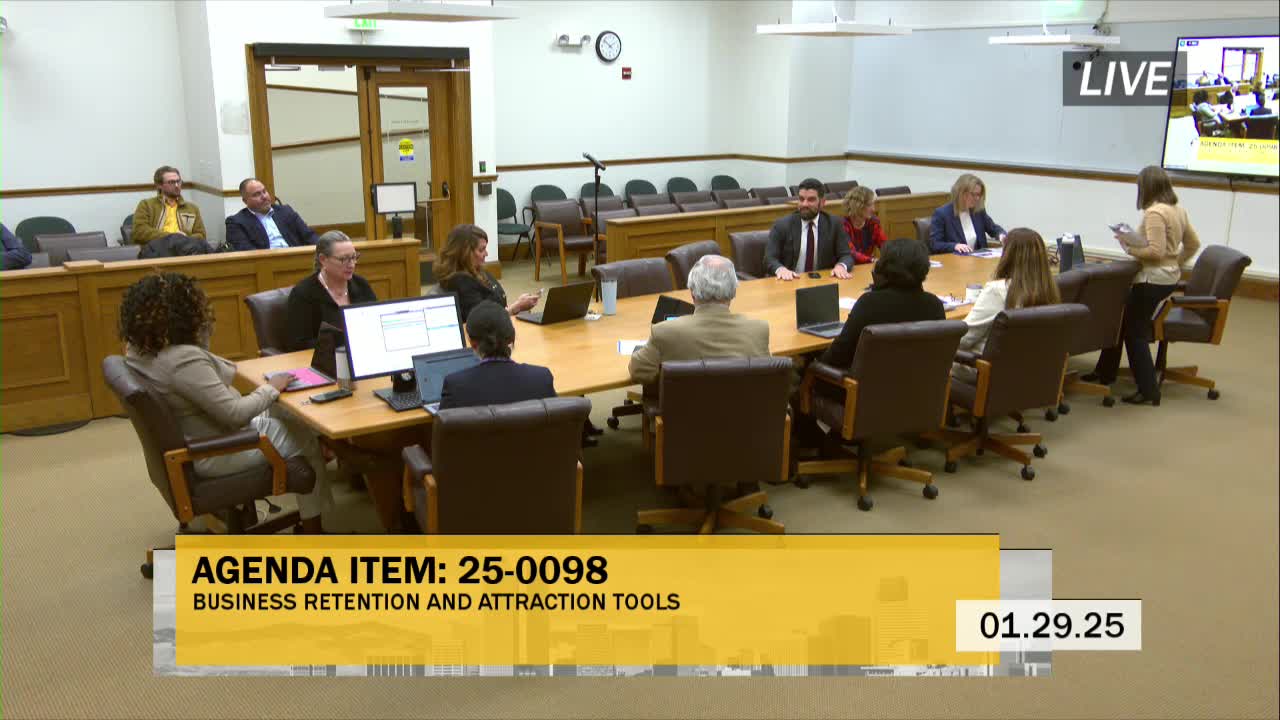
Denver Economic Development and Opportunity (DEDO) officials told the Business, Arts, Workforce, Climate, and Aviation Services Committee on Jan. 29 that the city has a range of financial and nonfinancial tools to support businesses — from gap financing and facade grants to tax credits and workforce programs — but that Denver faces competitiveness and permitting challenges that require new policies and closer coordination across city agencies.
Adeep Khan, executive director of DEDO, said the city historically relied on quality of life and labor‑market advantages to attract employers but must act more deliberately now to retain and recruit firms. Khan told the committee Denver has shifted in recent years from proactive recruitment to preserving existing businesses affected by factors such as construction impacts and affordability, and said the agency is beginning a three‑ to five‑year strategic planning effort.
Presenters from DEDO gave an overview of programs and impacts: access to capital through gap financing and federally funded Community Development Block Grant (CDBG) dollars; the Business Impact/Opportunity Fund (BIF) that provided emergency and stabilization grants during the pandemic; tax credits administered at the local level for businesses in designated enterprise zones; the Denver legacy business program that recognizes long‑standing neighborhood establishments; the Park Hill Innovation Hub for entrepreneurs; and the Denver Scale Up Network for growth‑stage companies. Staff said DEDO’s integrated workforce development arm — which provides job fairs, training and recruiter support — distinguishes Denver’s approach from many other cities.
Officials cited program impact numbers during the briefing. DEDO said the Business Impact/Opportunity Fund has distributed more than $25 million in grants in more than 3,800 awards (program scale benefited from one‑time federal/state pandemic funds). The agency said roughly 2,000 businesses pre‑certify for enterprise‑zone tax credits each year, with about 200 businesses claiming credits in a recent tax year; those claimants reported a collective increase of almost 4,000 employees, $165 million invested in business personal property and $30 million invested in employee benefits or training in the most recent reporting period DEDO cited.
Khan and staff also warned of troubling trends: DEDO staff said Denver experienced a net job loss while neighboring jurisdictions grew, and that the city recorded a net loss of 182 restaurants in the prior year; presenters described the restaurant losses as concentrated and severe and argued that a combination of permitting times, cost pressures and minimum‑wage impacts have contributed.
Committee members pressed DEDO on practical supports and neighborhood outreach. Councilmember Kevin Flynn asked detailed questions about tax incentive mechanics (what portion of sales tax a city rebate can apply to and how the city calculates fiscal impact and cannibalization). DEDO staff said rebate offers are limited to the city’s 3.5% general‑fund sales‑tax portion and that policy safeguards (for example, a cap on rebate percentages and fiscal‑impact analysis) are used to evaluate proposals. Councilmembers also raised recurring concerns about permitting delays; DEDO said it is working with Community Planning and Development (CPD), permitting agencies and the mayor’s office to streamline processes and pilot a “permit owner” or customer‑champion model to reduce handoffs among departments.
Neighborhood‑level support and language access were recurring themes. Turret Nagel Keesbord, DEDO’s director of business development, and Elvis Rubio from Neighborhood Equity and Stabilization (NEST) described targeted programs and partner networks that provide services in multiple languages and offer façade grants, technical assistance and contract navigation. DEDO said it will pilot coordinated neighborhood teams in five pilot communities aligned with safety and vacancy priorities to bring agencies together and provide consistent outreach.
The state’s enterprise‑zone redesignation was highlighted as an immediate item for outreach. DEDO staff said the state process began in August 2024, local outreach will intensify in February–April 2025, and local designations affect eligibility for state tax credits; staff asked council members to help amplify outreach and noted statutory timelines and population caps affect what areas can remain designated.
On incentives, Khan said Denver has not traditionally relied heavily on incentives compared with peer cities and that city leaders should consider whether to build a more strategic incentives toolbox to retain and attract employers; any incentive DEDO would recommend, staff said, is performance‑based and paid over time tied to job creation or other public benefits. DEDO officials asked for council engagement on policy options and signaled they will return with proposal(s) for council consideration.
Staff closed by offering follow‑up materials (a small‑business toolkit, newsletter links and contacts) and said they will coordinate with council offices for neighborhood outreach, enterprise‑zone communications and potential future briefings on permitting reforms and targeted incentive proposals.
Discussion versus decision: the session was a briefing and information exchange; no formal council action or vote on new incentives was recorded in the transcript. Staff noted several follow‑ups and committed to additional briefings and materials.