Get Full Government Meeting Transcripts, Videos, & Alerts Forever!
Get email alerts on the Youth Municipal Court topic
No spam. Unsubscribe anytime.
Denver public defenders report racial disparities, procedural hurdles in new youth municipal court
Summary
City municipal public defenders told a Denver City Council committee that their new youth municipal defense unit has secured dismissals and expungements but identified racial disparities in ticketing, gaps in diversion services and potential immigration consequences for low-level charges.
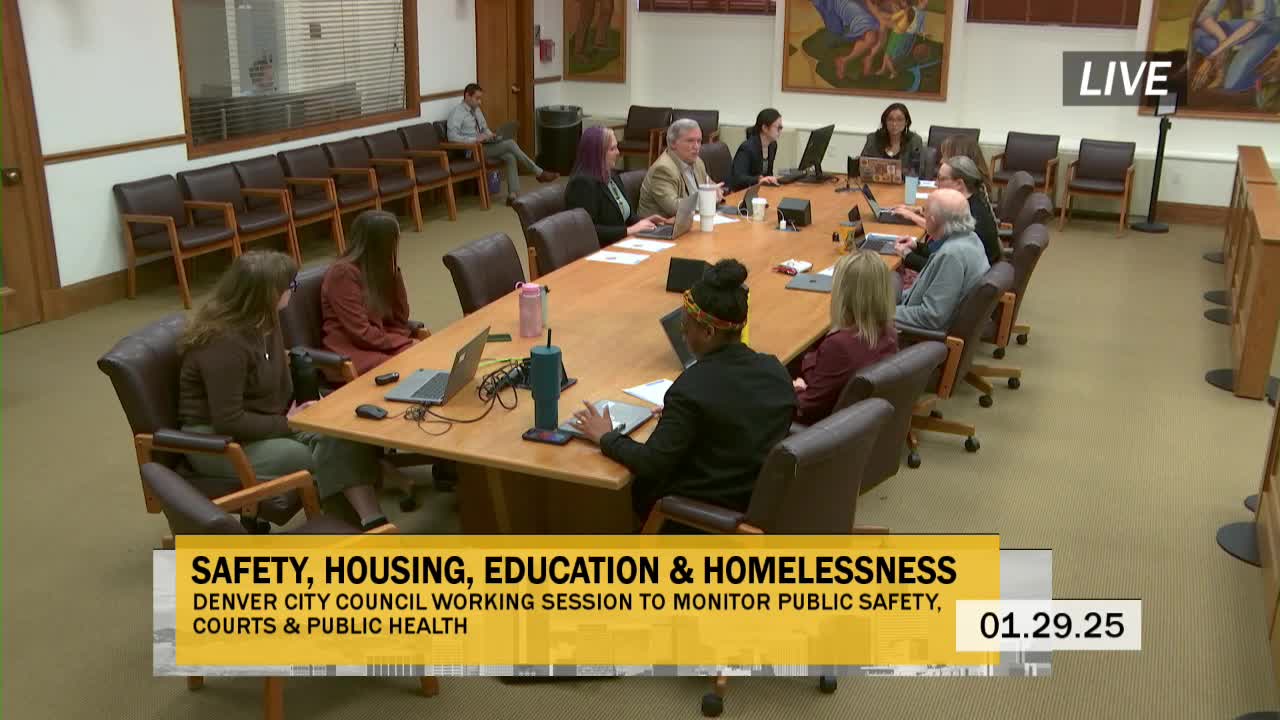
Denver municipal public defenders presented data to the Safety, Housing, Education and Homelessness Committee on Jan. 29 saying the city’s first dedicated youth municipal defense unit has produced case dismissals and expanded access to expungement but also exposed racial disparities in ticketing, gaps in diversion services and other procedural problems that can push young people deeper into the justice system.
"It was kind of a theory that I had that perhaps municipal court was step 1 in the school to prison pipeline. That theory has been essentially proven," said Nicole Duncan, a senior municipal public defender on the youth team, summarizing the unit’s early findings after it began regular court coverage in mid‑2023 and began collecting systematic data in 2024.
The defenders told the committee they had handled roughly 333 youth cases through December and said assaults accounted for the single largest category — about 36 percent, or 107 of those cases. About 42 percent of youth charges were resolved at first appearance, and the defenders said their investigations and negotiations have led to dismissals in roughly 16 percent of cases.
Lulu Scully, a legal administrative assistant with the youth team, walked members through demographic and school‑related findings: school citations made up roughly 30 percent of the unit’s caseload, and the data show pronounced disparities. "Of that 30 percent, about 26% of all those charges brought from schools are directed toward Black female youth specifically," Scully said. She and other presenters said Black male youth made up about 20 percent of the unit’s caseload — roughly double the share of Black youth in Denver’s population.
The defenders described several procedural problems they say are common in youth municipal cases: a two‑month delay between issuance of some tickets and the first court date, limited initial fact‑finding by police or school staff, and instances where warrants or failure‑to‑appear records from childhood remained unresolved into adulthood. The team highlighted that a change in Colorado law now allows many youth records at the municipal level to be expunged — a development the defenders said they are using to clear longstanding barriers for young adults.
Staff and council members raised specific operational hurdles tied to diversion and sentencing practices. The presenters said diversion menus and contracted service options have changed after budget cuts; some standard offers now include 20 hours of community service in addition to diversion, which the defenders warned can be impractical for young people who lack adult supervision or transportation. "What is 20 hours for a 14‑year‑old or 15‑year‑old that has school, has a job, may need a ride?" Casey Duncan, a senior public defender, asked the committee.
The defenders also described a practical gap: many community organizations that provide service hours do not accept participants under 16, leaving children ages 10–14 with few realistic options to complete court‑ordered community service. The presenters said that problem has led to troubling workarounds in some cases that are not appropriate, and they said the court has begun accepting a wider range of positive activities as community service where possible.
Council members repeatedly pressed for follow‑up actions. Councilman Paul Cashman praised the unit’s evidence collection but asked about coordination with the city attorney’s office and the city diversion program. Chair Sarana Gonzalez Gutierrez and the presenters said they are seeking additional stakeholder meetings and noted a planned briefing from the Office of Neighborhood Safety and Denver Public Safety Youth Programs on Feb. 26.
Immigration consequences also emerged as a pressing concern. Presenters warned that because municipal youth charges can be treated like adult charges in some immigration contexts, even low‑level offenses such as shoplifting or theft may carry collateral immigration risk. "We are seeing so many adults facing shoplifting charges and not being given or offered immigration‑safe pleas on it," the presenters said. They described at least one case in which a youth faced transfer out of state and serious immigration impacts until the defenders intervened.
The committee did not take formal legislative action on the briefing. At the meeting’s close the chair said five consent items would move to the full council because no member pulled them; committee members also requested further data on non‑school‑related tickets, middle‑school caseloads, and whether particular schools or charter schools were producing disproportionate numbers of referrals.
The defenders recommended more coordinated outreach to Denver Public Schools, diversion providers and the city attorney’s office, and urged clearer funding for evidence‑based diversion services tailored to young people. Presenters said the unit’s presence in court has produced tangible case outcomes — dismissals, expungements and more informed plea and diversion decisions — but they emphasized that structural changes in ticketing, diversion funding and school practices will be necessary to reduce longstanding disparities.
The committee requested the unit return for further briefings and to share additional breakdowns requested by council members, including analyses of the 70 percent of youth tickets that do not come from in‑school citations and more granular middle‑school data.