Get Full Government Meeting Transcripts, Videos, & Alerts Forever!
Get email alerts on the Fair Elections Fund topic
No spam. Unsubscribe anytime.
Denver committee advances broad revisions to elections code, Fair Elections Fund rules
Summary
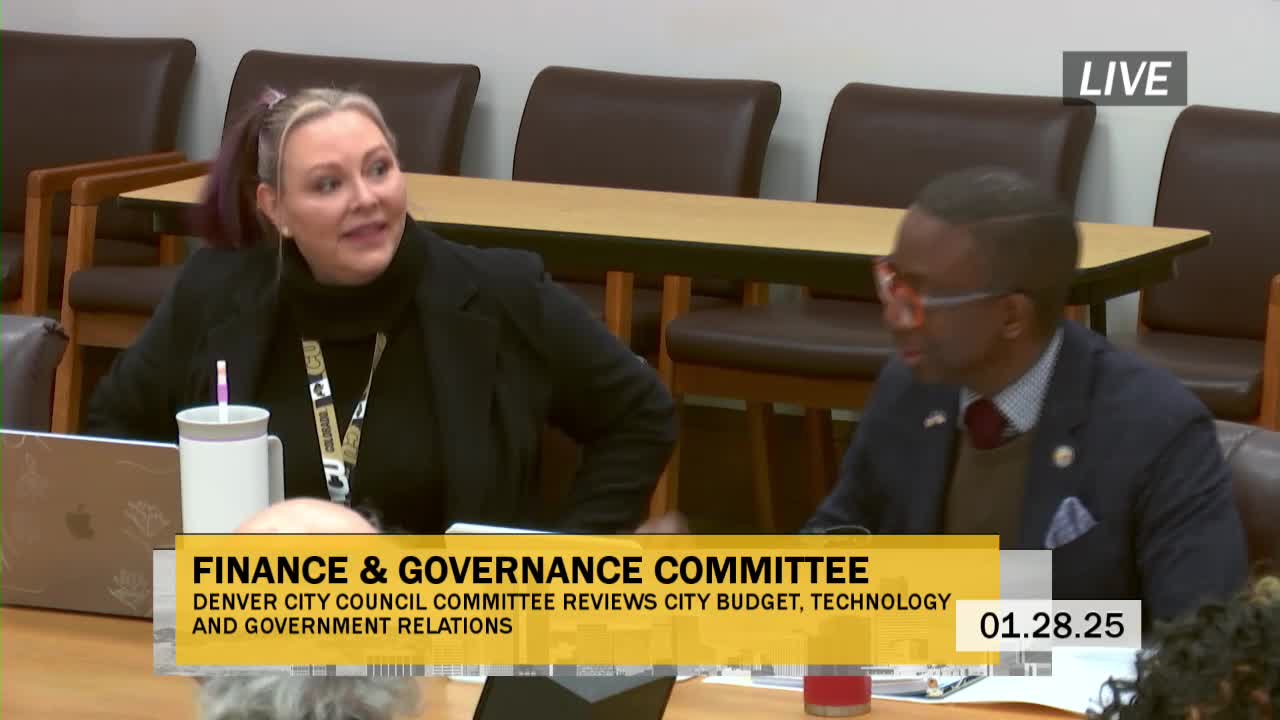
The Finance and Governance Committee on Jan. 28 voted to file proposed revisions to Denver’s elections code and to tighten rules for the voter-approved Fair Elections Fund, including a ban on anonymous donations, new requirements for neutral and accessible debates and a formal third-party investigatory process.
Denver — The Finance and Governance Committee on Jan. 28 voted to file a proposed ordinance (Bill 24-4676) that would revise Denver’s elections code and tighten rules for the voter-approved Fair Elections Fund (FEF).
The committee advanced the package by voice/thumbs call after a lengthy discussion about debate logistics, spending restrictions and investigatory process. Councilwoman Amanda Sawyer, District 5, a prime sponsor of the changes, told the committee the updated package consolidates code language and responds to problems identified after the FEF’s first full use in 2023. "We have gotten to a place where I think we are all very, we're on the same page, we're all very excited about these changes, we think that they're going to strengthen our entire campaign finance, and elections division," Sawyer said.
Why it matters: The proposal combines five substantive changes to Denver’s campaign finance rules: (1) unifying and simplifying the elections code; (2) banning anonymous donations (while keeping the existing $50 cash contribution option but requiring contributor identification); (3) setting accessibility and neutrality standards for FEF‑related candidate debates and requiring broadcast; (4) formalizing a neutral, third‑party administrative hearing officer process for investigations into campaign finance complaints; and (5) listing prohibited expenditures for FEF dollars, including alcoholic beverages (as referenced in "chapter 6"), regulated marijuana (cited as the "Colorado marijuana code"), tobacco ("chapter 24"), gifts over $50, payments of fines/penalties to the city, purchase of prepaid credit/gift cards and reimbursable purchases of personal/real property above a de minimis threshold.
Key details and debate: Sponsors emphasized readability and easier navigation of the elections code so prospective candidates, independent expenditure groups and campaign staff can find requirements about becoming a candidate, fundraising and reporting.
On anonymous donations, Sawyer and colleagues argued undisclosed cash can erode public trust; the proposal keeps the existing $50 cash contribution allowance but would require the same identification and reporting that other donations require.
The debate section prompted the most sustained questioning. The draft requires that debates tied to FEF participation be neutral, accessible and broadcast, and it directs the city to contract with a third party that is not affiliated with a political party or candidate to organize and broadcast debates. Council President Sandoval and several members expressed concern about embedding a requirement to contract in the ordinance because an RFP might receive no responses, and because operational details (who holds the contract, fiscal impacts and scheduling) remain uncertain. Katie Spares, chief deputy city clerk, said the office is discussing a memorandum of understanding (MOU) with other city agencies (for example Arts & Venues and Technology Services) and that the likely approach is an MOU combined with an outside coordinator to handle event logistics and moderator vetting. "The plan will be to sign an MOU," Spares said.
Committee members pressed for remedies if neutrality or accessibility standards are not met; legal staff said contractual remedies would be the primary enforcement mechanism if contracting language is used. Assistant City Attorney Anshul (last name not specified in the transcript) explained the legal distinction the sponsors were relying on: "If we are giving candidates city money — Fair Elections Fund money — then we can require reasonable restrictions on the spending of that money."
Prohibited expenditures: Sponsors and clerk staff said the list of banned FEF expenditures was narrowed after stakeholder feedback. Finance Administrator Nick (last name not specified) said the city's main enforcement concern is resale value, not the precise de minimis threshold: "Our concern is really resale value, not even de minimis value." The clerk's office described a draft rule that would treat items under a proposed $250 threshold as not requiring liquidation, while items with meaningful resale value (for example a $5,000 computer or high-end camera) would have to be sold or reimbursed to the fund. Clerk staff said the property reimbursement rule was enforced during the 2023 election cycle for a small number of items (a printer and laptops) and that guidance and candidate training would clarify how the rule would operate going forward.
Investigations and hearing officers: The draft ordinance formalizes a process in which the clerk’s office refers complaints (for example filing or reporting anomalies) to neutral administrative hearing officers who would follow state judicial conduct standards and make determinations, including potential decertification or fines. Sponsors said this step is intended to preserve due process and avoid the clerk’s office making investigative determinations in cases that could present conflicts of interest.
Fiscal questions: Committee members asked about the funding needed to contract and broadcast debates. City staff said costs vary widely by approach — hosting debates at Denver 8 (the public broadcaster) could cost tens of thousands of dollars for studio staffing, while conducting live, broadcast debates across every council district could be in the low millions. Clerk staff said the fair elections fund could contribute, but the city’s general fund and other partner agencies would likely need to share costs depending on the chosen model.
Votes at a glance: The committee approved a motion to file Bill 24‑4676 and move it to the full City Council, with a yes outcome in committee. The ordinance is scheduled to advance to a public town hall on Feb. 4, first reading on Feb. 10 and a required public hearing and second reading with vote on Feb. 18, per presenters.
What’s next: If the full council accepts the filing, the clerk’s office plans a public town hall at the Glenarm Recreation Center, 2800 Glenarm Street, on Feb. 4 (6–7 p.m.) with interpretation services and food. The clerk’s office also expects to finalize rules and guidance that will explain de minimis thresholds, candidate education, and the MOU or contracting approach for debates.
Context and limits: The changes apply to candidate accounts and the FEF program, which serves mayoral, council, clerk and other municipal races in Denver. The proposed ordinance references existing clerk rules and regulations that were in effect during the 2023 election and seeks to codify several of those practices. The committee discussion included multiple references to existing provisions (for example identification requirements for $50 cash donations and existing clerk reimbursement rules) and to the voters’ 2023 adoption of the Fair Elections Fund. The article reports only actions and statements recorded in the committee transcript and does not infer outcomes beyond the committee’s vote to file and refer the bill to the full council.