Get Full Government Meeting Transcripts, Videos, & Alerts Forever!
Get email alerts on the Homelessness topic
No spam. Unsubscribe anytime.
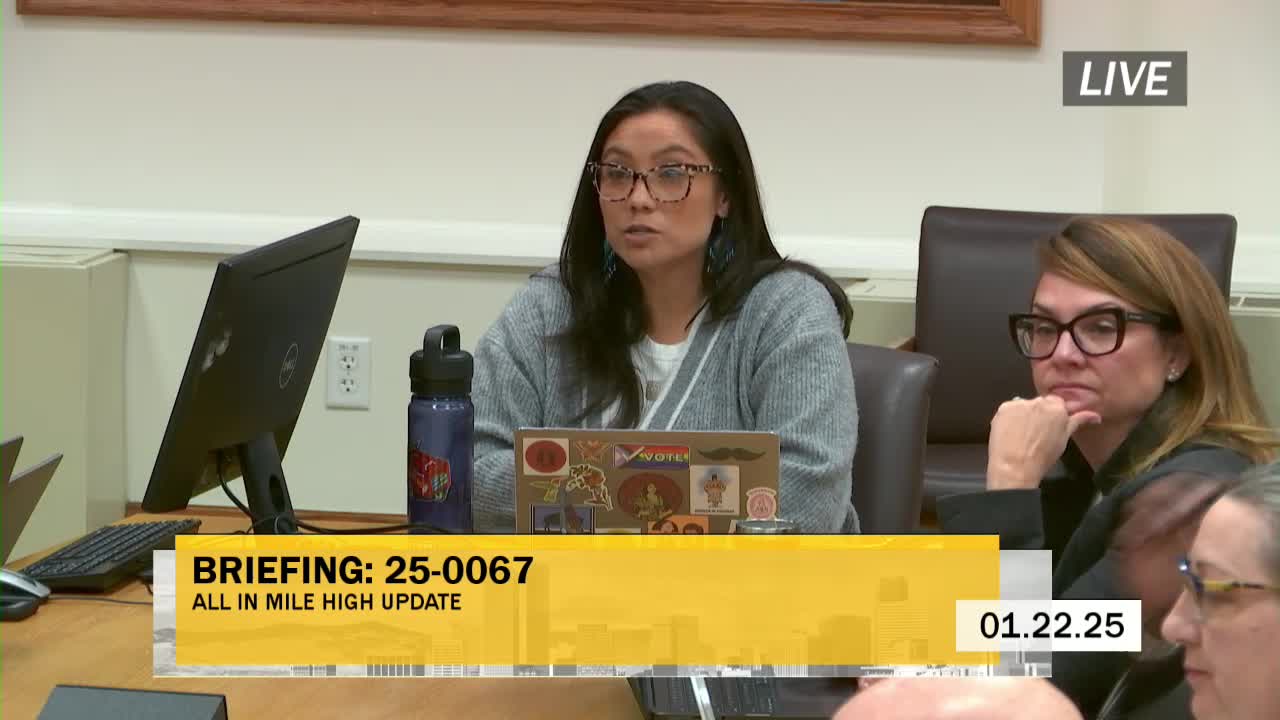
Denver officials outline 2025 plan to shift All In Mile High from short-term sheltering toward permanent housing
Summary
City departments briefed the Safety, Housing, Education and Homelessness Committee on plans to refocus Denver’s All In Mile High program in 2025: add intake and navigation staff, amend provider contracts, wind down one hotel site and prioritize connecting people to permanent housing and services.
Denver officials presented a high-level plan Wednesday to shift the city’s All In Mile High homelessness response in 2025 from emergency hotel sheltering toward permanent housing and enhanced on-site services.
Cole Chandler, deputy director of the All In Mile High initiative at the city’s Department of Housing Stability (HOST), told the Safety, Housing, Education and Homelessness Committee the administration plans to realign contracts, add new staffing roles at shelter sites and move short-term shelter investments into permanent housing. "We are a national leader in this space," Chandler said, adding the city has brought more than 2,200 people indoors and connected roughly 850 people to housing to date.
The committee was told the city will emphasize three site-based roles in 2025 — intake specialists, housing navigators and housing stabilizers — instead of a single case manager role. Intake specialists will assess and orient people on arrival; housing navigators will work with people during the initial move-in phase; and housing stabilizers will provide 12 months of follow-up after placement.
Why it matters: Officials said the remaining unsheltered population shows higher behavioral-health and substance-use acuity, so the city wants faster, real-time coordination among HOST, the Denver Department of Public Health and Environment (DDPHE), the Department of Economic Development and Opportunity (DEDO), Denver Workforce and safety partners to connect people to the right services quickly.
Tristan Sanders, director of community behavioral health at DDPHE, described steps to strengthen clinical capacity: a nurse care coordinator placed at the DoubleTree last fall completed nearly 250 clinical intakes in the last two months of 2024, he said, and that role will be expanded in 2025. "That care coordinator was able to do intakes for anybody that needed it across the system," Sanders said, and the city is negotiating an amended contract with the Colorado Coalition for the Homeless (CCH) to reflect additional nurse care coordination and on-site services.
Officials also described operational and site changes: the Radisson Hotel master lease will end in March and the city is winding that site down while moving residents into permanent housing; the city plans to request a one-year extension for the Comfort Inn; four tiny-home and pallet-shelter micro communities have been integrated into the system and new sites were resourced to provide 24-hour staffing.
On outcomes and safety metrics, presenters said a city dashboard shows 19 deaths among people experiencing homelessness recorded through 2024, about 65 percent of which were confirmed overdoses, and that the Office of the Medical Examiner’s early reporting indicates a 32 percent reduction in overall deaths for people experiencing homelessness from 2023 to 2024. The city also reported a 45 percent reduction in 311 and 911 calls related to homelessness since the initiative began, officials said.
Workforce and evaluation: Denver Workforce described a referral pathway for people placed into rapid rehousing and said monthly three-day “Next Step” employment workshops and monthly hiring fairs will be offered, with initial fairs at Fort Barnum Library and bus tickets available for attendees. The Urban Institute will serve as an external evaluator to produce a multi-year review of the effort.
Contracting and provider questions: Committee members pressed the administration about reliance on a single large provider, the Colorado Coalition for the Homeless, and said they want options to scale services across multiple providers. Chandler said the city is considering either amending CCH’s contract or pursuing additional procurements to bring other providers into care delivery, and that negotiation on reporting and staffing details is ongoing.
Neighborhood impacts and policing: Council members raised concerns about concentration of sites and impacts on neighboring districts, particularly along the Quebec Corridor in Districts 2 and 8. The Denver Police Department said it has designated priority response within a 1,000-foot radius of sites and will adjust patrol staffing and targeted strategies for Quebec and downtown areas. Committee members and presenters reiterated that every site has a Good Neighbor Committee that meets monthly to address local concerns.
Next steps: Officials told the committee they will return quarterly with reports and that several contract actions — including an amended CCH contract and other service contracts — will be filed with the council in the coming weeks to months. Chandler said the goal for 2025 is to bring 2,000 people indoors and help 2,000 people exit homelessness permanently, while continuing investments in prevention and affordable housing.
Ending note: The committee did not take any formal votes on actions during the briefing. Members said they want regular one-page updates on site operators, client counts and contract details as items move forward to formal filings.