Get Full Government Meeting Transcripts, Videos, & Alerts Forever!
Get email alerts on the Homelessness topic
No spam. Unsubscribe anytime.
Denver committee hears All In Mile High plan to shift contracts, wind down Radisson and expand housing supports
Summary
City officials briefed the Safety, Housing, Education and Homelessness Committee on contract changes and service shifts in the All In Mile High street-homelessness response, the planned March wind-down of the Radisson site, and goals to move 2,000 people indoors and help 2,000 exit homelessness in 2025.
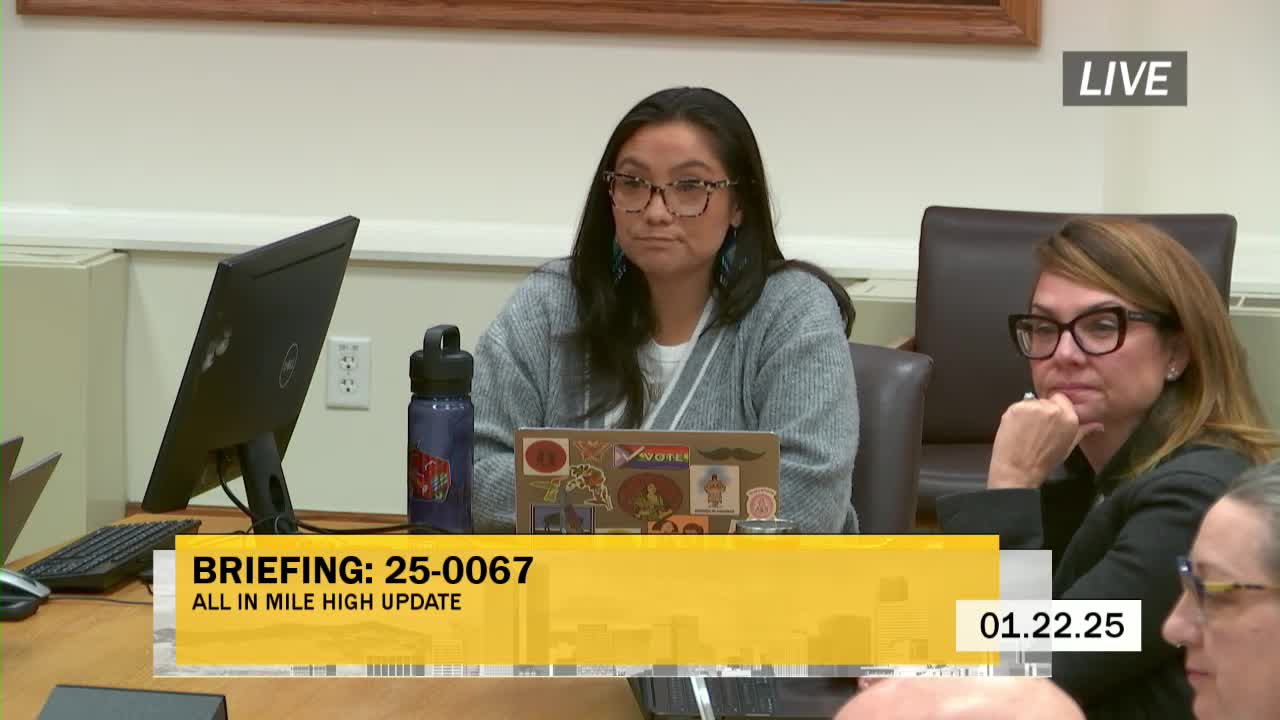
Denver City Council’s Safety, Housing, Education and Homelessness Committee received a briefing Wednesday on the city’s All In Mile High effort to reduce street homelessness, including planned contract changes, a March wind-down of the Radisson site and new staffing roles to connect people to housing and services.
Cole Chandler, deputy director of the All In Mile High work at Host, told the committee the city’s effort will shift in 2025 from clearing large encampments to ‘‘real-time coordination’’ across agencies and more intensive support for people with higher behavioral-health and substance-use acuity who remain unsheltered. ‘‘We are a national leader in this space, and have developed a system that has really been able to respond to the needs of people living on the streets and move forward to address large encampments,’’ Chandler said.
Why it matters: city officials framed the changes as a move from short-term emergency shelter spending toward investments that produce longer-term exits to permanent housing. Chandler said the city’s North Star is ‘‘to end street homelessness in Denver for all populations,’’ and described goals to bring 2,000 people indoors and help 2,000 people exit homelessness in 2025.
Key details - Scope and outcomes to date: presenters said the city has brought more than 2,200 people indoors, connected about 850 people to housing and recorded a roughly 45% reduction in 311 and 911 calls related to homelessness compared with earlier baselines. Officials also said the city ended the cycle of street homelessness for veterans in 2024 using All In Mile High resources.
- Deaths and harm reduction: Chandler and other presenters reported 19 deaths among people experiencing homelessness by the end of 2024, about 65% of which are confirmed overdoses on the Office of the Medical Examiner dashboard. Chandler said the medical examiner’s early data showed a 32% reduction in overall deaths among people experiencing homelessness from 2023 to 2024.
- New roles and contracts: Host will push for contract changes that split what had been a single ‘‘case manager’’ role into three distinct positions: intake specialists (initial assessment and site orientation), housing navigators (30-day move-in support) and housing stabilizers (12-month post-move support). Tristan Sanders, director of community behavioral health at the Denver Department of Public Health & Environment (DDPHE), said the city will seek a contract amendment with Colorado Coalition for the Homeless (CCH) to add nurse care coordination and more on-site services; Sanders said CCH’s nurse care coordinator completed ‘‘almost 250 intakes in the last 2 months of the year.’’
- Service delivery questions: multiple council members asked whether relying on a single large provider (CCH) created risk and urged the administration to consider additional providers. Chandler and Sanders said officials are exploring whether to amend CCH’s contract for expanded services or to procure additional service providers later in 2025.
- Radisson site and budget implications: the administration said the Radisson master lease will end in March and the city is working to wind that site down while helping residents move into housing. The committee was told the Radisson cost was on the order of $10 million per year for lease costs and about $3 million annually for services; Chandler said those dollars could be redirected to permanent housing or rapid rehousing supports after the site closes.
- Micro communities, permits and property restrictions: presenters said the city incorporated the 4,000 Monroe Street micro community and upgraded another site at 3800 Steel Street to pallet shelters with 24-hour staffing; both are in District 9. Lisa Lumley, director of real estate, said land exchanged with the Colorado Department of Transportation (CDOT) carries a public-purpose restriction and may include reversion language if the land stops being used for housing-related public purposes.
- Operations and neighborhood coordination: every All In Mile High site has a Good Neighbor Committee, and the city has designated a 1,000-foot priority-response radius around shelters (including the Quebec Corridor) for coordinated police and outreach response. Several council members raised concerns about police-district workload and requested clearer reporting on who is operating each site and up-to-date occupancy and operator lists.
Questions and concerns from council members Council members acknowledged progress but pressed for more data and transparency. Paul Cashman asked for an update on Rose Recovery and a brief one-page dashboard on who is where in All In Mile High. Darryl Watson and others asked about diversifying service providers rather than concentrating contracts with a single large provider. Amanda Sawyer, Kevin Flynn and others asked for clearer service-quality reporting and more detail on staffing frequency and training; Tristan Sanders said the administration will add reporting requirements and negotiate contract language that specifies staff roles supported by the contract.
Next steps Chandler said the administration plans to file multiple contract amendments and new service contracts in the coming weeks and months; the committee was told it will receive quarterly report-outs and that the Urban Institute has been contracted to provide a multi-year independent evaluation. Committee members requested follow-up materials, including a one-page site operator/occupancy report and more detail on Radisson lease costs. No formal committee votes or ordinances were taken during the briefing.
The committee adjourned after the briefing and moved 11 consent items to full council.