Get Full Government Meeting Transcripts, Videos, & Alerts Forever!
Get email alerts on the Lead Reduction Denver Water topic
No spam. Unsubscribe anytime.
Denver Water briefs council committee: 30,000 lead service lines replaced; program to continue with new tools and consent changes
Summary
Denver Water told the committee it has replaced about 30,000 lead service lines since launching its lead reduction program in 2020 and described inventory, consent and outreach changes intended to accelerate remaining replacements.
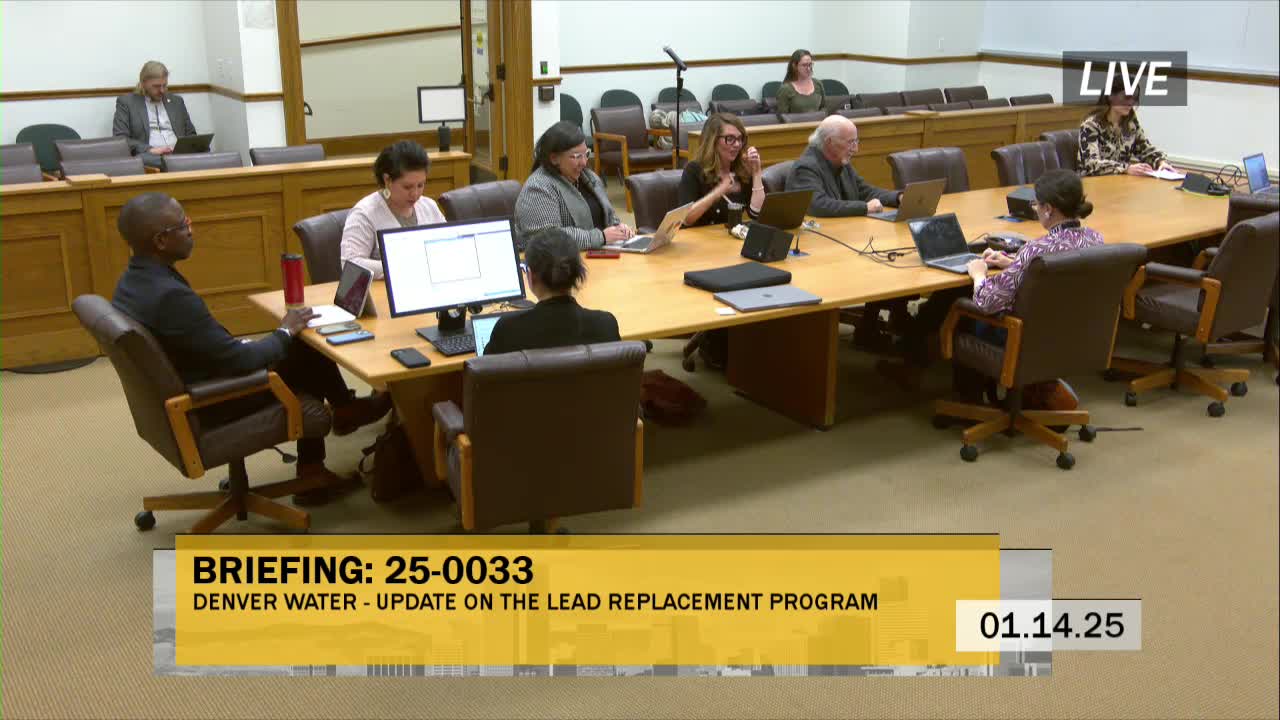
Denver Water presented an update to the Land Use, Transportation and Infrastructure Committee on Jan. 14 on the utility’s lead reduction program, describing program progress, process changes and outreach tools for neighborhoods slated for work this year.
"We hit 30,000 lead service lines replaced," Meg Truby, Denver Water public affairs manager for the lead reduction program, told the committee, reporting what the utility described as a major program milestone since launching the effort in 2020. Truby and Pam Williams, who co-manage communications for the program, explained the program’s five components: managing water chemistry, maintaining an inventory of service-line materials, distributing certified pitcher filters, replacing customer-owned and utility-owned lead service lines (no direct cost to customers), and ongoing communications and outreach.
Key updates Denver Water provided: - Inventory revisions and online tools: Denver Water maintains a searchable inventory on denverwater.org; the utility added a self-reporting tool in 2025 that allows property owners and tenants to upload photos (mobile or desktop) to help identify service-line materials and remove addresses from the "unknown" category when confirmed. - Consent and enrollment changes: Denver Water now accepts signed consent from tenants or authorized representatives (not only property owners), a change intended to accelerate replacements at occupied properties where owners are non-responsive. - Pitcher-filter program: Free NSF-53-certified pitchers and replacement cartridges are distributed to enrolled addresses and tracked by address; replacements are issued automatically on a rotation and remain available until the service line is replaced and for six months afterwards. - Replacement progress and inventory: The utility said it had replaced roughly 30,000 lead service lines. Denver Water’s earlier full-inventory estimate (80,000–84,000) has been refined: current inventory shows 60,000–64,000 addresses classified as lead or unknown, with about 30,000–34,000 remaining replacements to complete. - Nonresponsive-customer protocol pilot and shutoffs: Denver Water ran a pilot with 199 nonresponsive customers; it issued shutoff notices as a last-resort enforcement step and reported one shutoff during the pilot. The utility plans to incorporate the outreach and shutoff protocol into routine operations during 2025, emphasizing layered outreach (mail, door knocking, robocalls, tags) before any shutoff. - Regulatory changes: Revisions to the federal/state lead and copper rules require annual notice to customers whose service lines are known or unknown and will expand school and child-care facility testing beginning in 2027; Denver Water said these regulatory changes did not alter customers’ day-to-day participation in the replacement program.
Truby and Williams described restoration expectations for property owners: streets receive temporary patches during construction followed by permanent repairs coordinated with city paving schedules; Denver Water repairs irrigation and meter boxes and attempts to return landscaping to preexisting condition but does not perform drywall repairs inside homes. Denver Water recommends that households continue to use pitcher filters for approximately six months after a replacement and offers retesting at about the four-month mark to check for residual interior-plumbing lead.
Program staffing and procurement details cited by Denver Water: a combination of Denver Water crews and multiple contractor teams execute replacements; federal funding (a $76 million award from the Bipartisan Infrastructure Law) accelerated work and expanded contractor capacity. At the time of the briefing Denver Water reported four active contractor teams (transitioning to two later in 2025), a broader program workforce of approximately 500 people (staff plus contractors), and the utility’s total workforce at about 1,100 employees.
During Q&A council members raised neighborhood-specific concerns (e.g., Lincoln Street concrete panels and an aging main that require coordinated main replacement before service-line work) and distribution/identification questions; Denver Water pledged to follow up with individual council offices on localized scheduling and to publish work-area maps and a "pipes" map that shows current construction activity (denverwater.org/pipes). The utility announced a virtual community meeting scheduled for the following evening for residents in neighborhoods slated for 2025 work.
What this means locally: Denver Water’s program continues to rely on directed outreach, address-level inventory work and contractor operations to complete remaining replacements. Tenants and property owners who receive notices should use the online inventory tools, sign consent (owner or authorized representative), and use provided NSF-53 pitchers until their service line has been replaced and retested.