Get Full Government Meeting Transcripts, Videos, & Alerts Forever!
Get email alerts on the Land Use topic
No spam. Unsubscribe anytime.
Committee advances citywide limits on new gas stations; exceptions for large grocery stores and EV charging expansion allowed
Summary
The Land Use, Transportation and Infrastructure Committee advanced two companion text amendments that would limit where new retail gas stations can be built in Denver, creating buffers around rail stops, existing stations and low‑intensity residential districts.
The Land Use, Transportation and Infrastructure Committee on Tuesday advanced two companion text amendments to the Denver Zoning Code that would restrict where new retail gas stations (automobile fueling stations) may locate in the City and County of Denver.
Community Planning and Development staff described the proposal as a targeted use limitation designed to preserve land along transit corridors for walkable, mixed‑use and housing‑oriented development. Under the proposed language, new retail gas stations would be prohibited in three circumstances: inside a quarter‑mile buffer from rail transit stations; inside a quarter‑mile buffer from an existing retail gas station; and within 300 feet of a protected district (low‑intensity residential zone districts). The proposal exempts non‑public fueling facilities (for example, fleet fueling) and allows an exception where a fueling station is developed concurrently with a large format retail use in a structure of 20,000 square feet or more (for example, a full‑service grocery store or warehouse‑format retailer).
CPD staff, Alisa Childress and Andrew Webb, said the amendment would also allow existing gas stations that become “compliant” under the new rules to add electric‑vehicle charging equipment even if other expansion is restricted. The adopting ordinance would also include a sunset/grace provision: projects submitted for review by May 13, 2024, may continue under the existing rules.
Why it matters: Sponsors — Council President Pro Tem Diana Romero Campbell (District 4), Councilmember Amanda Sawyer (District 5) and Councilmember Paul Cashman (District 6) — framed the text amendments as a tool to limit proliferation of auto‑oriented uses on scarce land so more parcels can be used for housing and transit‑supporting development. Romero Campbell said, “The problem we're trying to solve here is an extreme proliferation of gas stations in the city and county of Denver on land that could and should be used for housing.”
Public input and review: CPD reported robust stakeholder engagement and a planning board informational item; the Planning Board unanimously recommended approval on Dec. 18. CPD said it received about 123 public comments from 118 unique commenters: roughly 42% expressed support (including a letter of support from the Colorado‑Wyoming Petroleum Marketers Association), about 35% opposed citing property‑rights and competition concerns, and the remainder were neutral or conditional. Sponsors and staff said they held targeted outreach, mailed notices to commercial property owners and briefed the City Council Budget and Policy Committee in May 2024.
Discussion and technical points: Councilmembers asked about impacts on existing closed or contaminated fueling sites, future fuels and electric‑vehicle infrastructure, grocery‑store thresholds and the proposed buffers. CPD clarified that a new station could occupy an existing site if the site completed any required remediation; existing compliant gas stations could replace pump equipment and add EV chargers but could not expand pump islands beyond their lawful footprint. Councilmember Paul Cashman said he has not received constituent calls about a lack of stations and framed the policy as prioritizing scarce developable land for housing.
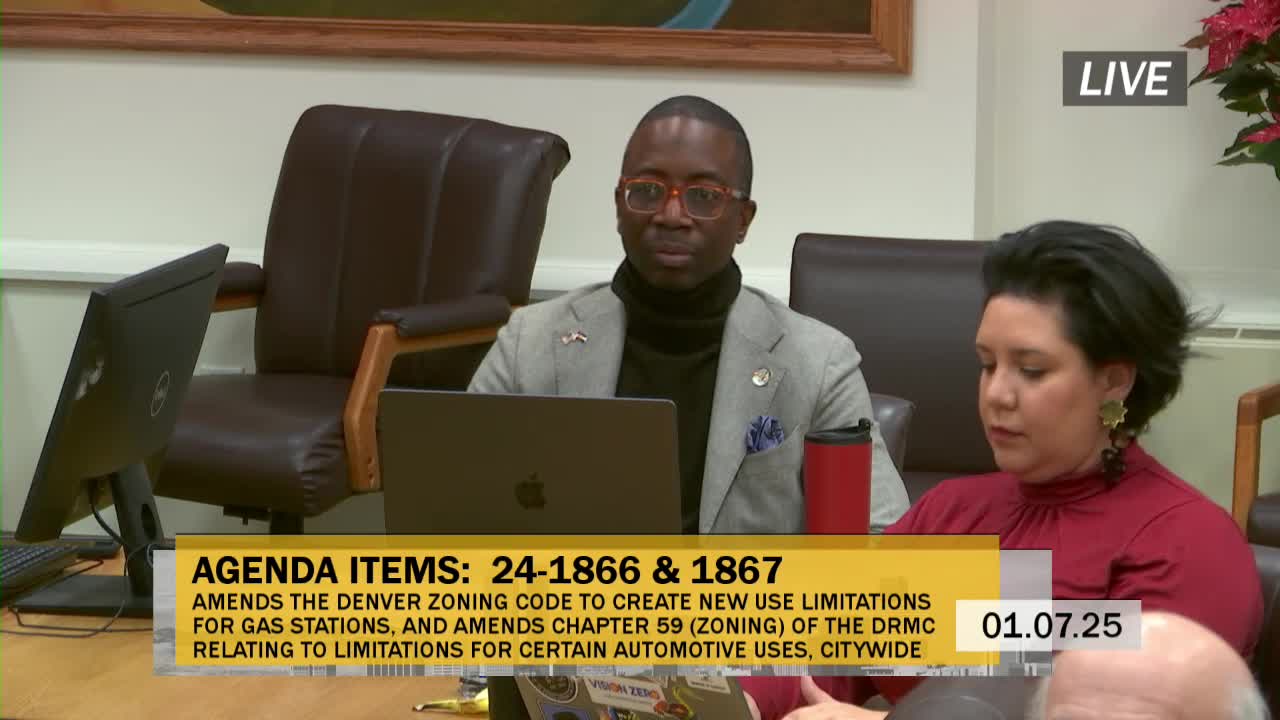
Outcome and next steps: The two items (agenda 241866 and 241867) were presented as a block, moved and seconded and advanced to the full City Council. Staff recommended Council consideration; a future council hearing date was not specified in the committee transcript.
Ending: If the council adopts the ordinances, the limits will apply citywide with the specified exceptions. CPD and sponsors signaled openness to future refinements — for example, Parks requested adding a buffer around parkland but the sponsors said that request arrived after the public notice period and will be considered separately.