Get Full Government Meeting Transcripts, Videos, & Alerts Forever!
Get email alerts on the Criminal Justice Electronic Monitoring topic
No spam. Unsubscribe anytime.
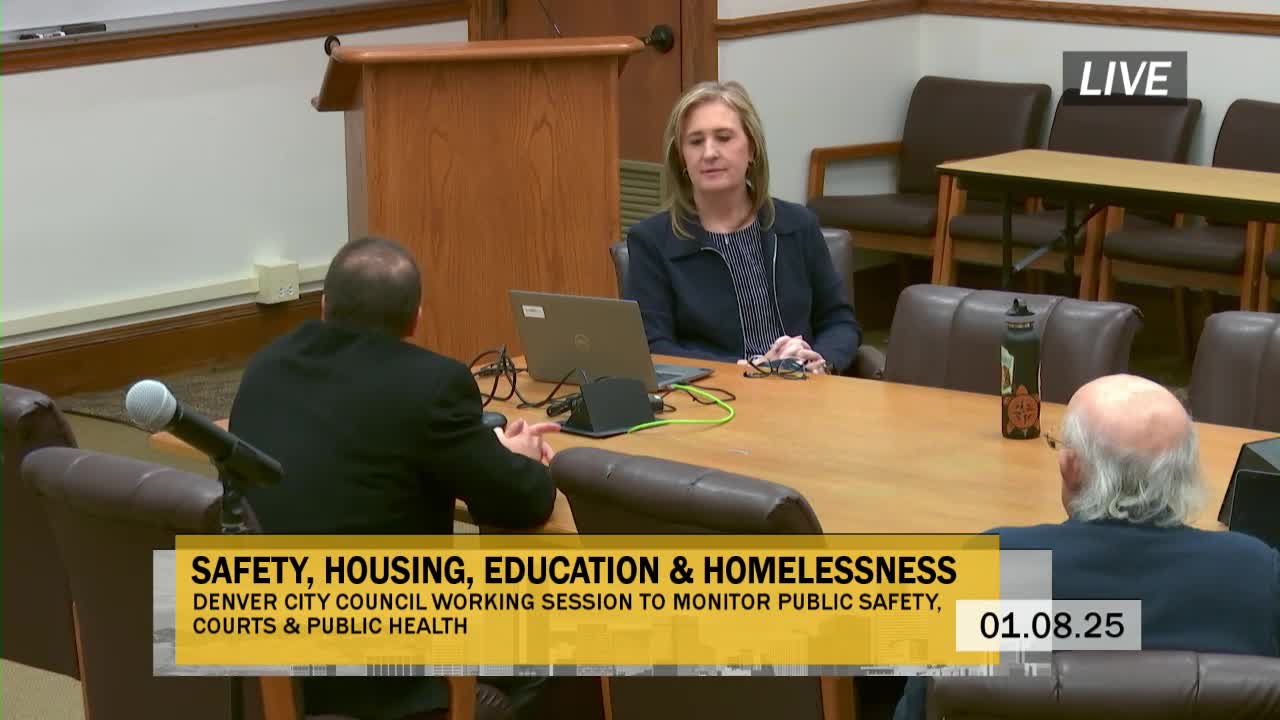
Committee hears presentation on electronic monitoring; two vendor contract extensions sent to full council
Summary
Denver Community Corrections staff briefed the Safety, Housing, Education and Homelessness Committee on use of electronic monitoring in pretrial and in‑home detention programs and requested two contract extensions with monitoring vendors; the committee referred both items to the full City Council for action.
Denver City Council’s Safety, Housing, Education and Homelessness Committee heard a briefing on Wednesday about the city’s use of electronic monitoring for people on pretrial release and serving in‑home detention sentences, and considered two contract extensions for monitoring equipment vendors.
Councilwoman Serena Gonzalez Gutierrez, chair of the committee, opened the agenda item and invited Community Corrections staff to present. Greg Morrow, Director of Community Corrections, told the committee the meeting covered two action items: extending an existing contract with Alcohol Monitoring Systems (AMS) and extending a separate contract with B.I. Incorporated. “The first action item would amend, action item 17 95 would amend a contract with Alcohol Monitoring Systems, or AMS, by extending the term for 2 additional years, running us through January 30 first of 2027,” Morrow said. He said the B.I. Incorporated extension would also run through January 2027 and would add $1,650,000 to that contract “for a new total of 3,150,000.00.”
Aubrey Cote, a manager with Pretrial Services, described how the city uses several types of monitoring technology: active GPS ankle bracelets (used with exclusion and inclusion zones), remote breath devices that use facial recognition for identity confirmation, transdermal alcohol monitors (SCRAM/TAD), and simple radio frequency (RF) bracelets tied to a base station in a residence. “We do that as what we call active GPS… twenty‑four/seven we’re getting information on that client’s location,” Cote said. She explained exclusion zones are commonly used when a court issues a protection order.
Staff described program scale and purpose. Morrow said the city’s Community Corrections and Pretrial Services manage monitoring (staff perform case management and decisionmaking; vendors supply equipment). He and Cote gave these approximate figures: about 2,300 people are on pretrial release on any given day, roughly 18–20% of those have electronic monitoring conditions, and about 600 people in the City and County of Denver are on some type of electronic monitoring device on a typical day (about 500 on GPS specifically). Cote said the in‑home detention (post‑conviction) program is typically used for lower‑level offences and often allows people to remain employed while serving a sentence at home.
Committee members asked for program details and expressed interest in data and equity review. Councilwoman Torres asked about participant fees for the post‑conviction in‑home detention program; Cote said the program charges $13 per day on a sliding scale and noted staff regularly reduce fees for financial hardship. Councilwoman Stacy Gilmore requested data on how many participants are sent to collections; Morrow said the Department of Safety will evaluate the practice in 2025 and provide follow‑up. Council members asked whether Denver’s use of monitoring is higher than in other jurisdictions and whether monitoring replaces incarceration or adds conditions for people who otherwise would be released; Morrow said Denver’s pretrial utilization is relatively high and described the agency’s “time‑limited supervision” option (a common practice in Denver that allows the agency to remove GPS after 60 days of compliant monitoring without returning to court).
Committee members also raised equity and operational questions: whether exclusion zones have been used against people who are unhoused (Cote said exclusion‑zone monitoring is generally ordered only when there is a known protected party and the agency “would shy away” from monitoring vague area restrictions), how drug testing is applied (urinalysis is used when courts order it and when drug involvement is a concern; staff cautioned that testing alone does not treat addiction), and the general fund budget impact of equipment and monitoring (Morrow estimated roughly $750,000–$800,000 per year in the Community Corrections general fund for monitoring expenses).
No final vote on either contract was recorded in the committee transcript. Chair Gonzalez Gutierrez asked for a motion on the two items and, after brief confirmation with members on site and online, said: “Alright, we’ll move forward to the full council.” The transcript indicates both contract extensions were referred to the full City Council for final action. Staff noted both vendors were selected through a competitive process in 2021.
Why it matters: electronic monitoring touches public‑safety policy, court practice and city budgets. Committee members pressed staff for more disaggregated data on race/ethnicity, offense type and outcomes; staff said they are working with research partners (including Arizona State University) and will follow up with additional analysis and with the courts where necessary.
What’s next: The two contract extension items will be considered by the full City Council. Committee staff and Community Corrections committed to returning follow‑up data on fee practices, collections, comparative safety rates for monitored vs. non‑monitored pretrial populations, and equity analyses of who receives monitoring and why.