Get Full Government Meeting Transcripts, Videos, & Alerts Forever!
Get email alerts on the Auraria Framework Plan topic
No spam. Unsubscribe anytime.
Auraria Campus presents framework plan to Denver council committee, cites $6 million general‑fund shortfall
Summary
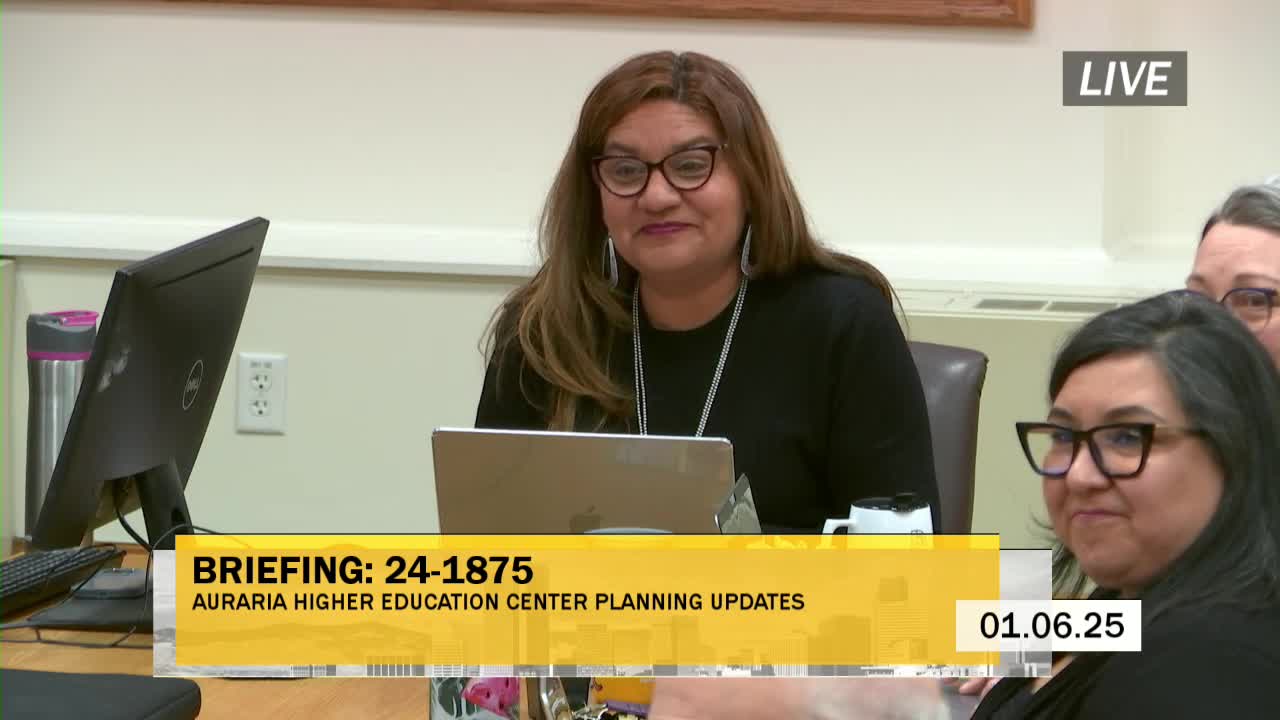
Auraria Higher Education Center leaders told the Denver City Council Budget & Policy Committee on Jan. 6 that a newly adopted Auraria Framework Plan will guide campus development and new revenue streams meant to cover a roughly $6 million annual shortfall in operating funds.
Auraria Higher Education Center leaders told the Denver City Council Budget & Policy Committee on Jan. 6 that a newly adopted Auraria Framework Plan will guide campus development and new revenue streams meant to cover a roughly $6 million annual shortfall in operating funds.
“My name is Colleen Walker. I’m the chief executive officer for the Auraria Higher Education Center,” Colleen Walker told the committee as she introduced the presentation. “But we are Denver’s oldest neighborhood, and that’s something that we really hold quite sacred.”
The presentation outlined the campus’s governance and three primary operating funds — a general fund for campus operations, a student revenue bond fund tied to the Tivoli Student Union and a parking enterprise — and described how campus leaders intend to rely less on parking revenue by growing auxiliary revenues and development opportunities.
“The issue we have is it’s costing us right now about $37,000,000 annually to operate the campus from a general fund standpoint. And so we have a $6,000,000 shortfall that exists,” Zach Hermsen, chief financial officer, said during the briefing.
Why it matters
Auraria hosts Metropolitan State University of Denver (MSU Denver), Community College of Denver (CCD) and the University of Colorado Denver (CU Denver). Campus leaders said the three institutions together enroll about 41,000 students and employ roughly 5,000 faculty and staff, and that the campus generates substantial economic activity for downtown Denver. Council members pressed presenters on housing, transit, and how campus revenues are used.
Plan and near‑term projects
Carl Meese, deputy chief of planning and sustainability, described the Auraria Framework Plan — approved, he said, in June of the previous year — as a 20‑to‑50 year guide emphasizing a compact academic core, transit‑oriented perimeter development, higher‑density mixed uses, and stronger connections between campus and surrounding neighborhoods. Meese read the plan’s vision into the record: “to create a thriving and active campus to support the student success, and institutional identities so that we enrich our collective experience, strengthen that campus cohesion, and achieve the financial sustainability, to continue to operate the campus.”
As an early proof of concept, presenters described redevelopment near the Tivoli Student Union and a 2‑acre former MSU Denver ball field across from Ball Arena. The proposal includes two towers framing a new Tivoli Quad, a “classroom‑to‑career hub” to co‑locate employer partnerships and internship space, ground‑floor dining and retail, expanded early learning facilities and student housing.
Developers and campus staff said the project would add roughly 550 student beds and about 330 affordable housing units targeted to 60%–120% area median income (AMI) for faculty, staff and community members. Presenters said the site will also accommodate an expanded early‑learning center and services for campus events.
Financing and governance
Campus leaders described how the three institutions reappropriate state higher‑education funding to the Auraria Campus based on building square footage and student head count, producing roughly $31 million in annual revenue that covers part of operations and about $2 million in deferred maintenance. The campus’s auxiliary funds — especially parking — currently provide additional revenue.
Skip Spear, chief administrative officer and general counsel, explained the statutory governance structure created by the state to oversee shared services and disputes among the three institutions. The board has nine members, including representatives from the institutions and gubernatorial appointees; two advisory groups, a student advisory committee and a faculty advisory committee, currently serve without voting rights.
When asked about public‑private partnerships, presenters cited the campus’s statutory P3 authorities and told council members the revenue from any P3 development would flow back to campus operations. “Everything that we would be partnering on, the revenue generated would be to go 100% back into the campus,” Walker said.
Community engagement and cultural projects
Auraria staff emphasized community and cultural work alongside physical redevelopment. Lulu Lansy, chief activation officer, summarized programming aimed at “creating healing spaces” and making the campus “belong to everyone.” She cited recent cultural partnerships and events — murals and exhibits, conferences with community groups, a concert on the quad with thousands of attendees, and the first‑time display of five tribal flags in the CU Atrium. Leaders also said a Peace Garden design phase has begun for Ninth Street Park and that restoration work at St. Cajetan’s church is underway.
Council questions and concerns
Council members sought specifics about governance, the board’s statutory authority and whether student and faculty advisors could become voting members; Colleen Walker said the board membership is established in “Title 23, Article 70 of the Colorado Revised Statutes” and that adding voting seats for those advisory groups is under consideration and would require legislative change.
Members also pressed on the campus’s reliance on parking revenue and its sustainability. Hermsen and other presenters said parking revenue currently supports operations but called that dependence “not sustainable long‑term,” noting parking is vulnerable to changes in commuting behavior and to development that may replace surface lots with vertical projects.
Other details captured
- Campus leaders estimated an annual economic impact of about $2.7 billion and roughly $85 million in state and local taxes tied to the campus. - Presenters said the old early‑learning facility has about $2.5 million in deferred maintenance and that the new plan would increase childcare capacity by about 30%. - Parking: presenters said the campus operates more than 6,000 parking spaces across 14 surface lots and three garages. - Community benefits: presenters noted the Ball Arena community benefits agreement includes up‑front funds for the Peace Garden and for displaced and Indigenous community investments (presenters cited roughly $250,000 each in early funds tied to the first permitting phase).
The presentation was informational; no formal council votes or committee motions on Auraria projects were recorded during the session.
What’s next
Auraria leaders said project plans and detailed drawings for the Tivoli Quad and ball‑field redevelopment are forthcoming and encouraged committee members to visit the campus or experience a virtual‑reality walkthrough. Staff also said the campus will continue engagement with displaced community members, Indigenous groups and surrounding neighborhoods as project designs advance.