Get Full Government Meeting Transcripts, Videos, & Alerts Forever!
Get email alerts on the Needle Exchange topic
No spam. Unsubscribe anytime.
Denver residents urge council to reject expansion of needle-exchange rules; supporters push harm-reduction case
Summary
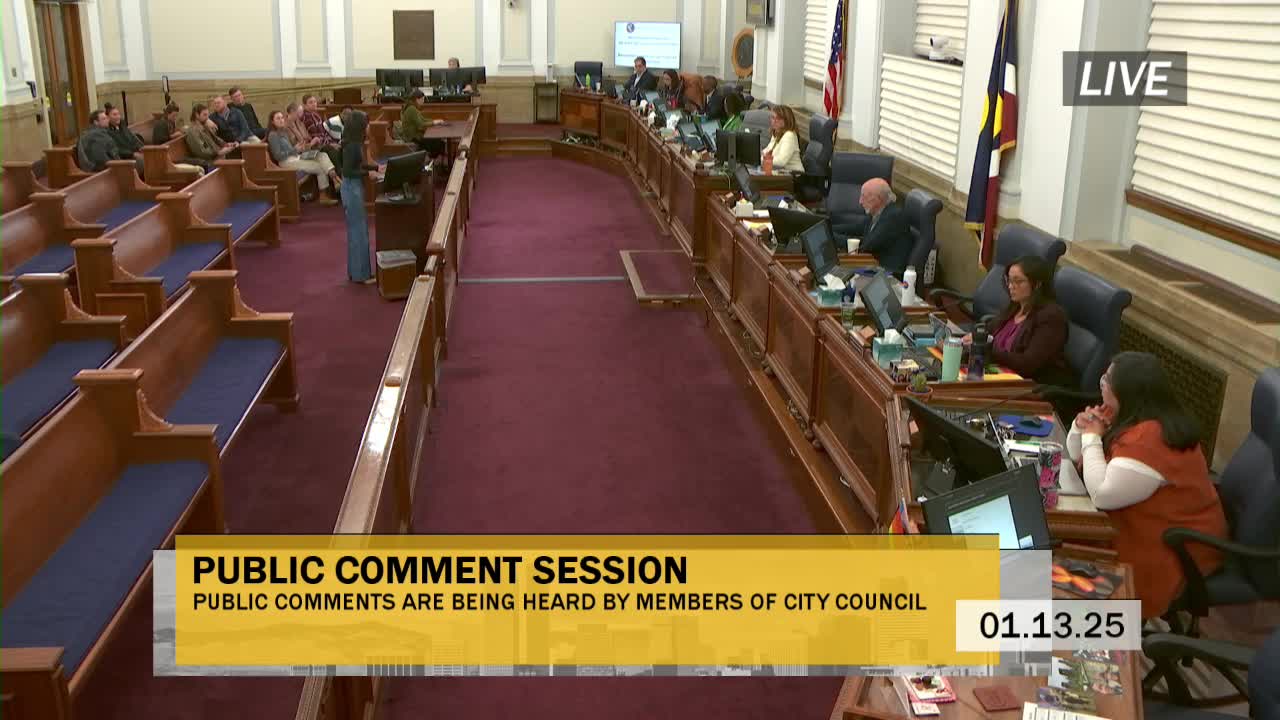
During the Jan. 13 public comment period, multiple residents urged Denver City Council to vote no on File 24-1791, version 2 — a proposal tied to expanding needle-exchange and safe injection-site rules — while others urged support for harm-reduction approaches.
Several dozen Denver residents used the City Council’s Jan. 13 public comment session to debate a proposed change to needle-exchange and safe-injection rules identified in the meeting as “file 24-1791, version 2.” Multiple speakers urged council members to vote no on the file, while others argued expanding harm-reduction services can prevent disease and save lives.
The debate centered on whether to remove a cap on needle distribution sites and to lift a 1,000-foot buffer that currently limits exchanges and related services near schools and day-care facilities. Maria Alicia, who described herself as "a devoted advocate for the Latino and other vulnerable communities," told the council she had lost relatives to addiction and asked members to "vote no on file 24 1 7 9 1 version 2," saying a yes vote would "abdicate your responsibilities" and transfer too much authority to the executive branch.
Opponents raised child-safety and neighborhood-quality concerns. Lisa Cardiff, a District 6 resident, said that although the council’s goal is to reduce harms from drug use, "expanding this...nearby schools, there's absolutely no reason to do this," and cited examples she said showed other cities reversing course. Several other speakers — Shannon Swaro, Heidi Robinson, Christian Jones and Carrie Krambeck among them — asked the council to prioritize children’s safety, questioned how the program would be paid for and warned of increased crime or public exposure to drug use.
Supporters of harm reduction also spoke. Flanders Lautner, who said he has addressed council repeatedly, called harm prevention "an extremely important aspect of actually reducing drug use" and argued that safe injection sites can reduce disease and some criminal behavior. Lautner also asked the council to consider the experiences of people with addiction and the public-health rationale for supervised sites.
Speakers cited other cities during their remarks. Lisa Cardiff referenced Vancouver and Toronto as examples she said had negative outcomes; Lautner and other supporters disputed opponents’ characterizations and framed the policy as public-health intervention rather than endorsement of drug use.
Council members did not respond to comments during the half-hour public comment session, consistent with the stated rules for the period. The council’s meeting agenda and any formal consideration of File 24-1791, version 2 were not part of the public-comment record and no vote or formal action on the file is recorded in the Jan. 13 session.