Get Full Government Meeting Transcripts, Videos, & Alerts Forever!
Get email alerts on the Senior Care topic
No spam. Unsubscribe anytime.
Rocky Mountain PACE tells council it keeps frail seniors at home and saves the state money
Summary
Rocky Mountain Healthcare Services presented its PACE (Program of All‑Inclusive Care for the Elderly) model to the council, describing enrollment, services, funding structure and local scale of operations and saying the model reduces nursing‑home placements and state spending.
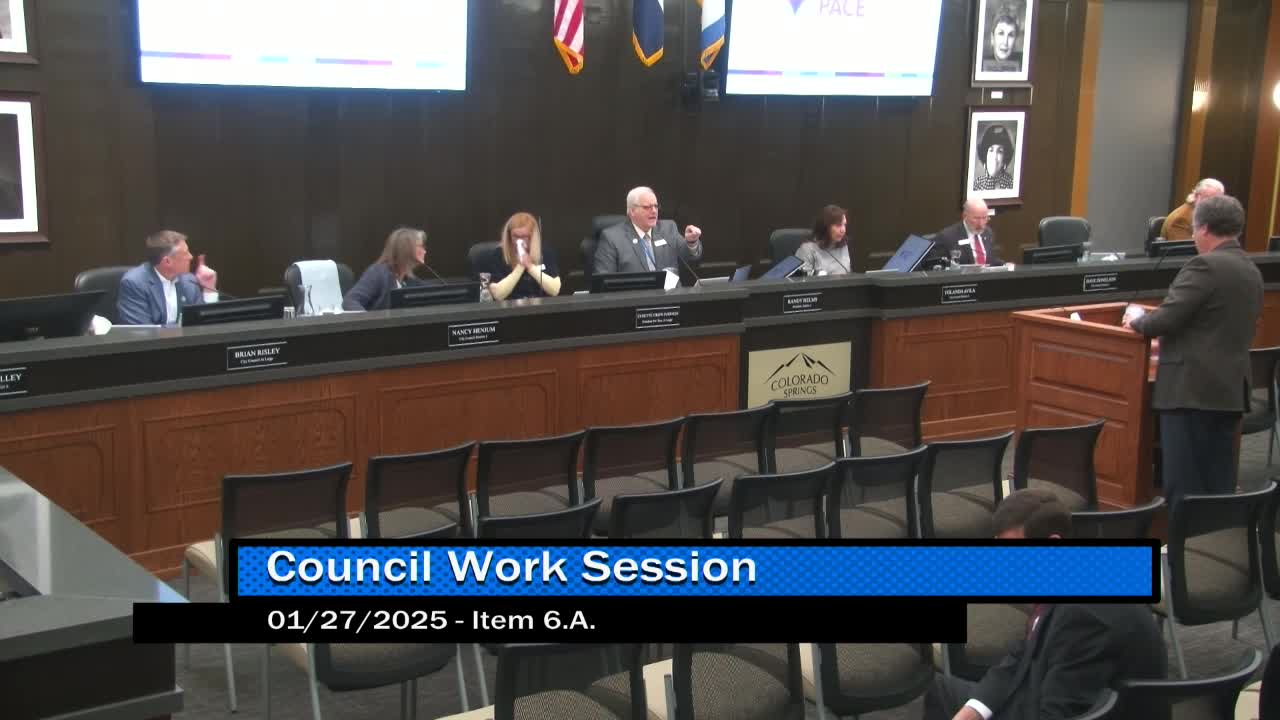
Nate Olsen, chief encouragement officer (CEO) of Rocky Mountain Healthcare Services, told the Colorado Springs City Council at a work session that the nonprofit’s PACE program provides a full continuum of care allowing frail, low‑income seniors to stay at home instead of moving to nursing facilities. "We provide the complete continuum of care," Olsen said, describing a capitated payment model that covers services through an interdisciplinary care team.
The organization, which Olsen said began in 1976 and serves about 1,100 participants, described a range of services — from transportation and home care to dental, vision and social support — and said it uses locally based day centers and field teams to keep people healthy and out of hospitals. Mark Hartman, chief operating officer, added that PACE delivers “door through door” transportation and staff who personally walk participants into appointments.
The presenters said Rocky Mountain Healthcare Services is financially substantial in the local nonprofit mix: they reported roughly $120–$130 million in revenues, about $40 million in payroll and spending of roughly $114 million on other local services during the prior year. The nonprofit said it employs about 440 people with an average annual wage “close to $68,000,” and that participant satisfaction is high.
Olsen described the PACE funding structure as a Medicare/Medicaid capitated arrangement. “We receive a flat fee, and we provide all services that our participants might need,” he said, explaining that PACE acts as both the insurer and the provider and is therefore incentivized to prevent hospitalizations. He said Rocky Mountain PACE has saved the state “over $10,000,000 in the last five years” by avoiding higher‑cost care and emergency visits.
Council members asked how people enroll and how PACE compares to Medicare Advantage. Olsen said people are generally referred through Medicaid eligibility channels and must be clinically eligible for nursing‑home level care; he added that people enrolled in Medicare Advantage cannot simultaneously enroll in PACE. Council members also pressed on transportation and geographic coverage; presenters said the program makes roughly 90,000 trips annually and operates about 50 vehicles that support both center‑based and in‑home services.
The presenters invited council members to public events and said PACE plans to open an additional center later in the year to serve southern participants. They also noted a national footprint: the Colorado Springs program is among the larger PACE organizations nationally and hosted the national conference in 2023.
Why it matters: Council members asked because PACE touches local healthcare capacity and community supports for seniors. The presentation highlighted a nonprofit operator that combines clinical care with social services and represents a sizable local employer.
Council next steps: No council action was taken at the work session. Presenters said they would provide follow‑up materials and information to council and the public.