Get Full Government Meeting Transcripts, Videos, & Alerts Forever!
Get email alerts on the Film Tax Credits topic
No spam. Unsubscribe anytime.
Montana committee hears broad support and sharp fiscal concerns for bill to raise film tax-credit cap
Summary
Supporters told the House Taxation Committee HB 200 would grow a Montana film industry and local jobs; opponents and fiscal analysts warned the proposal would cost the state hundreds of millions and could worsen housing affordability. Sponsor offered amendments that would lower the cap and expand eligibility for smaller productions.
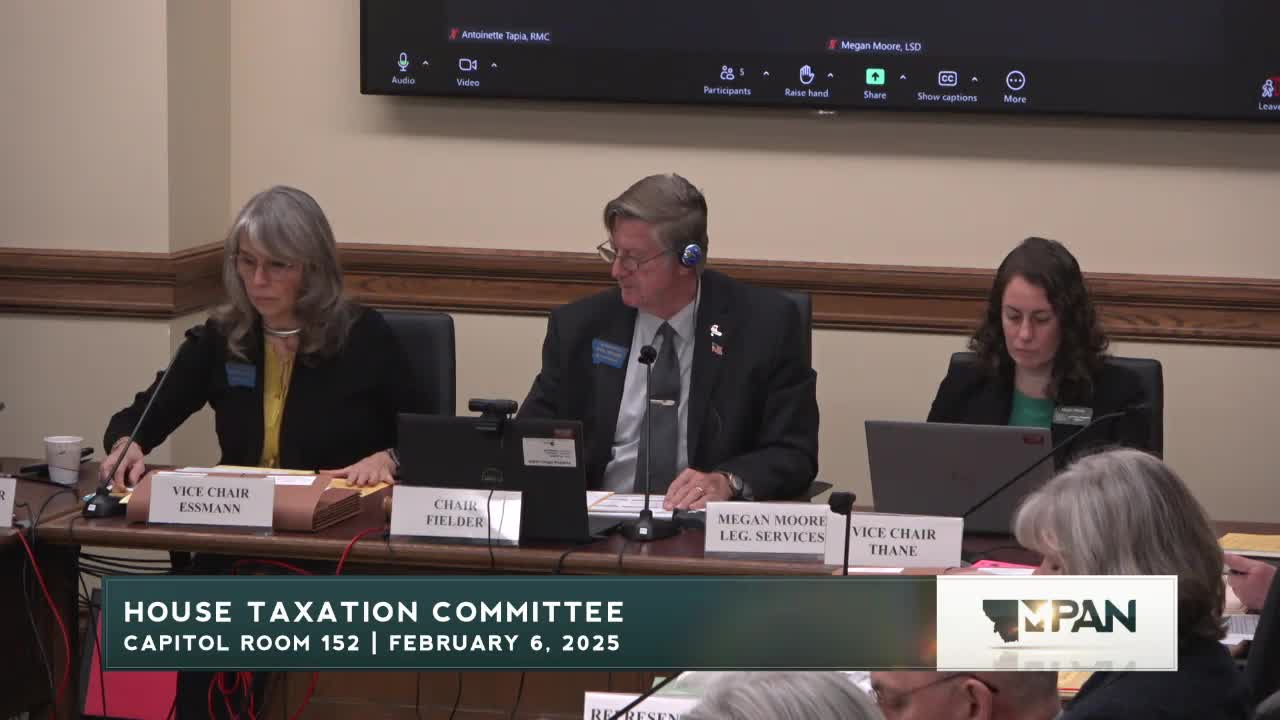
At a House Taxation Committee hearing, lawmakers heard more than three hours of testimony on House Bill 200, which would raise the cap and amend qualifying rules for Montana’s film production tax credit (the Montana Media Act).
Sponsor Representative Keri Seakins Crow told the committee HB 200 is intended to “incentivize the film industry in Montana” and to create jobs across restaurant, transportation, construction and other sectors. Seakins Crow described an amendment she was proposing to reduce the bill’s initial cap from $350,000,000 to $250,000,000; lower the minimum production budget that qualifies for the credit from $350,000 to $50,000; add documentary films and reality television to eligible productions; and change the statutory sunset referenced in the draft language (transcript language: “02/1935”).
Proponents — including the Montana Chamber of Commerce, the Billings Chamber of Commerce, producers and local studios — said the existing credit has already produced substantial spending and local employment and that a higher cap is needed to sustain infrastructure investment. Charles Robinson of the Montana Chamber cited a widely reported example in which a single season of a popular television series spent more than $72,000,000 in Montana over five months and employed 116 Montana residents for several months; Robinson said productions also spent millions on lodging, equipment rentals and location leases. Witnesses submitting or citing state-commissioned studies said that from July 2022 to mid-May 2024 productions generated roughly $334,000,000 in direct spending and approximately $312,000,000 in total local economic impact, and that a recent ESI/University of Montana analysis shows thousands of job-equivalents and tens of millions in workers’ compensation tied to productions.
Several producers and consultants described how the existing program is administered: a production must submit a $500 nonrefundable application, have its in-state qualified spend reviewed by the Department of Revenue, and may receive a tax credit limited by a statutory ceiling (testimony described a 35% ceiling on the credit value relative to qualified spend). Witnesses said tax credits awarded to a production can be sold to Montana businesses or individuals; testimony from both proponents and industry participants gave different recall of the minimum resale value (one witness said a legal minimum of 50¢ on the dollar and a maximum of 90¢; another said marketplace rates were generally 90–95¢ and recalled an 80¢ minimum in his recollection).
Opponents included Montana residents and policy groups who said the proposal would divert large sums of general fund revenue to relatively small numbers of productions and outside investors. Dan Norris, testifying as a private citizen, called the bill “a shell game” that would worsen housing affordability by encouraging wealthy out‑of‑state purchases and vacation homes. Heather O’Loughlin of the Montana Budget and Policy Center urged caution, noting the fiscal note projection her office highlights: the Department of Revenue and the executive budget office estimate the bill could cost roughly $290,000,000 across the four fiscal years shown in the fiscal note attached to the draft.
Informational witnesses included Department of Revenue audit and tax policy staff and an acting division administrator from the Department of Commerce’s film office, all of whom said they were available to answer questions about administration and the fiscal note. Committee members asked detailed questions about how credits are awarded and sold, whether the program favors large productions over local independent producers, how “sideboards” in statute require Montana hires or use of in‑state resources, and whether a higher cap would produce stable demand sufficient to justify private investment in sound stages and other infrastructure.
Supporters said a larger cap and longer horizon would encourage investors to build facilities and train Montana workers; opponents and fiscal analysts said long‑term social‑service needs (housing, childcare, behavioral health) and the size of the projected fiscal cost should be weighed against the economic benefits proponents described. Proponents pointed to examples where studios and small retrofitted facilities produced local property‑value gains and one‑time community donations from productions, but informational witnesses and committee members noted that the transcript and testimony did not include a systematic tally of ongoing local cost offsets such as road maintenance or public safety reimbursements.
The sponsor asked the committee to consider the offered amendment and vote the bill out of committee; no formal committee action on HB 200 was recorded in this hearing.