Get Full Government Meeting Transcripts, Videos, & Alerts Forever!
Get email alerts on the State Prisons Security topic
No spam. Unsubscribe anytime.
After staff shooting, Idaho DOC seeks new surveillance tech, transport expansion
Summary
Following a spring ambush that left staff wounded, the Idaho Department of Correction requested funds for mail scanning, drone detection, phone‑call transcription, expansion of a transport bureau and a body‑worn camera pilot to reduce contraband and respond to high‑risk transports.
The Idaho Department of Correction asked the Joint Finance Preparations Committee on Feb. 4 for supplemental and ongoing appropriations aimed at mitigating contraband and improving transport safety after an assault during an emergency medical transport last spring.
Noah Peterson, Legislative Services Office analyst, said the requests stem from an incident in which staff were shot while escorting an inmate from a hospital. The agency proposed a bundle of security enhancements described as responses to vulnerabilities discovered during that event.
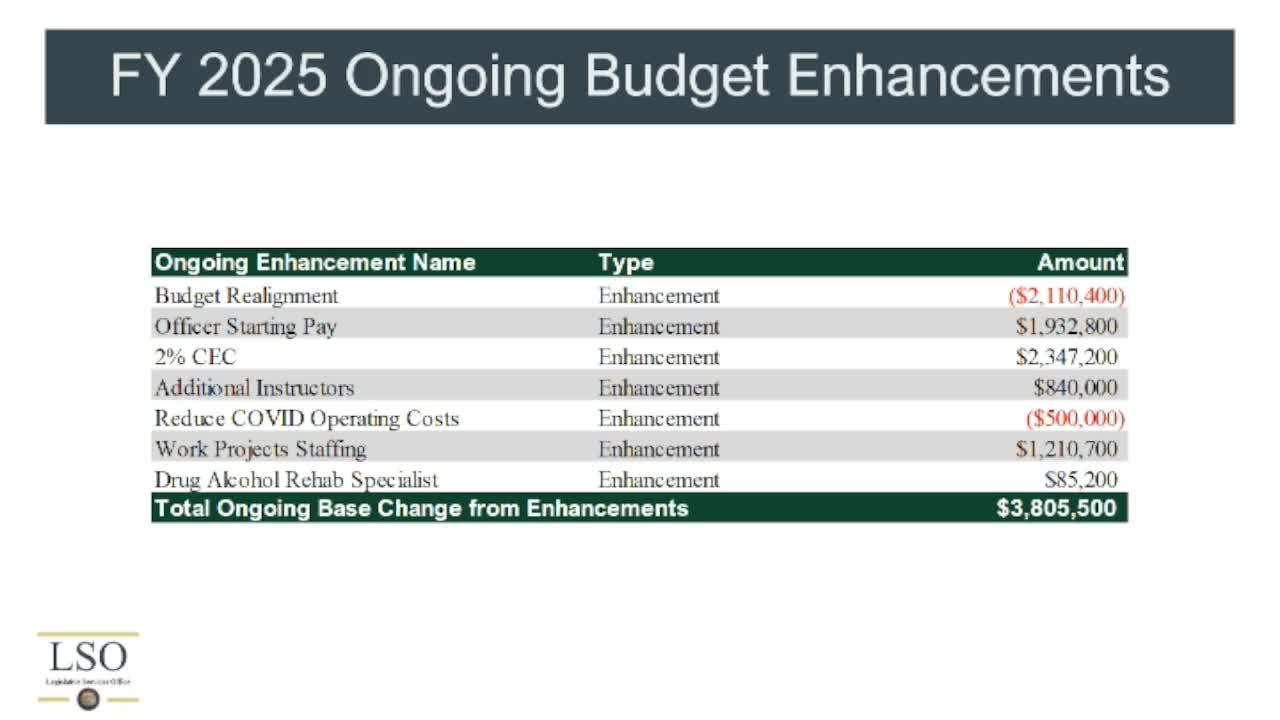
The major requests for the State Prisons Division include: - Advanced surveillance technology to digitize and screen incoming mail, detect drones, and transcribe and analyze inmate phone calls (a package Peterson said would cost $795,000 for the remainder of FY2025 and about $2.4 million annually thereafter). Peterson described digital mail scanning as diverting physical mail to an off‑site unit where it is opened, scanned and sent to residents digitally. - A one‑time supplemental to expand the Transport Bureau, adding 12 positions and equipped vehicles to take on high‑risk and emergency transports previously handled by facility staff. - A federal body‑worn camera pilot across three locations, with federal funds covering most startup costs and a state match requested for FY2026 licensing.
Director Josh Tewalt told the committee the level of sophistication in contraband introduction is escalating and that digitizing mail would “completely eliminate our most porous point of entry for contraband in our facilities.” He described novel threats — altered inks and semi‑autonomous drone deliveries — and said the technology would let the department redeploy staff to other security priorities and help law enforcement identify external actors.
On the Transport Bureau expansion, lawmakers questioned why 12 full‑time positions were needed if responsibilities are being shifted rather than incrementally increased. Tewalt explained the operational difference between an emergency transport staffed as an “other duty” by on‑shift personnel and a dedicated transport team trained and equipped for high‑risk movements. He said covering a permanent, statewide high‑risk team at the duty‑hours and relief factors required would have necessitated far greater increases in staff if reassignments inside facilities were used instead. The department reported thousands of overtime hours used for transports at major facilities in the prior year.
The committee also heard a smaller capital request for snow‑removal equipment at a work camp. The governor recommended an alternate approach: contract snow removal ($30,000 ongoing) rather than buying an $83,200 skid‑loader.
Peterson said most items in the division were recommended by the governor. Committee members asked the department to provide implementation details and ongoing cost estimates before final appropriation decisions.